Yuval Noah Harari
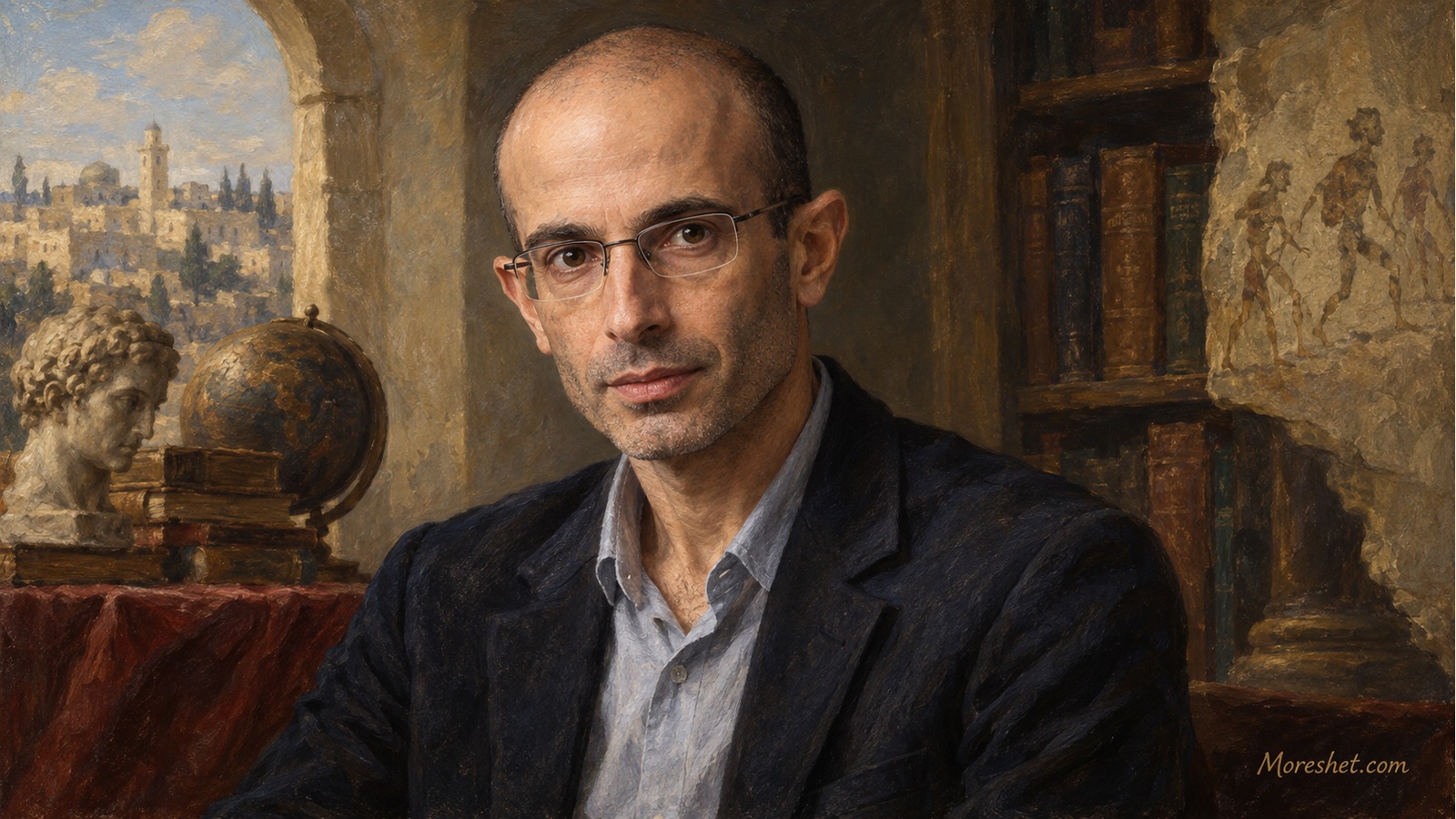
Yoval Nachman Harari — AI-generated artistic portrait · Moreshet.com
Israeli historian, writer and public thinker, author of Sapiens, Homo Deus, 21 Lessons for the 21st Century and Nexus, and one of the most influential Israeli voices in global debates on human history, artificial intelligence, technology and moral responsibility
Yuval Noah Harari is an Israeli historian, writer, lecturer and public thinker, among the best-known Israeli intellectuals of the 21st century. He became internationally known through Sapiens: A Brief History of Humankind, which grew out of a Hebrew University course and became a global bestseller, and later through Homo Deus: A Brief History of Tomorrow, 21 Lessons for the 21st Century, the Sapiens: A Graphic History series, the children’s series Unstoppable Us, and Nexus: A Brief History of Information Networks from the Stone Age to AI. His books have been translated into many dozens of languages and sold tens of millions of copies, making him a rare Israeli figure: a scholar shaped by the Hebrew academy whose ideas reached readers, leaders, entrepreneurs, teachers and students almost everywhere.
Harari’s significance is not only a matter of sales or international fame. He has managed to turn very large questions into public conversation: how humans created cultures, states, religions, money and science; how shared stories enable mass cooperation; what biotechnology may do to the human body; how artificial intelligence is changing politics, economics and consciousness; and what information, trust and institutions do in history. In this sense, his contribution to Israeli and Jewish heritage is cultural as well as intellectual: he brought an Israeli, Hebrew and universal voice into the center of the global conversation about the future of humankind.
Childhood in Kiryat Ata and an Israeli family background
Harari was born on February 24, 1976, in Kiryat Ata, Israel, and grew up in a Jewish-Israeli family with three children. His family background connects Eastern European, Central European and Israeli roots. His father, Shlomo Harari, worked as an engineer at Rafael, and the home in which he grew up was shaped by a familiar Israeli mixture of science, security, education and historical curiosity.
As a child, Harari studied in a gifted-students class at the Leo Baeck Education Center in Haifa. From an early age he showed unusual abilities in reading, independent learning and abstraction. At 17 he began studying history and international relations at the Hebrew University of Jerusalem through the academic reserve program. He began service in the Armored Corps but was released after a short time for medical reasons and returned to his studies.
The choice of history was not accidental. Harari was drawn to broad questions: how empires are formed, how wars reshape consciousness, how people build identities, and what lies behind social orders that appear natural but are in fact human creations. From the beginning of his academic path, he showed an inclination not to stop at the small historical detail, but to ask what that detail teaches about the human condition.
The Hebrew University, Oxford and military history
From 1993 to 1998 Harari studied for his bachelor’s and master’s degrees in the Department of History at the Hebrew University of Jerusalem. His master’s thesis dealt with logistics and supply in the Middle Ages, a subject that may sound technical but opens a window onto war as a system of organization, resources, movement, trust and command. He then continued to a doctorate at Jesus College, University of Oxford, supervised by Dr. Steven Gunn, completing the degree in 2002.
His doctoral dissertation examined Renaissance military memoirs and compared them with modern soldiers’ memories. It became his first book, Renaissance Military Memoirs: War, History and Identity, 1450–1600. Already there, one of his enduring themes appeared: the relationship between personal experience and historical story. What does a person remember from war? How does he tell himself as a fighter? And how does an entire culture shape the way individuals understand violence, fear, glory and death?
After his doctorate, Harari completed postdoctoral research as a Yad Hanadiv fellow. In 2005 he joined the Department of History at the Hebrew University, later advanced in the academic ranks, and from 2003 to 2011 coordinated the university’s world-history program. In 2012 he was elected to the Young Israeli Academy. His early academic research focused mainly on medieval military history, the history of war experience and world history.
The first three academic books
Before the global breakthrough of Sapiens, Harari published three academic books in English. The first, Renaissance Military Memoirs, examined how military memoirs from the 15th and 16th centuries connected war, history and identity. The second, Special Operations in the Age of Chivalry, 1100–1550, dealt with medieval special operations — kidnappings, assassinations, infiltrations, commando actions and sabotage — and showed that even in the so-called age of chivalry, small forces, intelligence, deception and precise action could influence wider campaigns.
The third, The Ultimate Experience: Battlefield Revelations and the Making of Modern War Culture, 1450–2000, explored the way battlefield experience became, in Western culture, a source of revelation, truth and identity. Harari examined how soldiers, writers and societies came to tell themselves that war exposes deep truths about the human being, even when in practice it produces trauma, destruction and suffering.
These books are essential for understanding the later Harari. They show that behind the popular writer stood a scholar who had spent years studying memory, violence, experience and identity formation. His move into big history did not come from nowhere; it grew from an effort to understand how stories, institutions and experiences transform physical power into social reality.
Sapiens: from Hebrew lecture to global phenomenon
Harari’s great breakthrough came with קיצור תולדות האנושות, published in Hebrew in 2011. The book grew out of an introductory world-history course he taught at the Hebrew University. Instead of presenting history as a sequence of dates, kings and wars, Harari offered a broad framework: the development of humans from earlier species of the genus Homo to the world of science, capitalism, empires and modern technology.
The book introduced a wide readership to the idea that human power does not come only from individual intelligence, but from the ability to cooperate in huge numbers around shared stories: myths, religions, money, states, corporations, rights and institutions. Harari described the cognitive and linguistic revolution, the agricultural revolution, the spread of empires, the rise of science and capitalism, and the price paid by both humans and animals along the way.
The English edition, Sapiens: A Brief History of Humankind, appeared in 2014 and became an international bestseller. It reached readers who would not normally pick up an academic history book, and drew interest from political leaders, entrepreneurs, technologists, educators and younger readers. For Israel, this was an unusual cultural phenomenon: a book originally written in Hebrew by an Israeli scholar became a global gateway into the discussion of human history.
Homo Deus and the upgraded human
In 2015 Harari published Homo Deus: A Brief History of Tomorrow in Hebrew, followed by its English edition. If Sapiens asked how humanity reached the present, Homo Deus asked where it might go next. The book examined the possibility that the 21st century would focus less on famine, plague and war as humanity had known them, and more on the pursuit of longer life, happiness, control of information and the upgrading of human capacities.
In this book Harari developed ideas that entered public discussion of technological futures: dataism, algorithms as social power, the combination of biotechnology and artificial intelligence, and the danger of new gaps between those who control information and bodies and those subject to systems that do not understand them as whole human beings. He did not present the future as a fixed prophecy, but as a field of possibilities and dangers produced by human choices in the present.
The book strengthened Harari’s position as a major voice in debates about artificial intelligence, biotechnology, consciousness and society. Business and technology leaders found in it a framework for thinking about the future, while educators and humanists found an attempt to return ethical and philosophical questions to the center of technological debate.
21 Lessons, Nexus and the struggle over trust and information
In 2018 Harari published 21 Lessons for the 21st Century, moving from distant history and distant futures to the questions of the present: nationalism, religion, terrorism, immigration, education, work, truth, fake news, technology, meditation and meaning. The book emphasized that in an age of rapid change, attention, critical thinking and information literacy are not intellectual luxuries but conditions of civic life.
In 2024 Harari published Nexus: A Brief History of Information Networks from the Stone Age to AI. In this book he returned to a basic question that runs through all his writing: how information networks create power. He examined the movement from oral storytelling to writing, archives, scriptural religions, bureaucracies, print, mass media and finally computer systems and artificial intelligence. The central question is not simply how much information humanity has, but how information is organized, who verifies it, who controls it, and how trust is built or destroyed.
Harari’s emphasis on information is especially important in the age of artificial intelligence. Unlike approaches that treat AI merely as a tool of efficiency, he asks what happens when non-human systems begin to produce texts, images, decisions, social relationships and even institutions of trust. In doing so he places the historian at the center of the conversation about new technology: not to program algorithms, but to remind us that every information network is also a network of power, responsibility and risk.
Children, comics and bringing history to new generations
After the success of his adult books, Harari also turned to younger audiences. The Sapiens: A Graphic History series, created with artistic collaborators, transformed the ideas of Sapiens into a visual, humorous and accessible story. The choice of comics is not only a marketing decision; it reflects the understanding that historical knowledge lives when it can move across different forms of storytelling.
The children’s series Unstoppable Us was designed to explain to children how humans took over the world, why the world is not fair, and how enemies can become friends. The volumes published in 2022, 2024 and 2026 present complex subjects in language that tries not to patronize children, but to give them tools for understanding a broad human story.
In this sense, Harari is also a public educator. He does not write only for adult nonfiction readers, but seeks to build a historical language for different generations. This is a real contribution to global historical education that originates in Israel: children and young readers around the world encounter through him ideas about myths, cooperation, justice, power, information and responsibility.
Sapienship, media and public influence
In 2019 Harari co-founded Sapienship with his husband and original agent, Itzik Yahav. The company works in education, media and shared human storytelling, seeking to spread ideas about global challenges, cooperation, technology and responsibility. The move from books alone to media and education reflects Harari’s changed public role: from a single scholar and writer to a public figure managing a wider system of idea distribution.
Harari appears at international conferences, in conversations with technology figures and political leaders, at the World Economic Forum, in interviews with journalists and public thinkers, and in academic and civic events. He has become one of the Israeli speakers most associated with questions of AI, the future of work, digital regimes, surveillance, biotechnology and the need for global cooperation.
This influence has naturally generated discussion and criticism, especially because Harari writes in very broad syntheses and speaks across many fields. Yet the discussion around him itself shows the force of his presence. Few Israeli historians have succeeded in moving questions from the humanities out of the classroom and library and onto the discussion tables of leaders, technology companies, teachers and general readers.
Animals, meditation and personal life
One of the prominent moral lines in Harari’s writing is his concern for animals. While working on the agricultural and industrial revolutions, he became deeply engaged with the scale of suffering among farm animals, and adopted a vegan lifestyle. He has participated in events for animal rights and presented non-human suffering as an inseparable part of the human story.
Harari has practiced Vipassana meditation since 2000 and regards it as a central tool for understanding consciousness, attention and suffering. He has often described meditation as a factor that helped him think and write, and dedicated Homo Deus to his teacher S. N. Goenka. For him, meditation is not only a personal practice but also a way of directly investigating human experience — a subject at the heart of his writing about happiness, pain, desire and identity.
Harari is married to Itzik Yahav, who has also served as his personal manager and as one of the central figures in building his public and international career. The two married in Canada, because same-sex civil marriages are not performed in Israel by recognized religious institutions, though Israel recognizes such marriages when conducted abroad. They live in Israel. Harari’s presence as an Israeli, Jewish, secular and gay writer of global influence adds a social dimension to his public identity.
Israel, democracy and the public voice
Harari is not a politician, but in recent years he has been a visible public voice on questions of democracy, freedom of thought, war and peace. He has opposed moves that in his view endanger the independence of Israel’s judiciary, participated in public protest, spoken about the danger of concentrated political and technological power, and supported a language of civic responsibility.
He has also addressed Russia’s invasion of Ukraine, the dangers of authoritarian regimes in the digital age, and the possibility that technology may give governments and corporations unprecedented ability to understand, predict and shape human behavior. For him, democracy is not merely an electoral method; it is a system of trust and information in which citizens can think, argue, check facts and preserve their inner freedom.
In the Israeli arena, his voice joins a long Jewish and Israeli tradition of intellectuals who do not stop at scholarship and writing, but see themselves as obligated to warn against moral and public dangers. Even when his views generate disagreement, they are part of the role he has chosen: a public intellectual trying to connect long history with political responsibility in the present.
Recognition, readership and global influence
Harari won the Hebrew University’s Polonsky Prize for Creativity and Originality in the Humanities in 2009 and 2012, the Society for Military History’s Moncado Award, and wide international recognition for his books. Sapiens achieved an unprecedented level of success for an Israeli work of nonfiction, and his later books expanded his influence into futurism, public philosophy and education.
His influence is not measured only in awards. It is measured by the way concepts and ideas from his books entered public discourse: shared stories, dataism, algorithms that know us, the future of work, biometric surveillance, animal suffering, consciousness as a scientific and political problem, and the relationship between information and power. Many readers do not accept all of his claims, but use his framework to think again about humanity’s place in the world.
Harari’s standing also demonstrates the power of the Israeli humanities when they manage to speak in a global language. He is a historian who emerged from the Hebrew University, first wrote in Hebrew, and reached major cultural and technological centers around the world. For Israeli culture, this is evidence that ideas born in a Jerusalem classroom can become part of the widest human conversation.
Why this legacy belongs in Moreshet
Yuval Noah Harari merits inclusion in Moreshet because he is one of the few Israelis to have deeply influenced the global discourse of the 21st century in history, public philosophy, education, technology and artificial intelligence. He took a Jewish and Israeli tradition of learning, argument, interpretation and large questions, and brought it to an enormous world readership. His books do not deal only with the past; they invite readers to think about how stories, institutions, information and technology shape human destiny.
Moreshet.com documents Harari because Jewish and Israeli heritage includes contemporary thinkers who shape the way the world talks about itself. Yuval Noah Harari’s place in Moreshet rests on his ability to turn Hebrew-Israeli historical thinking into international conversation, his contribution to broad education about human history, his influence on debates about the ethics of AI and biotechnology, and the continuing invitation he offers Jewish, Israeli and global readers to ask how a more humane, freer and more responsible future can be built.