Joseph (Yossi) Ciechanover
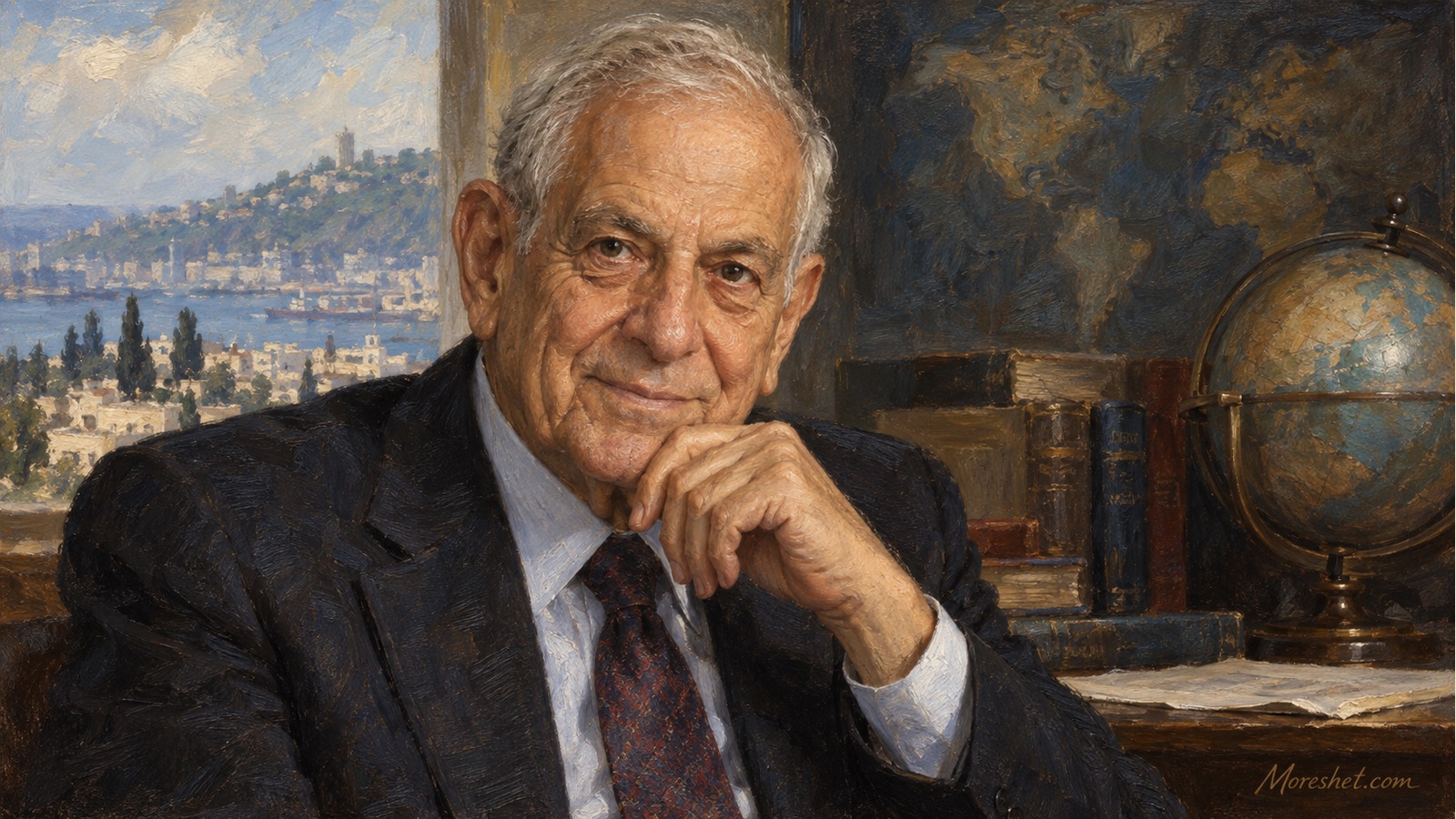
Yossi Chetboun — AI-generated artistic portrait · Moreshet.com
The Israeli lawyer, diplomat, and executive who linked public service, national security, foreign relations, economic leadership, and institutions of Jewish memory
Joseph (Yossi) Ciechanover (October 1, 1933–September 17, 2024), also known by the name Yitzhar, was an Israeli lawyer, diplomat, executive, and public servant. Over a career spanning nearly seven decades, he held an unusual range of responsibilities at the center of Israeli public life: legal adviser to the Ministry of Agriculture and the defense establishment, head of Israel's Defense Mission in North America, director-general of the Ministry of Foreign Affairs, Israel's representative on a United Nations inquiry panel, chairman of Israel Discount Bank, and chairman of El Al.
Ciechanover's importance lay not simply in the number of positions he held, but in his ability to work across very different institutions. He brought legal training, administrative discipline, diplomatic experience, and an understanding of national security to assignments that demanded discretion and practical judgment. Israeli governments repeatedly called on him after his formal civil-service career had ended, particularly when an independent inquiry, sensitive representation, or international negotiation was required. In 2021, he received the Israel Prize for special contribution to society and the state, recognizing a lifetime of work in public service, economic leadership, and civic institutions.
A Haifa childhood and an unusually broad education
Ciechanover was born in Haifa into a religious family. His father, Yitzhak, was a lawyer, while his mother, Bluma, worked as a clerk and taught English. His parents had immigrated from Poland to Mandatory Palestine in the early 1930s and settled in Haifa, where he grew up in the Hadar HaCarmel neighborhood. His younger brother, Professor Aaron Ciechanover, later shared the 2004 Nobel Prize in Chemistry.
During the 1950s and early 1960s, Joseph Ciechanover studied education, law, and business administration at the Hebrew University of Jerusalem, qualifying in teaching and law. This combination anticipated the shape of his career: rather than remaining within one profession, he worked where law, public policy, economics, and administration met.
From 1960 to 1968, he lectured in agricultural and administrative law at the Hebrew University's Faculty of Agriculture in Rehovot. He continued his legal studies at the University of California, Berkeley, in 1966–1967. Even amid a demanding public career, he maintained a serious engagement with scholarship, receiving a doctorate in philosophy and Jewish studies from Boston University in 1991.
From agricultural law to the defense establishment
Ciechanover began his government career in the Ministry of Agriculture. From 1957 to 1960, he managed the ministry's personnel and administrative apparatus, a role that brought him into contact with Agriculture Minister Moshe Dayan. He then served as the ministry's legal adviser from 1960 to 1968. His work involved turning government policy into workable legal and administrative arrangements while the young state was rapidly developing its institutions and infrastructure.
After Dayan became minister of defense, Ciechanover moved to the defense establishment and served as its legal adviser from 1968 to 1974. His tenure covered a period that included the War of Attrition, the Yom Kippur War, and their consequences. From 1974 to 1978, he headed Israel's Defense Mission to the United States and Canada, helping manage relations with Israel's most important strategic partner and representing Israeli defense needs before North American officials.
His work earned recognition from the United States Department of Defense. In 1980, he received its Medal for Distinguished Public Service, an acknowledgment of his contribution to the defense relationship between Israel and the United States.
Director-general of the Foreign Ministry
From 1978 to 1980, Ciechanover served as director-general of Israel's Ministry of Foreign Affairs while Moshe Dayan was foreign minister in Menachem Begin's government. These were the pivotal years stretching from the Camp David Accords to the Egyptian-Israeli peace treaty and the beginning of its implementation. As the ministry's senior professional administrator, Ciechanover worked at the center of Israel's diplomatic system as a historic political breakthrough had to be translated into durable agreements, relations, and institutional procedures.
The trust placed in him continued long after this appointment. In 1997, the government selected him to chair the committee investigating Israel's failed attempt to assassinate Hamas official Khaled Mashal in Jordan. Choosing Ciechanover for such a sensitive inquiry reflected his standing as an experienced institutional figure capable of examining an episode involving national security, intelligence, and relations with a neighboring state.
The Palmer Panel and negotiations with Turkey
In 2010, Ciechanover was appointed Israel's representative on the panel established by the United Nations secretary-general following the Gaza flotilla incident. Chaired by former New Zealand prime minister Geoffrey Palmer, the panel issued what became known as the Palmer Report in 2011. Ciechanover gave Israel a representative with extensive legal and diplomatic experience who could present its position within a difficult international process.
He later played a central part in efforts to repair relations between Israel and Turkey. He drafted an agreement framework and, in 2016, led negotiations on behalf of Prime Minister Benjamin Netanyahu to normalize diplomatic relations. That year he also served on a committee established after Operation Protective Edge to examine the authority of Israel's security cabinet and the way information was provided to its members. Both assignments called for the qualities that had defined his career: familiarity with security needs, command of legal frameworks, and the ability to design practical mechanisms for decision-making and dialogue.
Public and social responsibility
In 1992, Ciechanover was appointed chairman of Israel's national council for combating drug abuse. During his tenure, the council's work expanded, and rehabilitation settings included treatment villages at Kadima and Malkishua. This placed him in a sphere where public policy was measured not only through legislation or administration, but through its capacity to help people recover and return to family and community life.
That same year, he was appointed to the government council responsible for commemorating Israel's presidents and prime ministers. The position connected his long experience of state institutions with the preservation of public memory and the transmission of Israel's leadership history to later generations.
Leadership in the Israeli economy
Alongside his diplomatic and governmental service, Ciechanover held senior positions in the Israeli economy. From 1986 to 1991, he chaired the board of Israel Discount Bank following the bank-share crisis and the effective transfer of Israel's major banks into state control. At a time when stability, supervision, and renewed public confidence were essential, he carried responsibility for the governance of one of the country's leading banks. He concurrently served on the Bank of Israel's advisory committee and later returned to Discount's board after the Bronfman-Schron group acquired control of the bank.
From 1995 to 2001, Ciechanover chaired El Al's board. Israel's national airline was more than a commercial company: it was a vital link between Israel and the wider world, an instrument for bringing immigrants to the country, and an essential transport network for a state facing distinctive security constraints.
Between 1995 and 2010, he served as chairman of the Challenge investment fund associated with Edgar Bronfman and acted as Bronfman's representative in Israel. He also sat on the boards of major Israeli institutions and companies, including the Azrieli Group. His movement between banking, aviation, investment, and large corporations demonstrated his ability to apply principles of institutional accountability and disciplined management in the business sector as well as government.
Culture, Jewish memory, and social institutions
Ciechanover devoted a significant part of his public activity to institutions directly connected with Israeli society and Jewish memory. He served in governing capacities at the Israel Museum and Yad Vashem, two institutions essential to preserving Jewish and Israeli art, history, culture, and the memory of the Holocaust. He was also involved with the Elie Wiesel Foundation for Humanity in Israel, whose work reflected Wiesel's commitment to remembrance, moral responsibility, and human dignity.
As chairman of the Isler Fund, Ciechanover supported assistance for disabled IDF veterans and bereaved families. Until October 2014, he was also a member of the Rashi Foundation association, which works in education and social welfare. These responsibilities extended his influence beyond ministries and boardrooms to families carrying the human cost of military service, communities needing educational and social support, and institutions that shape Israel's collective memory.
Honors and personal legacy
Ciechanover's work received recognition in Israel and abroad. In addition to the United States Department of Defense medal, France appointed him an Officer of the Legion of Honour in May 2010 and promoted him to Commander in 2014. He received honorary doctorates from the Jewish Theological Seminary of America in New York and Boston University.
In 2021, Ciechanover was awarded the Israel Prize for special contribution to society and the state. The award served as a formal acknowledgment of decades spent strengthening public administration, Israel's foreign and defense relations, major economic organizations, and institutions devoted to culture, welfare, and remembrance.
Ciechanover was married to Atara, née Pachor, an architect who died in 2012. He died on September 17, 2024, at the age of 90, and was survived by their three children.
Why Joseph Ciechanover's legacy belongs in Moreshet
Joseph Ciechanover merits inclusion in Moreshet because his contribution to Israel was concrete, sustained, and unusually wide-ranging. He helped administer public institutions, represented Israel in sensitive international settings, participated in restoring relations with another regional power, and accepted responsibility for major organizations in banking and aviation. At the same time, he contributed to the Israel Museum, Yad Vashem, the commemoration of national leaders, and assistance for disabled veterans and bereaved families.
His life illustrates how public service can connect law with national security, diplomacy with administration, and state power with social responsibility and Jewish remembrance. Moreshet.com therefore records his career not merely as a sequence of senior appointments, but as an example of influence built over decades through institutions, professional trust, and a willingness to accept responsibility in complex moments.