Ze'ev Stef Wertheimer
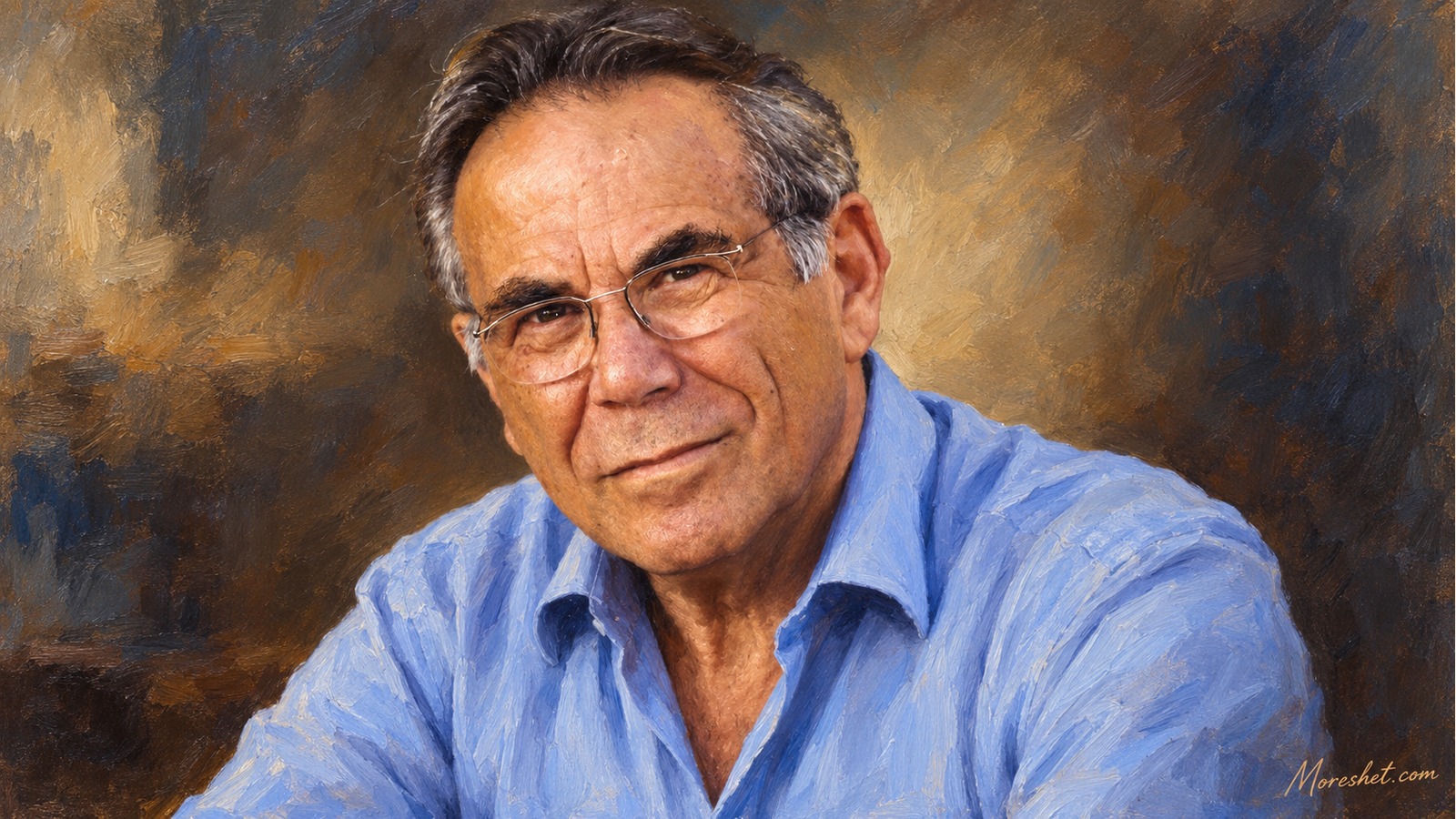
Steph Wertheimer — AI-generated artistic portrait · Moreshet.com
Israeli industrialist, entrepreneur and philanthropist, founder of ISCAR, Blades Technology and IMC, pioneer of industrial parks, Israel Prize laureate and former Knesset member who made manufacturing, technical education and regional development a form of practical Zionism
Ze'ev Stef Wertheimer, widely known as Stef Wertheimer, was an Israeli industrialist, entrepreneur, philanthropist and public figure, one of the builders of modern Israeli industry and one of the people who showed that Zionism could be expressed not only through settlement, army and politics, but also through a precise machine, an export factory, a vocational school and an industrial park in the Galilee. Born in Germany in 1926, he immigrated with his family to Mandatory Palestine in 1937, served in the defense frameworks of the Yishuv and the young state, founded a small workshop in Nahariya that became ISCAR, created Blades Technology and the IMC Group, and developed a model of industrial parks meant to connect manufacturing, professional training, entrepreneurship, community and coexistence.
Wertheimer was one of the most important industrialists in the history of Israel. His story begins with a Jewish refugee from Nazi Germany, a boy who left school and learned through hands, eyes and machines, and continues with an Israeli company that reached world markets and was sold to Warren Buffett’s Berkshire Hathaway in one of the largest and most celebrated transactions in Israeli economic history. Yet his importance is not measured only by wealth or exit value. Wertheimer sought to build in Israel a culture of productive work: a society that respects technicians, machinists, engineers, vocational teachers, entrepreneurs and exporters, and sees precision industry as a path to security, economic independence, social peace and regional development.
Childhood in Germany and immigration to Palestine
Wertheimer was born on July 16, 1926, in Kippenheim, Germany, to a Jewish family. The rise of Nazism changed the family’s world, and in 1937, when he was eleven, his parents immigrated with him to Mandatory Palestine. His father moved the family flour mill to the Nahalat Yitzhak area of Tel Aviv, and the family began building a new life in a small, poor and tense country that nevertheless carried a powerful sense of mission.
In Tel Aviv, Wertheimer studied at Tel Nordau School. At a young age he left formal education and began working in a camera shop, where he learned repair, optics, lenses, fine mechanics and precision. He also studied with Professor Emanuel Goldberg, an important figure in optics and photography. His real education was not an academic certificate, but a workbench, measuring tools, disassembly and assembly, trial and error, and the understanding that technological knowledge is acquired through disciplined practice.
This chapter is essential to understanding his life. Wertheimer became one of the builders of advanced industry in Israel precisely because he did not separate hands from mind. For him, a skilled production worker, technician, machinist or machine operator was not lower than the engineer. Each was part of a knowledge system in which precision, responsibility, order, experience and creativity work together. This would later become one of the foundations of his educational and industrial activity.
World War II service, Palmach and the War of Independence
In 1943, during the Second World War, Wertheimer joined the British Royal Air Force and served as an optical equipment technician. He was sent to the Middle East, including Bahrain, where he repaired optical equipment and systems on British fighter aircraft. The service gave him practical experience with military systems, technical reliability and the importance of precision under real operating conditions.
In 1945 he joined the German Department of the Palmach, a unit intended, among other roles, to operate among German speakers if needed. He completed a flight course at Kibbutz Na’an and served in the aviation department as a technical officer. During the Black Sabbath he was arrested by the British and held at the Rafah detention camp for several months. The arrest connected him directly to the Jewish Yishuv’s struggle against the British Mandate and to a generation of young people who saw the Haganah, Palmach and military industry as parts of one project of independence.
In 1947 he worked in the Haganah’s military industry, developing weapons including a recoilless rifle and other systems. He was sent to Europe to study manufacturing processes for barrels and other technical components. During the War of Independence he served as a technical officer in the Yiftach Brigade and continued to work on weapons development, including mortars. For him, national security was not only courage in battle, but also the ability to manufacture independently, repair independently and solve technical problems when no outside supplier could be relied upon.
From dismissal to a backyard workshop in Nahariya
After the establishment of Israel, Wertheimer worked in the defense industry, including Israel Military Industries and frameworks that later became Rafael. In 1952 he was dismissed because he did not hold an engineering degree. For another person, that might have closed a path. For Wertheimer, it became a beginning. He opened a small workshop in the yard of his home in Nahariya, about twenty square meters in size, and began producing knives, metal-cutting tools and sharpened metal plates.
He marketed the products himself, sometimes riding by motorcycle between customers. He knew the customers, listened to their problems, understood what factories and workshops lacked, and improved the tools according to practical need. In this way he created a business and technological method that would accompany him for years: do not invent a product from a presentation; solve a real production problem, make the solution more precise, more reliable and more competitive, and then bring it to a wider market.
That workshop grew into ISCAR, a company producing hard-metal cutting tools and machining systems. The name became associated with Israel carbide, but over time it became a global name in cutting tools. The company grew out of Nahariya, expanded in the Galilee, developed advanced production knowledge, exported to world markets, and proved that a young and relatively isolated country could build a world-class industrial advantage in precision manufacturing.
ISCAR: precision industry as practical Zionism
ISCAR was more than a successful company. It was proof of the model Wertheimer believed in: Israel had to produce things the world truly needed, at high quality, on time and by standards no lower than those of Germany, Switzerland, Japan or the United States. Instead of settling for a limited domestic market, ISCAR was built as an export company. Export was not only a business goal; in his eyes it was a way to make Israel more independent, more prosperous and more respected.
Wertheimer created around ISCAR a culture of professionalism: insistence on quality, worker training, investment in machines, deep understanding of the customer and a constant drive to improve. He believed that good industry is not built by the machine alone, but by the person beside the machine. The professional worker, instructor, manager and engineer all had to understand themselves as part of the same production circle. That is why he saw technical education as inseparable from industry itself.
In 1983 his son, Eitan Wertheimer, joined the company’s leadership. Under Eitan’s management and in continuation of his father’s vision, ISCAR grew rapidly, expanded around the world and became the core of IMC, International Metalworking Companies. The partnership between Stef and Eitan combined founding vision, international management, product innovation and the understanding that Israel could build an industrial company of global standing.
Blades Technology and industrial security
After the Six-Day War, and in response to the French arms embargo on Israel, Wertheimer founded ISCAR Blades in 1968, later known as Blades Technology. The factory was created to produce blades for jet engines and aviation industries, a field requiring advanced metals, strict quality control, engineering knowledge and very high production standards.
The creation of the factory expressed a principle that appears throughout his life: when Israel depends externally in a vital area, it must develop its own capability. This was not only national pride; it was a security and economic doctrine. A small country surrounded by threats cannot assume that every critical component will always arrive from abroad. Advanced industry is part of national security, even when it looks like a civilian factory.
Blades Technology became an important company in the field of jet engine and turbine components. It demonstrated Wertheimer’s ability to identify a security need, turn it into industrial infrastructure, and build around it knowledge, employment and exports. This was Israeli industry connecting security, aviation, metals, precision and international markets.
Tefen, Kfar Vradim and industrial parks
In the 1980s Wertheimer initiated the establishment of Kfar Vradim and the Tefen Industrial Region in the Western Galilee, to which ISCAR’s operations were moved. For him, development of the Galilee was not merely the creation of a pleasant hilltop community. It was the building of a regional system: home, factory, school, museum, entrepreneurship incubator, vocational training, high-quality employment and a setting in which Jews and Arabs could work side by side.
His industrial park model was one of the most important innovations in his public activity. An industrial park was not meant to be only an area of buildings for rent. It was meant to be a productive ecosystem: anchor factories, small companies, training centers, business services, environmental aesthetics, museums and culture. Wertheimer believed that a person who works in a clean, precise, beautiful and respectful place produces better, takes greater pride in work and sees a future in the place where he lives.
Additional industrial parks were later promoted, including in Tefen, Tel Hai, Lavon, Dalton, Omer, Nazareth and Gebze in Turkey. The model aimed to develop the periphery not through slogans or temporary grants alone, but by creating high-quality employment, productive entrepreneurship and vocational education. In that sense, Wertheimer turned industry into a social tool: not only owner profit, but a mechanism for regional development, reducing gaps and building a sense of worth.
Technical education and the person beside the machine
Wertheimer saw technical education as a national mission. He was involved in educational initiatives in Nahariya, vocational schools, soldier training, industrial education frameworks and the promotion of professional workers’ status. Again and again, he argued that a country that does not respect manufacturing, technical skill, machining and practical technological professions harms itself.
His emphasis differed from the common Israeli dream of a university degree for everyone. Wertheimer did not oppose higher education, but he believed the system neglected the professional track and missed talented young people who could become technicians, industrial craftspeople, production managers and entrepreneurs. In his eyes, high-quality vocational education was not a fallback for those who had failed academically, but an honorable way to build a creative, independent and contributing person.
His view was captured in the idea of the person beside the machine. Machines can be purchased; work culture must be built. For that reason he connected factories with schools, production with training, and business success with social responsibility. Technical education was, for him, the basis of an Israeli society that would be more productive, less dependent, less mediated and more connected to real making.
Politics, Dash and the effort to shape the national agenda
Wertheimer was also a public figure. He was among the founders of the Democratic Movement for Change, Dash, and was elected to the ninth Knesset in 1977. After the party split, he joined the Shinui stream. In parliament he served, among other roles, on the Economics Committee and the Foreign Affairs and Defense Committee, and tried to promote a more efficient state, a more productive economy, stronger vocational education and cleaner, more responsible public administration.
Politics was not the center of his life, and he resigned from the Knesset in 1981 and returned to business and development of the Galilee. But his entry into politics shows that he did not see industry as merely private. He wanted to influence the national agenda: to explain that a country cannot exist only on consumption, services, security and outside assistance. It must manufacture, export, train workers, improve productivity and build a periphery with high-quality work.
Even after leaving the Knesset, he continued to voice public positions. He spoke about the importance of exports, the need to reduce barriers, technical education, development of the Galilee and the Negev, and the possibility of using industry as a means of regional cooperation. He was political in the deeper sense of the word: a person who believed that a factory, a school and an industrial region could change the fate of a society.
IMC, Berkshire Hathaway and global recognition
The peak business achievement of the Wertheimer enterprise came with the sale of most of IMC to Berkshire Hathaway in 2006. In that transaction, Berkshire acquired 80 percent of the group for four billion dollars. It was a defining moment in Israeli economic history. It signaled to the world that from Tefen in the Galilee could grow a global industrial company with the quality, management, technology and profitability to attract one of the world’s most respected investors.
In 2013 Berkshire Hathaway acquired the remaining shares of the group for 2.05 billion dollars. Ownership changed, but the ISCAR brand and the industrial legacy built around it continued to operate within an international system. For Israel, the transaction was much more than a transfer of ownership. It proved that a seemingly traditional Israeli industry — metal, cutting tools, machining — could be advanced, profitable and global no less than high-tech companies.
Wertheimer received many awards and honors. In 1976 he received the Industry Prize in the metals category. In 1991 he received the Israel Prize for special contribution to society and the state. He also received the Kaplan Prize, the Rothschild Prize, the Yigal Alon Prize, the Quality Government lifetime achievement award, the Buber-Rosenzweig Medal, the Presidential Medal of Distinction and additional honors from industry and civil society. Yet the deepest recognition of his work may be visible in the many people who earned a living, learned a profession, founded businesses, worked in the Galilee and Negev, or drew inspiration from the idea that industry can be a mission.
Philanthropy, coexistence and regional development
Wertheimer’s philanthropy was a direct continuation of his industrial worldview. He did not want only to donate money; he wanted to create mechanisms that would allow people to generate value by themselves. That is why he invested in technical education, industrial parks, peripheral development and initiatives meant to bring young people into advanced work.
He believed that industry could also be a tool of coexistence. Jews and Arabs worked in factories and industrial parks, and at times he promoted ideas for shared industrial development with neighbors in the region, including plans that did not come to fruition because of security and political realities. Wertheimer did not present industry as a substitute for politics or formal agreements, but he saw it as a practical basis for human relations: people who work together, produce together and earn a dignified living can build trust where speeches alone are not enough.
He was among the founders of Kfar Vradim, initiated industrial and educational spaces in the Galilee and Negev, and supported a vision of more balanced regional development. In his eyes, the periphery should not be a place waiting for favors from the center. It could be a place of quality, production, export, education and beauty. This is one of the most important parts of his legacy: the desire to give Israel’s border and peripheral regions a productive and dignified role.
Family, continuity and death
Stef’s first wife, Miriam Wertheimer née Wallach, was an important partner in ISCAR’s early path and in the life of the family and factory. They had four children: Irit, Eitan, Ruti and Yiftach. Their son Eitan Wertheimer continued the business path and became central to the expansion of IMC and its connection to international markets. The Wertheimer family became one of Israel’s most prominent business families, but beyond the image of wealth, the family story is tied to industry, management, philanthropy and education.
Wertheimer published his autobiography in Hebrew under the title A Man Beside a Machine, a name that captures his worldview. He saw himself not only as a businessman but as a person of work, production, machines, solutions and social vision. The book and his public interviews over the years presented a consistent belief: Israel must build a productive culture, believe in technological professions, invest in the periphery and connect industry with social peace.
Ze'ev Stef Wertheimer died on March 26, 2025, at the age of 98. His death brought broad recognition for a figure regarded as one of the fathers of Israeli industry. He left behind not only companies, factories and wealth, but a worldview: a state is also built through metalworking plants, vocational schools, workers proud of their craft and entrepreneurs who believe that high-quality manufacturing is a national act.
Why this legacy belongs in Moreshet
Ze'ev Stef Wertheimer merits inclusion in Moreshet because he represents a central stream in Israeli heritage: Zionism of production, work, precision, vocational training and regional development. He did not merely speak about economic independence; he built factories, trained workers, exported to the world, created industrial parks, promoted technical education and helped shape Israel as a country capable of producing advanced industrial knowledge.
Moreshet.com documents Wertheimer because Jewish and Israeli heritage is not built only by political leaders, soldiers and writers, but also by industrialists who created jobs, built regions, connected security with economy and turned craftsmanship into a national project. Ze'ev Stef Wertheimer’s place in Moreshet rests on the rare combination of Jewish refugeehood from Germany, defense service, industrial entrepreneurship, international success, vocational education, philanthropy and development of the Galilee and Negev. He showed that a precise machine, a skilled worker and an export factory can be a deep part of the story of the Jewish state.