Abba Gershon Fromchenko
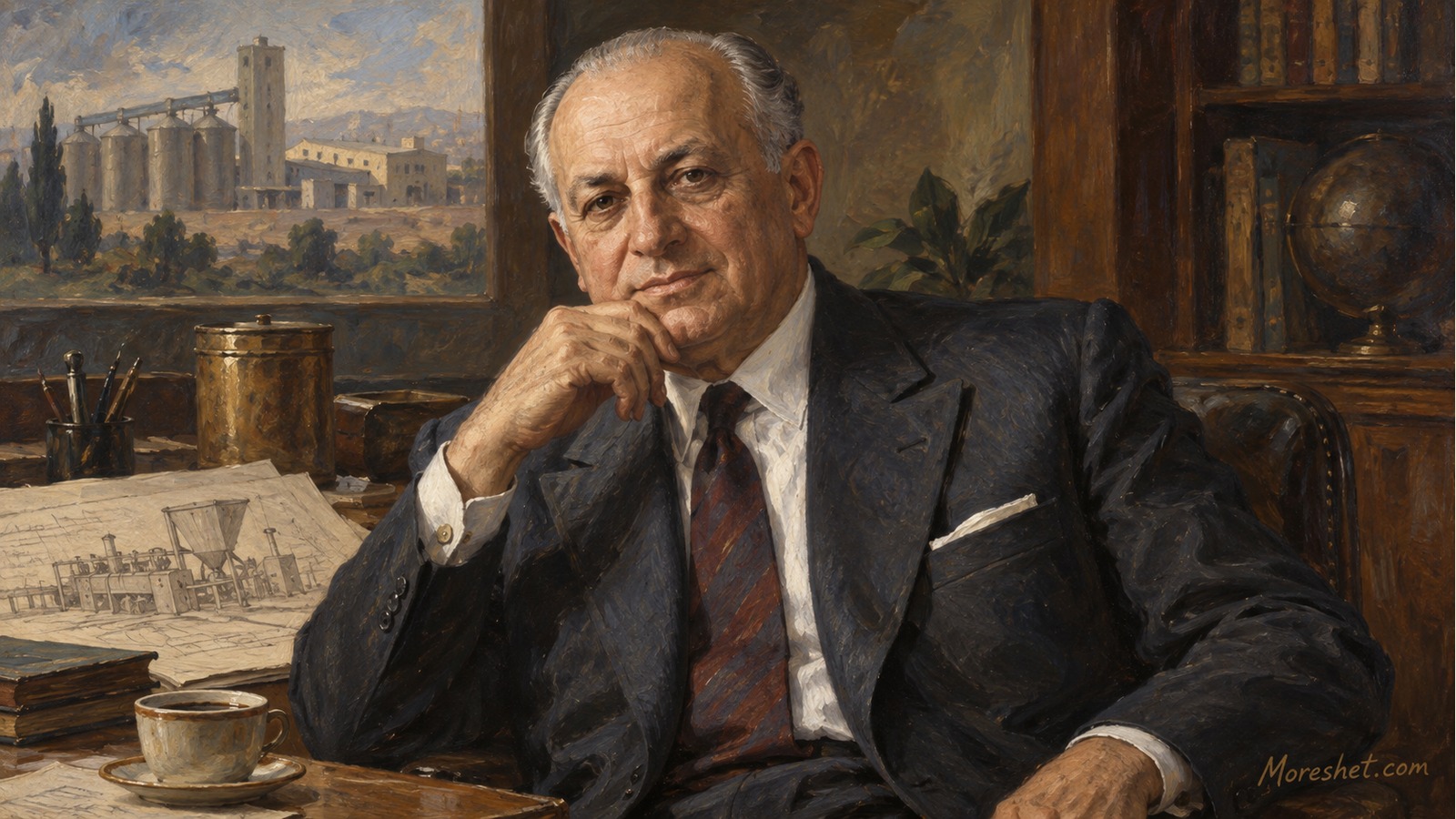
Abba Fromchenko — AI-generated artistic portrait · Moreshet.com
Israeli industrialist and engineer, longtime owner and chief executive of Elite, who helped turn a pre-state chocolate factory into a major Israeli food company and played a central role in making locally produced instant coffee an everyday household product
Abba Gershon Fromchenko (August 4, 1916 – November 5, 2005) was an Israeli industrialist and engineer, an owner of Elite and the company's chief executive for twenty-one years. Across nearly five decades at Elite, he helped develop a young Ramat Gan chocolate factory into a large food manufacturer and became one of the executives who linked engineering, production management, product development and business growth during the formative decades of Israeli industry.
His career also tells part of the story of Israel's everyday economic development. Fromchenko immigrated to Mandatory Palestine as a teenager in the 1930s, studied engineering at the Technion and joined his family's factory before the establishment of the State of Israel. He advanced from distribution and customer relations to manufacturing management and ultimately corporate leadership. Among the projects most closely associated with him was Elite's move into locally produced instant coffee, a product that evolved from a relatively prestigious novelty into an ordinary feature of Israeli homes and workplaces.
Working alongside Mark Mushovich, Fromchenko belonged to the generation that expanded Elite beyond its origins as a family chocolate enterprise. Mushovich was strongly associated with marketing and advertising, while Fromchenko brought an engineering and production orientation to the company's leadership. Their complementary roles mattered in a business that had to master not only branding and sales but machinery, factory processes, quality control and large-scale supply.
Born in Latvia and brought to the Land of Israel
Fromchenko was born in the Livonia Governorate of the Russian Empire, in territory that is now Latvia, to Sarah and Eliyahu Fromchenko. His family already had experience in the European chocolate and confectionery business.
In 1933, when Abba was seventeen, the family immigrated to Mandatory Palestine. The move came during a period in which the Jewish community was rapidly developing its own economic and industrial institutions.
In 1934 his father Eliyahu became one of the founders of the Elite factory in Ramat Gan. The young enterprise produced chocolate and confectionery and formed part of a broader pre-state effort to create local manufacturing rather than depend entirely on imported consumer goods.
Engineering at the Technion
Abba Fromchenko chose a professional path well suited to the needs of the family enterprise. He studied engineering at the Technion in Haifa and completed his studies in 1938. He then joined Elite.
His technical training became central to his later contribution. Industrial food production depends on machinery, raw materials, heat, storage, packaging, quality control and reliable processes. Fromchenko therefore entered the family business not simply as a founder's son but with professional skills directly relevant to factory development.
His first assignment was remarkably practical: delivering Elite products to Arab-owned shops. He later became the company's representative to the British Army in Palestine, one of Elite's important institutional customers during the wartime period.
Fromchenko gradually joined the management team and assumed responsibility for production processes. The move from distribution and customer contact to engineering and factory supervision gave him experience across several layers of the business before he entered senior management.
Elite and the building of local industry
When Fromchenko joined Elite, the local economy was small and manufacturing capacity was limited. Machinery, ingredients and technical knowledge often had to be obtained abroad, while the consumer market itself was still developing.
After the establishment of Israel, rapid population growth created both opportunity and pressure for domestic food companies. New immigrants arrived from Europe, North Africa, the Middle East and elsewhere, bringing different tastes and consumption habits. Food manufacturers had to expand production while learning to serve a far more diverse society.
Elite grew within that environment. What had begun as a pre-state chocolate factory gradually became a much broader food and beverage company. Fromchenko was one of the executives who helped make that transition from a family factory to industrial production on a national scale.
A management partnership with Mark Mushovich
Mark Mushovich was one of the principal figures working alongside Fromchenko. Together they were credited with a major phase of Elite's expansion and its emergence as one of Israel's most important food companies.
Their roles were complementary. Fromchenko was closely associated with engineering, manufacturing and execution, while Mushovich concentrated strongly on marketing and advertising. A successful consumer-goods company required both disciplines: the ability to produce consistently and efficiently, and the ability to create brands consumers recognized and wanted.
This partnership was particularly important as Israeli industry moved beyond relatively small factories toward companies operating several production facilities, distribution networks and nationally recognized brands.
The instant coffee project
One of the initiatives most closely associated with Fromchenko was Elite's entry into instant coffee in the middle and later 1950s. Until then, instant coffee was familiar abroad but had not developed into a major locally manufactured Israeli product. Elite decided to build domestic production capacity, with Safed becoming an important center of its coffee operation.
Initial technical knowledge was obtained with the assistance of a Jewish instant-coffee manufacturer in the United States. Fromchenko was the engineer and principal execution figure on Elite's side, responsible for translating the idea into an industrial process. Mushovich led marketing and promotion.
The product initially carried an air of novelty and relative luxury, especially among consumers familiar with instant coffee from Europe and America. Within years, however, it became an ordinary and widely consumed product.
The significance was larger than a single successful launch. Elite instant coffee became one of the products most strongly associated with the company and entered the routines of Israeli homes, workplaces and institutions. The brand survived for decades and remains part of Elite's consumer identity.
The tin that became part of the brand
Fromchenko's involvement extended beyond factory machinery. He was also credited with designing Elite's familiar instant-coffee tin, whose appearance remained largely unchanged for many years.
During the 1970s Elite introduced glass jars for its instant coffee, but consumers continued asking for the traditional metal container. The company eventually restored the familiar packaging.
The episode illustrates how industrial design can become part of collective consumer memory. A package begins as a practical solution for protecting and distributing a product, but after years of use it may become inseparable from the brand itself.
For Fromchenko, the tin also reflected the combination that characterized much of his career: engineering practicality, production requirements and an understanding of the finished product as something experienced by the customer.
Twenty-one years as Elite's chief executive
During the 1960s Fromchenko became chief executive of Elite and chairman of the boards of its subsidiary companies. He served as CEO for twenty-one years, overseeing a period in which the company grew far beyond the scale it had when he entered it in 1938.
Managing a major food manufacturer during these decades meant responding to population growth, import restrictions, competition, factory expansion, new products and rapidly rising consumer expectations. Fromchenko brought to the top position an unusual range of firsthand experience in distribution, customer relations, engineering, factory operations and management.
Mushovich served as chairman of Elite and held senior roles in the group's subsidiaries. The leadership structure reflected the continued importance of the founding families while the business itself became increasingly complex and professionally managed.
Nearly fifty years with one company
Few industrial careers span as much institutional change as Fromchenko's did at Elite. He joined in 1938, only four years after the Ramat Gan factory was established, and remained directly connected with the company until 1987.
During those decades, the surrounding society was transformed. The Yishuv became the State of Israel; the population multiplied; domestic manufacturing expanded; advertising and capital markets matured; and family-owned enterprises increasingly developed into large corporations.
Elite underwent the same transformation. It expanded its product portfolio, production capacity and market position and became a nationally recognized consumer brand. Fromchenko's unusually long career therefore provides a window into the larger development of Israeli industry.
Danut and a broader investment venture
In 1979 Fromchenko was among the founders of the holding company Danut, together with a group of prominent Israeli industrialists and businesspeople. The venture sought to invest in businesses beyond the founders' original industrial companies.
Danut ultimately ran into financial difficulty and collapsed in the mid-1980s. The episode forms part of a complete account of Fromchenko's business career: alongside decades of successful industrial growth at Elite, he also participated in an investment venture that did not endure.
His involvement nevertheless reflected the position he had reached in the Israeli economy. By then he was not merely a food-factory executive but part of a generation of senior industrialists seeking a broader role in the country's business development.
Changing ownership and retirement
During the 1980s Elite's ownership structure began to change. The Federman group acquired shares from members of the founding families and moved toward control of the company. Among the holdings acquired were shares owned by Abba's brother Yaakov Fromchenko.
In May 1987 Abba Fromchenko sold his own Elite shares, then representing roughly 6.5 percent of the company. In November he resigned from the board, ending almost fifty years of direct involvement with the business.
His departure also represented a broader transition in Israeli corporate history. Companies established by immigrant industrial families during the pre-state and early state periods were increasingly passing into new ownership structures and more complex capital-market systems.
Elite itself continued to evolve and later became part of the Strauss group. Yet the Elite name and many of the consumer categories developed during Fromchenko's era remained deeply embedded in Israeli food culture.
Family and personal life
Fromchenko was married to Ruth. They had two daughters, including Tamar, known as Tami, Wolf-Philosoph, who was formerly married to attorney and executive Avi Philosoph, himself later a senior figure at Elite, and another daughter, Baya Oz.
The family's continued involvement in business reflected a pattern common to many Israeli companies founded in the pre-state era, where the history of the enterprise was intertwined for decades with several generations of founding families.
Abba Fromchenko died on November 5, 2005. He was buried at Kiryat Shaul Cemetery in Tel Aviv.
A legacy embedded in everyday Israeli industry
An industrialist's impact is not always commemorated by a monument or an institution bearing his name. Sometimes it survives in products that become so familiar that their industrial origins are barely noticed. Elite instant coffee is a clear example.
Fromchenko belonged to a generation that built Israel's ability to manufacture consumer goods locally at scale. He brought engineering training, factory knowledge and long managerial experience to a company that served a rapidly growing society.
Elite changed ownership and structure many times after his retirement, but its name remained one of the best-known brands in Israeli food. Part of that foundation was created during the decades in which Fromchenko and Mushovich helped turn a family enterprise into a national food company.
Why this legacy belongs in Moreshet
Abba Gershon Fromchenko merits inclusion in Moreshet because his career represents a form of nation-building that is sometimes overshadowed by political and military history: creating local industry capable of feeding a growing population, training professionals, developing products and building recognizable Israeli brands. A teenager who immigrated from Latvia became an engineer and executive who devoted almost fifty years to one company and helped transform it from a young chocolate factory into a major Israeli food manufacturer.
His most recognizable contribution was his central role in Elite's development of locally produced instant coffee and in turning it into an everyday Israeli product, but his broader legacy includes production engineering, industrial expansion, long-term management and the transfer of practical manufacturing knowledge across generations of workers and executives.
Moreshet.com documents Fromchenko because Israeli heritage is also the history of the people who built the country's ordinary material life — its factories, products and companies. His place in Moreshet is that of an industrialist whose work became so thoroughly absorbed into daily Israeli culture that products he helped create remained familiar household objects decades later.