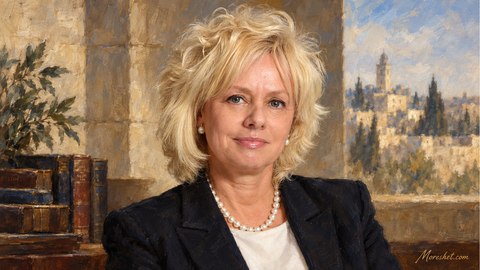
Rachel Freier
A Hasidic pioneer in public service, justice and community emergency care
Rachel “Ruchie” Freier broke new ground in two areas where women from the Hasidic community had rarely been seen in public leadership: the judiciary and emergency medical service. She became the first woman from the Hasidic community to be appointed a judge in the United States, and she founded Ezras Nashim, an all-female Orthodox Jewish volunteer ambulance service. Her work joined fidelity to tradition with practical, professional and civic leadership.
A breakthrough in the judiciary
Freier’s appointment as a judge was both a personal achievement and an institutional breakthrough. As the first woman from the Hasidic community to receive a judicial appointment in the United States, she opened a path into a major public role for women from a community in which traditional leadership opportunities had generally been more limited. Her presence in the judiciary demonstrated that a strong Hasidic identity need not prevent responsible and substantial participation in the institutions of public life.
The achievement mattered for more than its symbolism. A judge serves within a system built on judgment, responsibility and public trust. Freier’s appointment therefore represented the ability of a Hasidic woman to enter an important civic arena and contribute to it while retaining her communal identity. For Jewish women seeking broader opportunities without abandoning their religious belonging, her example carried particular significance.
Founding Ezras Nashim
Freier’s other major contribution was the creation of Ezras Nashim, an all-female Orthodox Jewish volunteer ambulance service. The organization addressed a concrete community need by providing emergency assistance through a women-led team, giving Orthodox Jewish women and families access to urgent care in a way that respected their religious values and boundaries.
Creating the service required initiative, organization and persistence. Freier worked to secure permission for Ezras Nashim to operate despite opposition from male counterparts in the field. That approval recognized that women could run an emergency service and accept direct responsibility for the safety of their community. Ezras Nashim thus became more than a local initiative: it represented a model of public service combining volunteerism, cultural sensitivity and an essential response in moments of crisis.
Tradition, responsibility and women’s leadership
Freier’s distinctive legacy lies in the combination of two forms of public action: leadership within a state institution and the creation of a community service from the ground up. In neither setting was she merely symbolic. She accepted practical responsibility, created new avenues for action and helped expand the understanding of how Hasidic women could contribute to public life, community health and justice.
Her story is especially relevant to modern Jewish society, in which communities seek to preserve a distinct religious identity while responding to changing practical needs. Freier showed that community solutions could be built in a way that respected tradition while also enabling full participation in broader public systems.
Why this legacy belongs in Moreshet
Rachel Freier merits inclusion in the archive because she made a direct contribution to two areas central to Jewish life: justice and emergency care. Her judicial appointment was a historic breakthrough for a woman from the Hasidic community, while Ezras Nashim created a volunteer service designed to meet an urgent medical need within the Orthodox community. Together, these achievements document a new form of Jewish women’s leadership—one that combines identity, independence, professionalism and responsibility for others. Freier’s place in Moreshet is therefore both natural and meaningful, and Moreshet.com preserves through this profile the memory of a woman who expanded the possibilities open to Jewish women in public life.