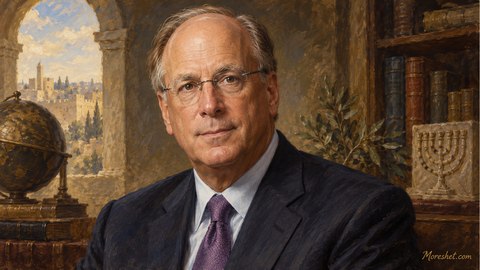
Pinchas Sapir
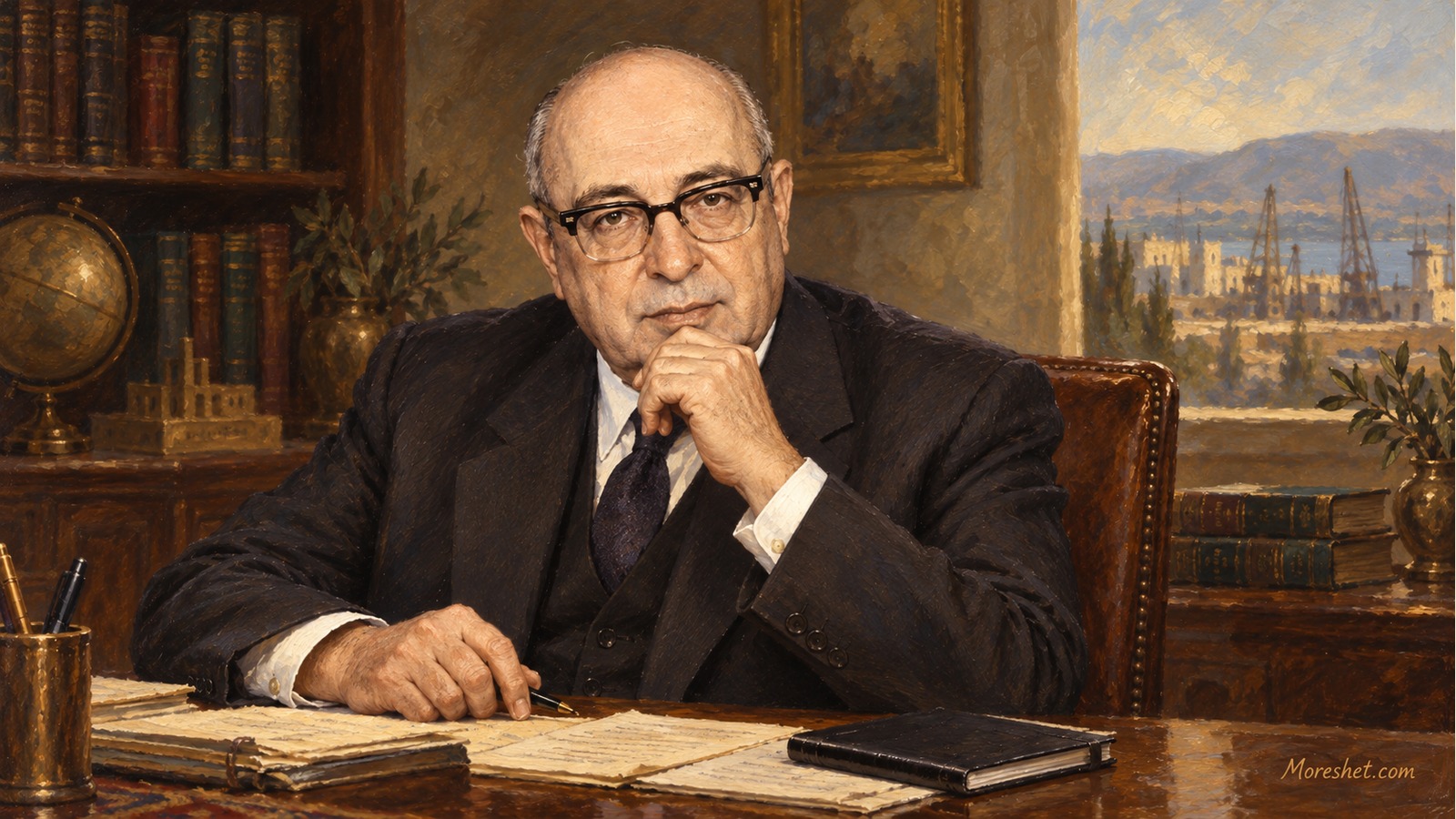
Pinchas Sapir — AI-generated artistic portrait · Moreshet.com
The statesman who built Israel’s early economic infrastructure through industry, investment and public development
Pinchas Sapir, born Pinchas Kozlowski, was one of the central architects of Israel during its first three decades. As minister of trade and industry, minister of finance, director general of the Ministry of Defense and chairman of the Jewish Agency, he worked on nearly every major challenge facing the young state: absorbing immigrants, creating employment, building infrastructure, developing outlying communities, attracting investment and establishing an independent industrial base. His sustained efforts earned him the enduring description “the father of the Israeli economy.”
From the HeHalutz movement to public leadership
Sapir was born on October 15, 1906, in Suwałki, then part of the Russian Empire and now in Poland. After graduating from a teachers’ seminary, he immigrated to Mandatory Palestine in 1929 and settled in Kfar Saba. He began by working in local orchards and community affairs, but quickly distinguished himself as an organizer with a practical understanding of finance, infrastructure and institution-building.
In Europe he had managed finances for the HeHalutz movement and raised money for training farms. In Kfar Saba he headed the local water enterprise, helped establish a small savings bank and arranged loans for workers seeking to build new neighborhoods. This early work expressed a principle that guided him throughout his life: economics was not an abstract goal, but a means of creating settlements, employment, security and opportunity.
In 1937 Sapir joined the leadership of Mekorot, Israel’s national water company, effectively serving as Levi Eshkol’s deputy. He helped expand the country’s water infrastructure, and in 1947 was entrusted with the construction of a major pipeline carrying water from central Israel to communities in the Negev. The project was vital to development in the south and reflected his conviction that national planning, resources and settlement had to advance together.
Security, independence and state institutions
In 1947 Sapir became director of the Haganah’s supply department. During the War of Independence he worked on arms procurement and transport, including the acquisition of some of the first half-tracks used by the Israel Defense Forces. After independence he served as director general of the Ministry of Defense from October 1949 to November 1951.
He later headed the government-owned Dead Sea Works and served as director general of the Ministry of Finance under Finance Minister Levi Eshkol. In 1955 he entered the cabinet as minister of trade and industry. Alongside his government work, he was among the leading supporters and initiators of Tel Aviv University, helping secure its foundations and encouraging its rapid development as a major Israeli center of higher education and research.
Industry, development towns and investment
Sapir understood that immigration absorption and national growth could not depend on agriculture alone. As minister of trade and industry, he shifted the emphasis of development policy toward manufacturing, promoted factories in development towns and sought to create employment beyond the country’s central region. He secured funding for industrial projects and national infrastructure, including the National Water Carrier, and worked to turn young settlements into viable economic communities.
His method was intensely personal. He approached businessmen in Israel and abroad, persuaded them to establish factories and often intervened in the smallest practical details to remove obstacles. In 1960, for example, he invited industrialist Israel Polak to establish a textile plant in Kiryat Gat. To convince him that the newly founded town was not as remote as it appeared, Sapir had him driven there before dawn from Tel Aviv. Polak agreed, and the factory became an important source of employment in the region.
Sapir also supported promising private entrepreneurs, including Stef Wertheimer, when he believed their enterprises could expand Israel’s productive capacity. The black notebook he carried everywhere—filled with names, figures, observations and ideas gathered across the country—became a symbol of his direct, energetic and results-oriented style of administration.
Finance minister in times of crisis and growth
In 1963 Sapir became minister of finance while continuing, for part of the period, to hold the trade and industry portfolio. He served as finance minister until 1968 and returned to the post in December 1969, remaining until 1974. Early in his tenure he concentrated on expanding the economy; in 1966 he faced a severe recession brought on by the end of German reparations, the completion of major public works, a slowdown in immigration and rising private consumption without comparable growth in output.
Together with Eshkol, Sapir introduced austerity measures that included higher taxes, reduced government spending, cuts in development budgets, restricted credit and lower imports of raw materials. These steps reduced the deficit and helped contain inflationary pressures, but they also produced a sharp rise in unemployment and declines in output, investment and living standards. The episode demonstrated the difficult trade-offs involved in managing a young country whose security, immigration and development needs competed for the same limited resources.
After the Six-Day War, Sapir supported increased public investment and policies that helped pull the economy out of recession. Between 1967 and 1973 Israel experienced a period of rapid growth and development. Industry, infrastructure and peripheral communities expanded, and the economy acquired a broader productive base. Although Sapir opposed continued control of the territories and the establishment of settlements on economic and demographic grounds, he worked within the government and accepted its decisions.
Political influence and public service
Sapir was also a major force within Mapai and the Labor Party. He served as the party’s secretary-general, helped shape important political appointments and became known as a “kingmaker.” After Golda Meir resigned as prime minister in 1974, Sapir was urged to succeed her but declined. Instead, he supported Yitzhak Rabin and helped him win the Labor Party leadership contest.
He was known for personal loyalty as well as political strength. During the Lavon Affair, Sapir was among the senior ministers who publicly stood by his friend Pinhas Lavon, even as most of Mapai’s leadership aligned itself with David Ben-Gurion. Despite his power, Sapir maintained a modest lifestyle. He lived in a simple apartment in Kfar Saba, the city where he had made his home since arriving in Palestine.
In 1974 he became chairman of the Jewish Agency. He died of a heart attack on August 12, 1975, during a Torah dedication ceremony in the Nevatim moshav in the Negev, shortly after assuming the position. He was survived by his first wife, Shoshana, their son and two daughters; after Shoshana’s death, he married Rivka El Nathan.
A legacy of development, institutions and opportunity
Sapir’s name lives on in Sapir College, Moshav Sapir, the Sapir site of Israel’s National Water Carrier, the Sapir Prize for Literature, the Mifal HaPayis foundation established in his memory, the Sapir Development Center near Tel Aviv University, streets, neighborhoods, schools and the cultural hall in Kfar Saba. These memorials are more than personal tributes. They reflect the scale of the infrastructure and institutions he helped shape and his belief that economic development had to reach people living beyond the country’s centers of power.
Why this legacy belongs in Moreshet
Pinchas Sapir merits inclusion in the archive because his influence can be seen not only in the offices he held, but in the systems he built and the lives those systems touched. He helped expand water infrastructure, promote industry, create employment in development towns, attract investment, establish Tel Aviv University and strengthen the Jewish Agency. These efforts affected immigrants, workers, entrepreneurs, families and communities throughout Israel.
Moreshet preserves the stories of people whose actions shaped Jewish and Israeli society. Sapir’s story, also documented at Moreshet.com, adds to that record the example of a state-builder who combined Zionist purpose with relentless practical work: water pipelines, factories, budgets, higher education and employment. His legacy connects the national vision of a Jewish state with the daily institutions and opportunities that made that vision durable, while also illustrating the difficult economic choices involved in building a country under pressure.