Milton Friedman
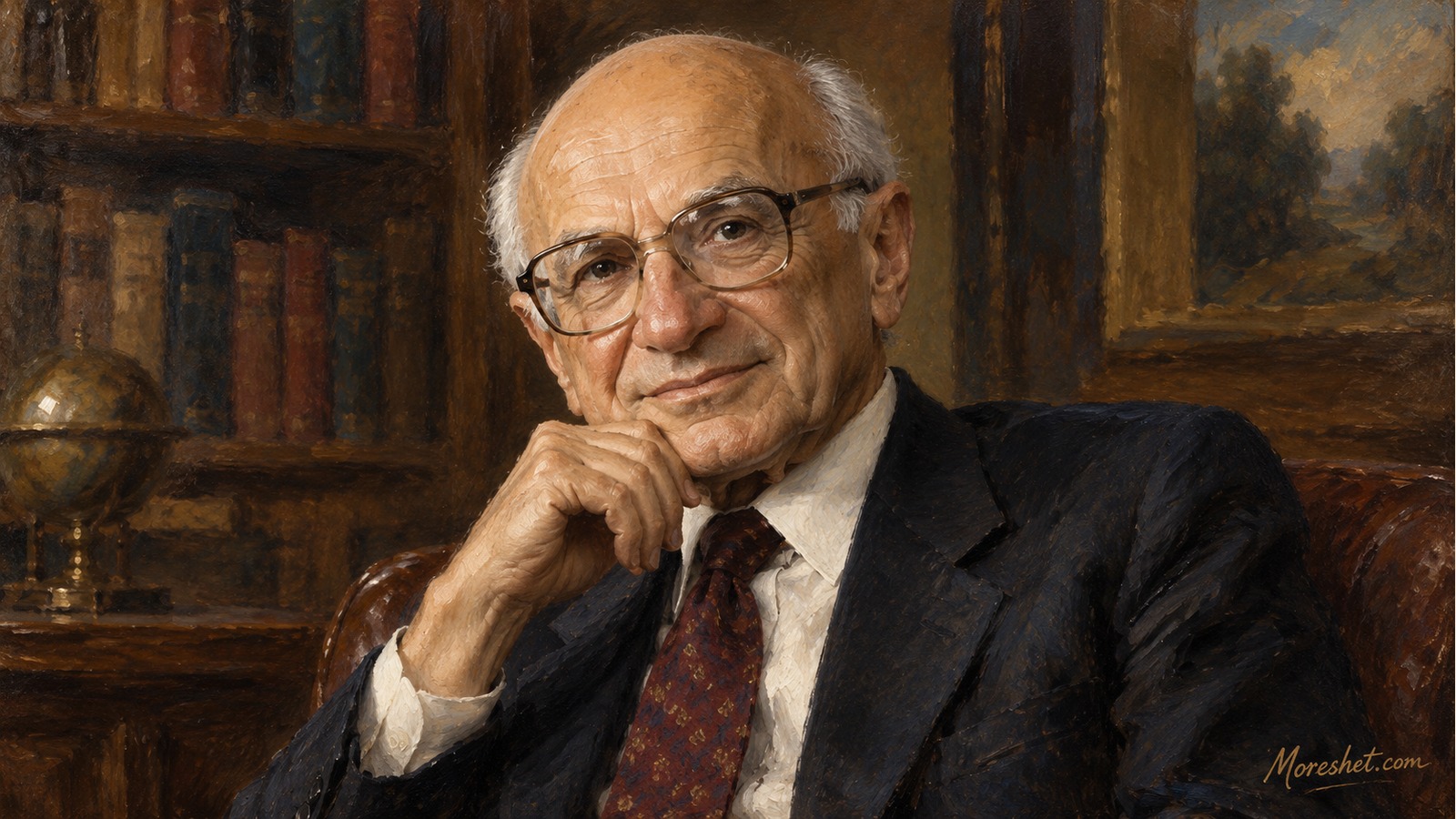
Milton Friedman — AI-generated artistic portrait · Moreshet.com
Jewish American economist, Nobel Memorial Prize laureate, leader of the Chicago School and major architect of modern debates on money, consumption, inflation, economic freedom and the role of government
Milton Friedman was a Jewish American economist, statistician, University of Chicago professor, 1976 Nobel Memorial Prize laureate in Economic Sciences, leader of the Chicago School and one of the most influential figures in twentieth-century economics and public policy. His work joined theory, economic history, statistics and unusually clear public argument, placing at the center of modern economics questions that became part of everyday policy language: how money affects prices and employment, what determines household consumption, what limits stabilization policy, and how economic freedom relates to personal and political liberty.
Friedman was not only an academic economist. He was a teacher, writer, lecturer, adviser, television figure and public intellectual who brought complex economic ideas out of the university seminar and into public debate. He influenced central banks, governments, political parties, business leaders, journalists, economists and students across many countries. Some of his positions drew strong opposition, especially on privatization, welfare policy, free markets, Chile and the role of government, but his centrality in the economic conversation is beyond serious dispute. Even those who disagreed with him had to engage with the questions, vocabulary and challenges he set.
Jewish childhood in Brooklyn and Rahway
Milton Friedman was born on July 31, 1912, in Brooklyn, New York, to a Jewish immigrant family from Eastern Europe. His parents, Sarah Ethel née Landau and Jenő Saul Friedman, came from the region of Beregszász in Carpathian Ruthenia, then part of the Kingdom of Hungary and now Berehove in Ukraine. They immigrated to the United States as teenagers, worked in small trade and carried the burdens of a working immigrant family with ambition but limited means.
Soon after his birth, the family moved to Rahway, New Jersey. Friedman was the youngest of four children and the only son. His father died during Friedman’s senior year of high school, leaving the family under real financial pressure. Even then, his mathematical talent, intellectual discipline and curiosity were evident. He graduated from Rahway High School in 1928, just before his sixteenth birthday, and became the first member of his family to attend university.
Friedman’s Jewish background did not later express itself through religious observance; as an adult he described himself as an agnostic. Yet his life was part of a distinctly Jewish American story: the son of poor immigrants who, through education, work, mathematics, research and the power of expression, became one of the world’s most influential intellectuals. In that sense, his life reflects the force of open institutions, scholarships, universities and a society that can give talent a path even when it begins at the economic margins.
Rutgers, Chicago and Columbia: from mathematics to economics
Friedman studied at Rutgers University and received a bachelor’s degree in mathematics and economics in 1932. At first he imagined becoming an actuary or mathematician, but the Great Depression made economics a burning question rather than simply an academic subject. He received two offers for graduate study: mathematics at Brown University and economics at the University of Chicago. His choice of Chicago determined the course of his life.
At Chicago he studied with Jacob Viner, Frank Knight, Henry Simons and others, and encountered an intellectual tradition that emphasized theory, price, markets, skepticism toward concentrated power and disciplined analysis. He also met Rose Director, an economist and sister of Aaron Director, who became his wife, intellectual partner and co-author in several of his most important public projects.
He later studied at Columbia University, where he encountered advanced statistics under Harold Hotelling and empirical research under Simon Kuznets. His work with Kuznets on professional incomes led to the doctorate he received from Columbia in 1946. Already at this stage, one feature of his career was visible: he was not satisfied with abstract theory alone, but insisted on testing it with data, history and statistical tools.
Public service, war and applied statistics
During the 1930s and 1940s Friedman worked in public and research institutions in the United States. He worked at the National Resources Planning Board, the National Bureau of Economic Research and the U.S. Treasury during the Second World War. His Treasury work dealt partly with taxation and financing the war effort. He helped shape payroll tax withholding, and later expressed unease that a tool created for wartime needs became a permanent feature of the government’s revenue-raising capacity.
During the war he also worked in statistical research at Columbia, in a group that addressed problems of military planning, experiments, quality and efficiency. His statistical contributions included work on sequential sampling and inspection methods that influenced quality control. This chapter matters because it shows Friedman as someone who understood economics through measurement, probability and decisions under uncertainty, not only through ideology.
The experience of government and war strengthened two tendencies that may seem opposed. On the one hand, he valued precise measurement and the ability of institutions to handle complex tasks. On the other, he developed deep suspicion of the permanent expansion of government machinery beyond a clearly defined purpose. That tension would reappear throughout his writing on public policy.
The University of Chicago and an intellectual school
In 1946 Friedman joined the faculty of the University of Chicago, where he taught and worked for three decades. Chicago became the institution most closely associated with his name, and he became one of the shapers of what came to be known as the Chicago School of economics: an intellectual community that emphasized prices, incentives, markets, competition, empirical analysis and skepticism toward claims that government could stabilize and manage the economy without serious limits.
As a lecturer and adviser, Friedman influenced generations of economists. His students and colleagues included researchers who became central figures in modern economics, including Nobel laureates and leading scholars in macroeconomics, microeconomics, finance, money and statistics. He was known as a demanding teacher, quick thinker and sharp speaker, but also as someone who forced students to place arguments against evidence and to say precisely what could be tested and what was merely a slogan.
Although the Chicago School is often associated in public debate with a political position, in Friedman there was also a deep methodological element. Economics, he argued, should generate hypotheses that can be tested, focus on predicted consequences, and avoid elegant explanations that predict nothing. His 1953 essay The Methodology of Positive Economics became one of the most influential and debated texts on economic method.
The permanent income hypothesis and the understanding of consumption
One of Friedman’s central scientific contributions was the permanent income hypothesis, developed in his 1957 book A Theory of the Consumption Function. Against views that stressed a direct link between current income and current consumption, Friedman argued that people plan consumption partly according to what they perceive as their permanent or long-term income. A temporary or one-time income change does not affect spending in the same way as a change believed to be lasting.
This idea changed the way economists think about households, saving, consumption, tax policy and incentives. It offered a framework for understanding consumption smoothing across time: people do not react to every momentary fluctuation as if it changes their whole future, but try to balance present needs against expected future resources. In this way Friedman linked a theory of rational choice with empirical evidence about consumer behavior.
The hypothesis was later debated, extended and criticized, especially around questions of credit constraints, uncertainty and liquidity. Yet even the criticism testified to its importance. Friedman gave consumption research a new starting point and showed how a relatively simple idea can transform a field when clearly formulated and tested against evidence.
Monetarism and the monetary history of the United States
Friedman’s most famous contribution was the restoration of money to the center of macroeconomic analysis. Together with the economic historian Anna Schwartz, he wrote A Monetary History of the United States, 1867–1960, published in 1963. The book examined nearly a century of American history through the development of money, banking, crises and monetary policy.
The book’s best-known argument concerned the Great Depression. Friedman and Schwartz argued that what turned a severe downturn into a historical catastrophe was a sharp contraction in the quantity of money, banking failures and mistakes by the Federal Reserve. In doing so, they challenged interpretations that treated the Great Depression as simple proof of the failure of free enterprise alone, and offered an explanation in which bad monetary policy deepened the crisis.
Friedman’s monetarism emphasized that sustained inflation is tied to excessively rapid growth in the money supply, and that stable and predictable policy is preferable to repeated attempts to surprise the economy. His proposed fixed rule for money growth was not adopted as a complete practical framework by most countries, and late in life he expressed doubts about some of its implementation. But his influence on central banking, inflation analysis and the relationship between money and expectations was profound.
Inflation, unemployment and public expectations
Friedman also made a decisive contribution to the debate over inflation and unemployment. In his 1968 presidential address to the American Economic Association and related work, he argued that unemployment could not be held below its natural rate over time through ever-rising inflation. If the public learns to expect inflation, the temporary advantage disappears and the economy may be left with high inflation but no lasting employment gain.
This argument was part of his critique of simplistic uses of the Phillips curve. Friedman, in parallel with Edmund Phelps, emphasized expectations and the difference between a short-term effect of surprise and a long-term outcome. When the 1970s brought stagflation — high inflation together with high unemployment — many saw it as strong support for his warning.
The debate he opened did not end with him. Economists of rational expectations, new classical macroeconomics, new Keynesian economics and post-Keynesian critics developed, revised or attacked his conclusions. Yet the move toward discussing expectations, policy credibility, rules versus discretion and the role of the central bank is a central part of his scientific legacy.
Capitalism and Freedom: economics as a language of liberty
In 1962 Friedman published Capitalism and Freedom, a book that brought his ideas to an audience far beyond academia. The book made a principled claim: economic freedom is not only an instrument of efficiency, but a central component of human liberty and a barrier against concentrated political power. For Friedman, when government controls too many areas of life, it is not merely managing budgets. It is narrowing the field of choice available to citizens.
In the book he supported policies including flexible exchange rates, a volunteer military instead of conscription, a negative income tax as a more targeted tool against poverty, reduced occupational licensing, school vouchers, deregulation and more liberal drug policy. Some of these proposals seemed radical or impractical at the time, but many later entered mainstream economic and political debate.
It is important to note that Friedman did not argue that government has no role at all. He recognized the need to provide defense, maintain law and order, define property rights, address some public goods and assist in cases where private action is insufficient. But he wanted to reverse the burden of proof: not why avoid intervention, but why intervene, by what tool, at what cost, and with what unintended consequences.
Free to Choose: economics on television and in public language
Friedman and his wife Rose turned their ideas into a broad public project with the television series Free to Choose, broadcast in 1980, and the companion book they wrote together. The series presented arguments about markets, government, education, welfare, inflation, consumers and personal liberty to a mass audience. It was a rare example of an academic economist speaking to the public without abandoning argumentative structure.
Earlier, Friedman had written regular columns for Newsweek and spent years in debates, lectures, interviews and public conversations. He knew how to use examples, analogies, short questions and sharp sentences to turn technical problems into questions any citizen could understand: who pays, who benefits, who decides, what is seen and what is unseen.
This ability made him an unusual public figure. He did not confine himself to professional articles and did not speak only to policymakers. He wanted to persuade citizens that economics is not a closed field for experts, but a way of thinking about liberty, responsibility, choice and consequences. In that sense he influenced not only policy, but also the way ordinary people learned to ask economic questions.
The Nobel Memorial Prize and scientific recognition
In 1976 Friedman received the Nobel Memorial Prize in Economic Sciences for his achievements in consumption analysis, monetary history and theory, and the demonstration of the complexity of stabilization policy. The award recognized the breadth of his scientific work, not only his public positions. It placed him among the central economists of the twentieth century.
The award also drew protests, especially because of his 1975 visit to Chile and his indirect intellectual connection to Chilean economists who influenced economic policy under Augusto Pinochet’s dictatorship. Friedman repeatedly answered that he had not been a permanent adviser to the regime, that he gave economic lectures there as he did in other countries, and that he opposed dictatorial political systems. The controversy remains part of the discussion about the public responsibility of economists, technical advice to undemocratic regimes and the relationship between economic and political freedom.
Friedman also received the John Bates Clark Medal, the National Medal of Science and the Presidential Medal of Freedom. He belonged to scientific academies and received recognition even from intellectual opponents. That recognition does not erase controversy, but it places him in the first rank of social scientists who changed the language of global debate.
Israel, Judaism and economic freedom
Friedman held special interest for Israel. In 1977, after the political upheaval that brought Likud to power, he visited Israel and met Finance Minister Simcha Ehrlich and senior figures in the economy. His visit provoked protests on the left, where many feared his influence on economic policy. For supporters, it was an encounter with one of the clearest formulators of economic liberty; for critics, a warning of the dismantling of welfare-state and planned-economy tools.
Friedman himself argued that Israeli governments of the late 1970s and 1980s did not truly adopt his recommendations, and continued to expand subsidies, public spending and government intervention. Critics in Israel associated him with trends toward privatization, liberalization and free currency trading, and sometimes with problems that followed partial and uneven reforms. Either way, his name became part of Israeli debate over inflation, foreign currency, privatization, regulation, private initiative and the role of the state.
In 1998 Friedman expressed hope that Israel would return, as he described it, to a long Jewish tradition of private initiative, commerce, learning and adaptation to changing economic realities. One may dispute his wording and conclusions, but in the wider frame of Jewish heritage he saw Jews not only as a community of faith and memory, but as a people of traders, learners, entrepreneurs, migrants and builders of economic networks.
Public policy, education and choice
One of Friedman’s best-known policy proposals was school vouchers. Already in the 1950s, he proposed separating public financing of education from direct government operation of schools. In his view, the state could help parents finance education without necessarily operating an educational monopoly. Competition among institutions, he argued, could expand choice and improve quality.
The idea influenced programs in the United States and elsewhere, and also drew strong opposition. Critics argued that vouchers could deepen inequality, weaken public schools or introduce market logic into a field that is not an ordinary product. Supporters saw them as a way to empower poor families and break bureaucratic monopolies. Friedman and Rose later founded a foundation to promote educational choice, eventually renamed EdChoice.
In other fields as well, Friedman sought to replace complex bureaucratic systems with simpler instruments: a negative income tax instead of numerous welfare programs, economic incentives instead of rigid prohibitions, flexible exchange rates instead of controls, and visible cost instead of hidden subsidy. Not all of his ideas were accepted, and not all proved complete solutions, but he forced policymakers to ask what tool best fits the stated goal.
Adviser, critic and international influence
After retiring from the University of Chicago in 1977, Friedman moved to San Francisco and became affiliated with the Hoover Institution at Stanford University. He continued writing, lecturing, appearing in media and advising. He was an unofficial adviser to Ronald Reagan, served on the President’s Economic Policy Advisory Board, and influenced debate in Britain during the years of Margaret Thatcher.
His ideas reached many countries: Britain, the United States, Chile, Hong Kong, Estonia, China and countries moving from communism toward market economies. Not everywhere was his influence direct or simple, and he was sometimes credited or blamed for policies he did not design personally. But he became a symbol of a wider transition: from postwar confidence in government planning toward renewed belief in markets, competition and the limits of the state.
This influence also brought criticism. Keynesian, post-Keynesian, institutional, Austrian, social democratic and other economists disagreed with him for different reasons. Some attacked his theory of money, some his understanding of markets, and some the consequences of free-market policies for inequality, workers and welfare. Yet the breadth of criticism itself shows the breadth of his influence. Friedman was one of the people who forced a whole world to define its position again.
Personal life, Rose Friedman and family legacy
Friedman married Rose Director in 1938. Rose was an economist, intellectual partner and co-author, and together they wrote Free to Choose and the memoir Two Lucky People. Their partnership was an important part of his public work. It helped turn academic ideas into language that was accessible, coherent and influential.
The couple had two children: David Friedman, who became an economist and independent libertarian thinker, and Jan Martel. The family lived for many years in Chicago and later in San Francisco. Friedman continued working, writing and giving interviews until shortly before his death. His final column appeared in The Wall Street Journal the day after he died.
Milton Friedman died in San Francisco on November 16, 2006, at the age of 94, of heart failure. After his death, many described him as one of the most influential economists of the second half of the twentieth century. That judgment came even from people who did not accept his political conclusions, because the history of modern economics cannot be separated from the questions he formulated.
Scientific and public legacy
Friedman’s legacy is layered and complex. As a scholar, he contributed to consumption theory, monetary history, the analysis of inflation and unemployment, economic methodology and applied statistics. As a teacher, he influenced generations of economists. As a public writer, he made economic ideas accessible. As a public figure, he became a symbol of economic freedom and skepticism toward concentrated government power.
His influence does not require full agreement with his positions. On the contrary, Friedman matters because he created a language serious people could argue with. He forced supporters of expansive government to explain costs and incentives, forced supporters of markets to think about institutions and rules, and introduced or popularized terms such as permanent income, monetarism, the natural rate of unemployment, monetary rules, vouchers, negative income tax and freedom of choice.
In Jewish and Israeli life, his figure represents the Jewish contribution to modern social science: not only memory, literature and politics, but analytical tools for understanding money, work, the state, the family and liberty. He was the son of Jewish immigrants who transformed the American experience, learned tradition and mathematical talent into a global language of social analysis.
Why this legacy belongs in Moreshet
Milton Friedman merits inclusion in Moreshet because he is one of the most important Jewish figures in twentieth-century social science. He contributed to the understanding of consumption, money, inflation, unemployment and economic policy; taught generations of researchers; influenced governments and central banks; and brought deep economic questions into broad public conversation.
Moreshet.com documents Friedman because Jewish and Israeli heritage includes the contribution of Jews to global economic thought and to debates over liberty, responsibility, the state and the market. Milton Friedman’s place in Moreshet rests on the combination of scholarly excellence, public clarity, intellectual courage and lasting influence on how modern societies think about choice, money, work, government and the everyday economic life of citizens.