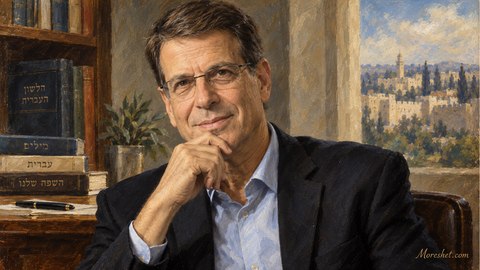
Nissim Meshal
An Israeli journalist, broadcaster and media figure who helped shape public affairs coverage on radio and television
Nissim Meshal (born May 25, 1949) is an Israeli journalist, presenter, editor, radio broadcaster and television personality. For more than four decades, he worked at the center of Israeli media: covering elections and major diplomatic events, reporting from Washington, managing Israel Television, helping lead the establishment of Channel 2, and hosting current-affairs programs that brought public debate into direct contact with politicians and other public figures. His career also reflects the transformation of Israeli broadcasting from a state-centered television system into a commercial and multichannel media environment.
From an immigrant childhood to journalism
Meshal was born in Iraq and immigrated to Israel with his family at the age of one. For eight years, the family lived in the Talpiot transit camp, part of the larger story of immigration, absorption and state-building in Israel's early decades. He studied at the Anaf HaChaim school in Jerusalem and attended the Religious Municipal High School in Bnei Brak.
When he was drafted into the Israel Defense Forces, he volunteered for the Paratroopers and served in the Nahal Airborne Battalion. He trained as a combat soldier and completed an infantry squad-commanders course. As a reservist, he fought in the Yom Kippur War. This military experience preceded his public career and formed part of his connection to Israeli society and its national institutions.
A political correspondent on Israeli television
In 1977, Meshal began working as a political-party correspondent for Israel Television. He covered the elections for the Ninth Knesset in 1977, the Tenth Knesset in 1981 and the Eleventh Knesset in 1984. Such reporting required close attention to parties, candidates and parliamentary developments, helping viewers understand a political system at a time when television was a primary source of public information.
In 1984, he edited and produced the current-affairs program Moked. During the Albin affair, it was reported that Meshal and Israel Segal had received shares worth $40,000 from Albin. Attorney General Yosef Harish determined that their actions did not constitute a criminal offense. The episode remains part of the professional history of Israeli media at the time, while Meshal's broader contribution lay in developing broadcast formats that connected news, analysis and direct conversation with decision-makers.
Washington correspondent and television director
From 1986 to 1989, Meshal served as a Washington correspondent. He covered United States–Israel relations, the American presidential election in which George H. W. Bush was elected, the Iran–Contra affair and Israel's involvement in it, and the Jonathan Pollard case. His reporting brought Israeli audiences the American context in which decisions of major diplomatic and security importance to Israel were being made.
After returning to Israel in 1989, he served for one year as director of Israel Television. Moving from reporting into management reflected his standing within the organization and his involvement not only in covering the news but also in shaping the work and content of the country's central television broadcaster.
From state television to Channel 2
In 1990, Meshal left the First Channel and became one of the leading figures in the founding administration of Channel 2. He therefore took part in building a commercial television channel that broadened Israel's programming choices and changed viewing habits and the nature of competition in the media industry. He also moderated televised debates between Yitzhak Shamir and Yitzhak Rabin, and between Benjamin Netanyahu and Yitzhak Mordechai. These encounters made direct debate between candidates and leaders a central feature of Israeli election coverage.
In 1995, Meshal returned to the First Channel as a diplomatic correspondent. During this period, he covered diplomatic affairs and exclusive reports, including the exposure of secret contacts between Yitzhak Rabin and Syrian President Hafez al-Assad, Israel's diplomatic relations with the United States, implementation of the Oslo Accords and the assassination of Yitzhak Rabin. He also covered the formation of Israel's twenty-sixth government, led by Shimon Peres after the assassination. This reporting accompanied the public through a period of national and diplomatic upheaval and illustrated the role of journalism in documenting decisive moments in Israel's history.
Meshal Haim, interviews and daily public affairs
In 1997, Meshal returned to Channel 2, where he edited and hosted Meshal Haim and presented Popolitika for one year. His programs brought in people who had appeared in that week's headlines and examined current affairs, investigative reports, field stories and opinion polls. The combination of direct interviews, news reporting and public discussion turned the studio into a meeting place for politicians, public figures and the issues occupying Israeli society.
Meshal Haim returned to the air in December 2008 ahead of the elections for the Eighteenth Knesset, and another season began in October 2012. One remembered interview featured Naftali Bennett and addressed his position on refusal of orders. Even as the media landscape changed, Meshal continued working in a format that combined current-affairs journalism with direct conversation with public figures.
Alongside his television work, Meshal hosted the daily morning program Meshal Al HaBoker for years on Radio Without a Break, broadcasting each day at 9:00 a.m. In May 2018, he moved from a daily program to a weekly Friday broadcast on the same station. His radio work extended his presence beyond the screen and made his voice a familiar part of many listeners' morning routines.
Family and public continuity
Meshal is the brother of the Middle East scholar Professor Shaul Meshal. In 2016, his son Ariel Meshal was appointed director general of the Ministry for the Development of the Negev and Galilee. Nissim Meshal married Amy Korman in 2012 and lives in Ramat Gan.
Why this legacy belongs in Moreshet
Nissim Meshal merits inclusion in Moreshet because he spent decades working in one of the central arenas through which Israeli society tells its own story: news, radio and television. He covered elections, foreign relations, peace agreements, national crises and the crucial transition from state television to commercial broadcasting.
His significance is not limited to a list of titles. As a correspondent, editor, manager, presenter and interviewer, he helped shape media institutions and habits that influenced how Israelis received information, encountered leaders and participated in public discussion. Documenting his career on Moreshet.com preserves an important chapter in the history of Israeli communications and public life.