Natalie Portman

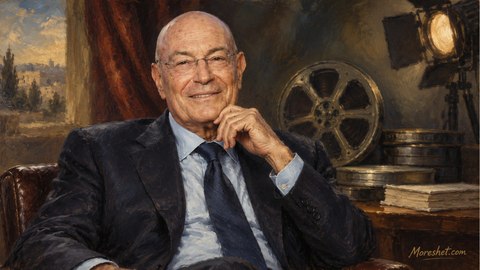
Natalie Portman — AI-generated artistic portrait · Moreshet.com
The Jerusalem-born actress, filmmaker and producer who carried Hebrew language, Israeli literature and Jewish identity onto the world stage
Natalie Portman, born Neta-Lee Hershlag in Jerusalem on June 9, 1981, is an Israeli-American actress, director and producer. Since her screen debut in Léon: The Professional in 1994, she has built an unusually wide-ranging career, moving between global blockbusters, independent cinema, directing, production, academic study and social activism.
International audiences know her as Padmé Amidala in the Star Wars prequel trilogy, Evey Hammond in V for Vendetta, Jane Foster in Marvel's Thor films, Jacqueline Kennedy in Jackie and Nina Sayers in Black Swan. Her importance to Jewish and Israeli cultural heritage, however, reaches beyond celebrity and awards. She grew up with a strong Jewish and Hebrew identity, studied at Harvard and the Hebrew University of Jerusalem, returned to work in Israel, and directed A Tale of Love and Darkness in Hebrew, adapting the autobiographical novel by Israeli author Amos Oz.
From Jerusalem to the stage and screen
Portman was born at Hadassah Hospital on Mount Scopus to a Jewish family. Her father, Avner Hershlag, is an Israeli physician, and her mother, Shelley Stevens, was born in the United States to a Jewish family with Eastern European roots. Her paternal grandparents immigrated to the land of Israel from Romania and Poland. When Portman was four, the family moved to the United States because of her father's work. She grew up in Washington, Connecticut and Syosset, Long Island, in pluralistic and Conservative Jewish settings.
Hebrew was her childhood language, and she maintained a close relationship with Israel after moving abroad. She adopted Portman, her paternal grandmother's maiden name, as her professional name both as a tribute to her family and to protect her privacy. She studied ballet and modern dance and attended performing-arts programs. When she was still a child, a Revlon agent noticed her in a pizza restaurant. Portman declined the modeling opportunity but used the encounter to find an acting agent.
In 1994, at the age of 12, she was cast as Mathilda in Luc Besson's Léon: The Professional, opposite Jean Reno. The role made her known to international audiences and revealed an early ability to combine vulnerability, restraint and dramatic force. She followed it with appearances in Beautiful Girls, Everyone Says I Love You, Heat and a Broadway revival of The Diary of Anne Frank. Playing Anne Frank connected her directly with one of the defining works of modern Jewish memory. In preparation, she visited the Anne Frank House in Amsterdam twice and met Miep Gies, who helped preserve Anne's diary.
A global star who kept studying
Portman's breakthrough came with the role of Padmé Amidala in the Star Wars prequel trilogy: The Phantom Menace (1999), Attack of the Clones (2002) and Revenge of the Sith (2005). The films made her recognizable across the world, but she refused to let a major acting career replace education. She graduated from Syosset High School in 1999 and then reduced her film work while studying psychology at Harvard University.
She earned her bachelor's degree in 2003, worked as a research assistant to Professor Alan Dershowitz and contributed to his book The Case for Israel. She also studied advanced Hebrew literature and neurobiology and participated in scientific research. A high-school paper she co-authored on the enzymatic production of hydrogen from sugar was entered in the Intel Science Talent Search. Another paper, written during her university years, examined frontal-lobe activation in object permanence.
This combination of international stardom and academic seriousness mattered because it challenged the narrow image of a young celebrity. Portman demonstrated that popular success could coexist with sustained study, research and independent thought. During a semester at the Hebrew University of Jerusalem through Harvard's exchange program, she studied subjects connected with violence, the Middle East and Israeli society.
Acting, awards and artistic range
After completing her degree, Portman moved into more mature and demanding roles. Her performance in Closer (2004) earned her a Golden Globe and an Academy Award nomination. In V for Vendetta (2005), she played Evey Hammond, a young woman confronting a repressive regime, and trained to perform the role in a British accent. The film broadened her range and made her a central figure in cinema concerned with freedom, resistance and personal responsibility.
In 2005 she returned to Israel to appear in Amos Gitai's Free Zone, alongside Israeli actress Hanna Laszlo. Working in Israel allowed her to act in a local production rather than merely represent Israel within the American film industry. That connection reached a high point with Black Swan (2010), in which she played a ballerina consumed by artistic perfection and its psychological costs. She won the Academy Award for Best Actress, the Golden Globe, the BAFTA Award and the Screen Actors Guild Award for the performance.
Portman continued to move between genres and audiences. She played Jane Foster in the Thor films, appeared in No Strings Attached, Annihilation and Vox Lux, and portrayed Jacqueline Kennedy in Jackie (2016). Her performance in Jackie earned her a Critics' Choice Award and a third Academy Award nomination. Across these roles, she helped expand the visibility of women in both commercial and art cinema, portraying women who were not simply supporting figures in a man's story.
Making Hebrew cinema: A Tale of Love and Darkness
Portman's most direct artistic contribution to Israeli cultural heritage is A Tale of Love and Darkness (2015). She acquired the rights to Amos Oz's book in 2007, wrote the screenplay, directed and produced the film, and played Fania, Oz's mother. Shot in Hebrew and set in Jerusalem during the final years of the British Mandate and the founding period of Israel, the film explores memory, family, language, loss and the power of stories to shape identity.
Portman's transition from internationally known actress to director of a Hebrew-language work had particular cultural significance. She brought a major Israeli literary text to international cinema without severing it from Hebrew, Jerusalem or its historical complexity. The film introduced Oz's world and an Israeli childhood experience to wider audiences while demonstrating that a Hollywood actor could create from local literature and memory.
Production, leadership and public work
Portman has also worked as a producer, seeking influence over the stories that reach the screen rather than limiting herself to the roles she performs. Her producing credits include Hesher, Jane Got a Gun and Pride and Prejudice and Zombies. In 2021 she and Sophie Mas founded the production company MountainA, whose projects have included the film May December, the documentary series Angel City and the miniseries Lady in the Lake.
In 2020 she became one of the founders and investors behind Angel City FC, a women's soccer team in the National Women's Soccer League that began play in 2022. The venture connected culture, business and women's sport, supporting the visibility and professional infrastructure of women's soccer in the United States. It also reflected Portman's broader view that women should not be only performers or characters on screen, but owners, producers, executives and decision-makers.
Her social activism has included support for women's rights, animal welfare, environmental causes and anti-poverty work. She served as an ambassador for FINCA, which promotes microfinance for women-owned businesses in developing countries, and traveled to Uganda, Guatemala and Ecuador to discuss economic opportunity. She also participated in educational initiatives supporting girls in Kenya and in public efforts addressing violence against women.
Her connection to Israel has also taken practical form. In 2006 she helped organize a fundraising event with the Jewish Federation to support northern Israel after the Second Lebanon War. In 2011 she voluntarily promoted a campaign benefiting Hadassah Medical Center in Jerusalem and the construction of the Sarah Wetsman Davidson Hospital Tower. She used her public profile to direct attention and resources toward Israeli institutions and medical needs.
Jewish and Israeli identity in a global culture
Portman represents a global Jewish-Israeli identity without abandoning its particular roots. Hebrew, Jerusalem, Jewish family history, Israeli literature and the Hebrew University are not incidental biographical details; they are among the materials that inform her creative life. Her relationship with Israel includes personal and cultural attachment as well as criticism of government policy and legislation.
The significance of such a presence extends beyond an individual career. For Jewish and Israeli communities around the world, Portman represents a complex form of belonging: Israeli and American, Jewish and universal, connected to tradition and language while fully active in international culture. For non-Jewish audiences, her work can serve as an entry point to Jerusalem, Hebrew literature and questions of memory, migration and belonging.
Why Natalie Portman's legacy belongs in Moreshet
Natalie Portman merits inclusion in Moreshet because she has worked across several of the arenas where contemporary heritage is created: cinema, literature, education, cultural institutions, social action and Jewish identity. She brought the name of Jerusalem and the Hebrew language to global audiences, built a film career of major artistic and commercial achievement, and used her influence to support productions, institutions and initiatives in which women hold meaningful creative and leadership roles.
A Tale of Love and Darkness is her most direct contribution to Israeli heritage: a Hebrew-language film based on a major Israeli book, made by a creator with international visibility. It stands alongside her academic work, support for Israeli institutions, advocacy for women and education, and the way she connects personal achievement with public responsibility. For these reasons, Portman's profile on Moreshet.com documents not only a film star, but a creator and public figure who made her Jewish and Israeli roots a living and influential part of world culture.