John Bercow
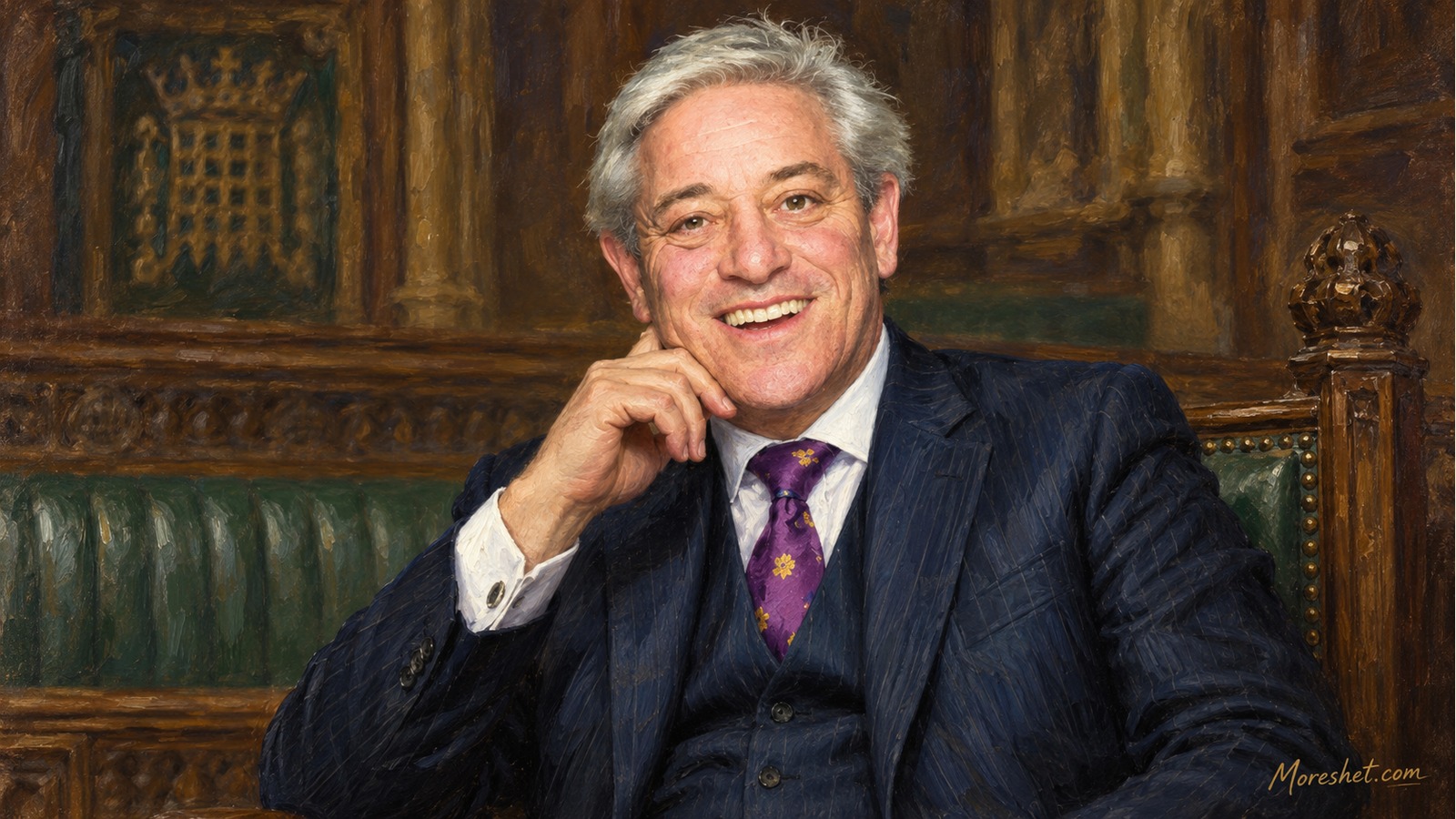
John Bercow — AI-generated artistic portrait · Moreshet.com
The first Jewish Speaker of the British House of Commons and a prominent voice for parliamentary participation
John Simon Bercow, born on 19 January 1963, is a British politician who served as Speaker of the House of Commons from 2009 to 2019. He represented Buckingham as a Member of Parliament for more than two decades before leaving Parliament in 2019. The first Jewish person to hold the speakership, Bercow made the office more publicly visible and helped place parliamentary procedure, backbench participation and youth engagement at the centre of national attention.
Bercow was born in Edgware, north London, to a Jewish family of modest means. His father, Charles Bercow, was a taxi driver, and his paternal family had come to Britain from Romania. His path from an ordinary Jewish household to one of the most important constitutional offices in Britain became part of the significance of his election: it reflected both Jewish participation in British public life and the possibility of reaching the highest levels of national institutional authority.
From tennis and university to public life
As a young man, Bercow was a highly successful junior tennis player and reached the top of the British youth rankings. A bout of glandular fever ended his hopes of a professional career, but his interest in the sport remained. In 2014, he published Tennis Maestros: The Twenty Greatest Male Tennis Players of All Time, demonstrating his continuing engagement with the history and personalities of the game.
Bercow graduated with first-class honours in government from the University of Essex in 1985. As a student, he developed the public-speaking, organisational and campaigning skills that would define his career, and he was elected to senior positions in Conservative student politics. From 1986 to 1987, he served as the final national chairman of the Federation of Conservative Students and later helped train hundreds of Conservative activists in public speaking, campaigning and political communication.
After university, Bercow worked in merchant banking and then joined a lobbying firm, where he became a board director. This early professional experience gave him practical knowledge of public communication, persuasion and political organisation—skills he later applied both in opposition and as Speaker.
The road to Parliament
In 1986, Bercow was elected as a Conservative councillor in the London Borough of Lambeth. The following year, he became the youngest deputy group leader in the United Kingdom at the time. After serving as a special adviser to ministers at the Treasury and the Department of National Heritage, he was elected to the House of Commons for Buckingham in the 1997 general election. He retained the seat at every subsequent election until his retirement in 2019.
Bercow advanced quickly through the opposition ranks. He served as a spokesperson on education, employment and home affairs before joining the Shadow Cabinet, where his responsibilities included the Treasury, work and pensions, and international development. His political views developed over time, but he consistently maintained an independent style and a willingness to challenge his own party on questions of principle.
A notable example came in 2002, when he supported the Adoption and Children Act, which allowed unmarried heterosexual and homosexual couples to adopt children. Against the Conservative leadership’s position, Bercow argued that MPs should have a free vote. He voted for the legislation and resigned from the front bench. His decision expressed a view of parliamentary responsibility in which conscience and independent judgment could take precedence over party discipline.
As an MP, Bercow repeatedly raised the situation of tribal peoples and the struggles for democracy and human rights in Burma. He served as treasurer of the All-Party Parliamentary Group for Tribal Peoples, a cross-party group that sought to bring these issues to parliamentary and public attention. In 2005, Channel 4 and the Hansard Society named him Opposition MP of the Year, recognising his scrutiny of government and his work on national and international issues.
Speaker of the House of Commons: a historic office in a new voice
On 22 June 2009, following the resignation of Michael Martin, Bercow was elected Speaker of the House of Commons in the third round of voting. In accordance with parliamentary convention, he gave up his Conservative Party membership and served as an independent presiding officer. He was re-elected without opposition at the opening of the Parliaments of 2010, 2015 and 2017, making him the first Speaker since the Second World War to be elected four times.
His election carried particular significance for British Jews: Bercow was the first Jewish Speaker in the history of the House of Commons. It marked the depth of Jewish integration into British public life and demonstrated that a member of a historically immigrant community could reach the symbolic centre of national constitutional authority. Bercow also departed from traditional ceremonial dress. He did not wear the customary wig or the traditional knee-breeches, while retaining the black gown that represented his respect for the rules and traditions of the House.
Bercow understood the speakership as more than the technical management of debates. He sought to strengthen the role of backbench MPs, make it easier for Parliament to scrutinise the government and prevent the Commons from becoming merely a rubber stamp for the administration of the day. During his tenure, the House of Commons became more prominent in public discussion, and the work of its Speaker reached audiences well beyond Britain.
One of his most important public initiatives was his involvement with the United Kingdom Youth Parliament. Beginning in October 2009, he chaired its annual sitting in the House of Commons and continued to do so until his retirement in 2019. By welcoming young people from across the country into the parliamentary chamber, he gave them an opportunity to practise democratic debate and to present their concerns in the setting where national decisions are made.
Bercow also commissioned the Speaker’s Lectures to mark the centenary of the Parliament Act 1911. The series, which continued after his tenure, explored major political figures, parliamentary history and contemporary affairs. It connected the institutional memory of Parliament with the public debates of the present.
A distinctive voice during the Brexit debates
In 2019, Bercow became one of the most recognisable figures in the public debate over Brexit. He allowed parliamentary initiatives and votes that increased the House of Commons’ ability to challenge the government. In March of that year, he relied on a parliamentary precedent dating from 1604 when he ruled that a motion substantially identical to one already rejected could not simply be brought back for another vote.
His energetic calls for order—especially the cry of “Order!” with which he became closely associated—became an international cultural phenomenon through social media videos. The attention was not merely entertaining. It introduced parliamentary procedure and the rules of debate to audiences who had not previously followed the work of the Commons. In the summer of 2019, Bercow publicly opposed the attempt to suspend Parliament, emphasising the importance of legislative scrutiny during a period of constitutional and political tension.
Advocacy for children with communication needs
One of the most socially significant areas of Bercow’s public work concerned children and families affected by speech, language and communication needs. The subject had a personal dimension for him because his eldest son, Oliver, is autistic.
In 2008, Bercow was asked to prepare a substantial review for the government on children and families affected by speech, language and communication difficulties. The review argued that communication is not simply an educational advantage but a fundamental condition for participation in society. It stressed the importance of early identification and intervention and called for continuous services for children and families rather than a fragmented and uneven system.
The review connected untreated communication difficulties with frustration, isolation, bullying, weaker educational outcomes, reduced employment prospects and, in some cases, later social problems. Following the review, the government pledged £52 million to raise the profile of speech, language and communication needs within education. A personal family concern was thereby transformed into a matter of public policy affecting children, parents and professionals throughout Britain.
Public and academic work after Parliament
Bercow left the speakership and the House of Commons in November 2019, after ten years in office—the longest tenure of a Speaker since Edward FitzRoy, who served for almost fifteen years. He later published his autobiography, Unspeakable, in 2020, and continued to contribute to political commentary, teaching and public discussion.
He served as Chancellor of the University of Bedfordshire from 2014 and as Chancellor of the University of Essex from 2017 to 2021. In January 2020, he became a part-time professor of politics at Royal Holloway, University of London. These roles enabled him to pass on his experience of democratic institutions, public speaking and the relationship between governments, legislatures and citizens to new generations.
Bercow has also supported charities working on myalgic encephalomyelitis, brain-tumour research, the political integration of disadvantaged and minority communities, and mental health. This activity extended his public influence beyond formal office and reflected the wider civic responsibility that he associated with public life.
Why John Bercow belongs in Moreshet
John Bercow merits inclusion in a heritage archive because his life connects Jewish identity, public service, democratic institutions and practical social impact. As the first Jewish Speaker of the House of Commons, he represented the participation of British Jews at the heart of national public life. His significance, however, goes beyond the historic symbolism of his election.
Bercow worked to strengthen Parliament’s independence, expand the voice of backbench MPs and make democratic participation more accessible to young people through the Youth Parliament. At the same time, his review of speech, language and communication needs helped turn a concern affecting children and families into a major public-policy issue and a substantial government investment. These achievements matter to British society and to the wider democratic conversation about representation, participation and equality.
Moreshet and Moreshet.com preserve the stories of people whose work shaped Jewish life, public institutions and the cultures surrounding them. Bercow belongs in the archive because he shows how one Jewish public figure could reshape the operation of an old national institution, open its doors to younger citizens and connect personal experience with broad public responsibility.