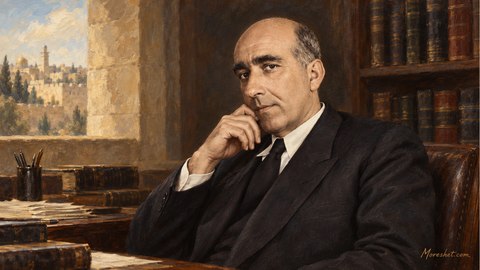
Hersch Lauterpacht
A Jewish jurist who helped shape international law and the global protection of human rights after the Holocaust
Hersch Lauterpacht (16 August 1897 – 8 May 1960) was a Jewish jurist and a major figure in the development of twentieth-century international law. His most distinctive contribution was his promotion of the concept of “crimes against humanity” and its influence on international law after the Holocaust. His work helped establish the idea that grave attacks on human beings are not solely an internal matter, but a concern of the international community as a whole.
International law after the Holocaust
Lauterpacht worked at a time when the world was confronting the scale of the crimes and devastation revealed after the Holocaust. In that setting, he advanced the recognition of crimes against humanity as a central concept in international law. The concept provided a legal language for addressing extreme violations against human beings and for strengthening international responsibility to protect them.
His influence was particularly important in shaping international law after the Holocaust. His work contributed to a shift away from an exclusive focus on relations between states and toward a growing recognition of individuals’ rights and the duty to protect them. In this way, Lauterpacht helped develop a legal framework intended to address crimes that injure humanity as a whole.
Influence on human rights
Lauterpacht also played an important role in shaping the Universal Declaration of Human Rights. His contribution formed part of the development of international human-rights law and helped provide it with a conceptual and legal foundation that influenced how states and the international community understand and protect human rights.
The significance of his work extends beyond legal terminology. It addressed fundamental questions of human dignity, public responsibility and the proper limits of state power. For Jewish and Israeli life, shaped profoundly by the experience of the Holocaust and by the need to protect human lives and rights, these contributions carry particular historical and moral significance.
Why this legacy belongs in Moreshet
Hersch Lauterpacht merits inclusion in Moreshet because his work connected law, the memory of the Holocaust and the effort to build an international order capable of protecting human beings. His promotion of the concept of “crimes against humanity,” his contribution to the shaping of the Universal Declaration of Human Rights and his influence on international human-rights law made his ideas part of the foundation of modern human-rights protection. Moreshet.com presents his story as part of a Jewish and universal legacy whose influence extends beyond his own time and place.