Gideon Moshe Sa'ar
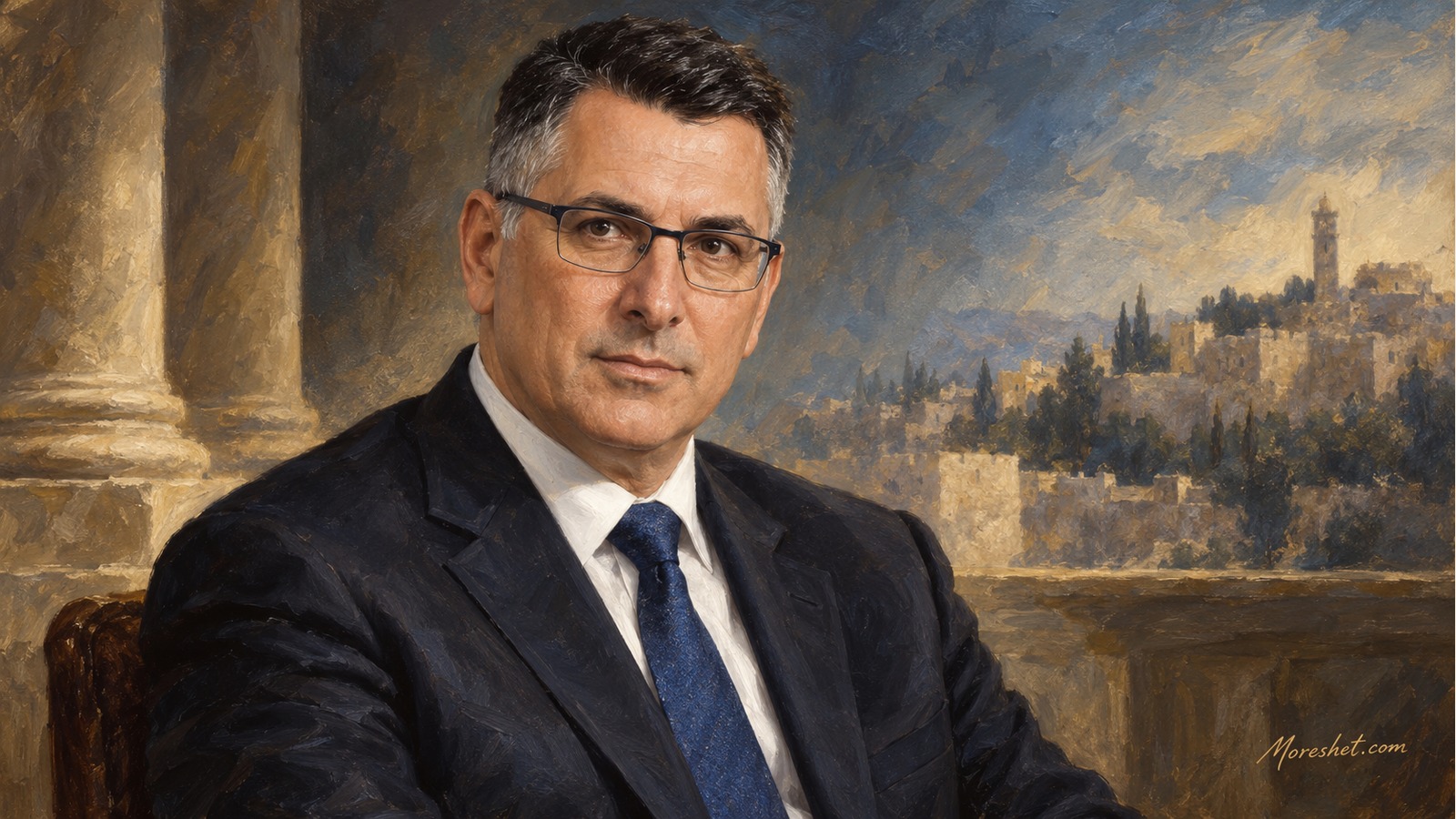
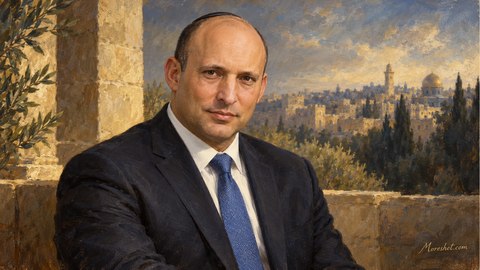
Gideon Sa'ar — AI-generated artistic portrait · Moreshet.com
Israeli lawyer, former journalist and politician, Foreign Minister, former Justice, Education and Interior Minister, and a central figure in Israel’s institutional right, legal system and wartime diplomacy
Gideon Moshe Sa'ar, born Gideon Moshe Serchensky, is an Israeli lawyer, former journalist and politician serving as Israel’s Minister of Foreign Affairs. Over more than two decades of public life he has served as cabinet secretary, member of Knesset, coalition chairman and Likud faction chairman, deputy speaker of the Knesset, Minister of Education, Minister of the Interior, Deputy Prime Minister, Minister of Justice, minister without portfolio and member of the Security Cabinet. He has worked within Likud, founded New Hope, joined the National Unity alliance, led the United Right faction and later returned to Likud through a political merger agreement.
Sa'ar’s importance in Israel’s political and legal heritage lies in the combination of three paths: careful parliamentary work, ministerial leadership in offices that affect everyday life, and the ability to move between loyalty to the Israeli right and political independence, including direct confrontation with its leadership. He was one of the most active private legislators in the Knessets in which he served, led reforms in education, dealt with planning and construction, local government, law, judges, governance, Israel–diaspora relations, wartime diplomacy and Israel’s public case abroad. His story helps explain how ideas, alliances, splits and returns shape Israel’s governing right and coalition politics.
Family roots, childhood and education
Sa'ar was born in Tel Aviv on December 9, 1966, as Gideon Moshe Serchensky. His mother, Bruriah Tzofiov, was an educator from a long-established Bukharian Jewish family in the Land of Israel; his father, Dr. Sergio Shmuel Serchensky, was a pediatrician who immigrated to Israel from Argentina, from an Ashkenazi family with roots in Moldova and Ukraine. From childhood Sa'ar carried a broad Jewish mosaic: Bukhara, Argentina, Eastern Europe, Tel Aviv, the Negev and a developing Israeli society.
As a child his family moved to Mitzpe Ramon and then to Kibbutz Sde Boker. His father served as the kibbutz doctor and as the physician of David Ben-Gurion. The young Gideon met Ben-Gurion many times while accompanying his father, experiencing directly the presence of Israel’s founding prime minister. This connection among family, medicine, the Negev, Zionism and statehood became part of his public background, even though his later political path developed as a clearly right-wing one.
After the family’s years in the Negev, they returned to Tel Aviv. Sa'ar studied at the Zalman Aran elementary school and at Tichon Hadash. Already as a teenager he was politically active: he joined the Tehiya movement, opposed the evacuation of Sinai settlements after the peace treaty with Egypt, and became national coordinator of Tehiya Youth. He also chaired his school’s student council. Those two foundations — ideological politics and institutional organization — would accompany him throughout his career.
The IDF, journalism and law
In 1984 Sa'ar enlisted in the Israel Defense Forces and served in the Golani Brigade. After being injured in brigade training, he moved to an intelligence NCO track and later returned to serve in Golani. Military service was not the central track of his career, but it helped shape his national and security outlook, especially regarding Israel’s place in a hostile region and the importance of security governance.
After his military service, he studied political science at Tel Aviv University and graduated with honors. During his studies he was elected student ombudsman of the university’s student union, a role already linking law, rights, institutions and public administration. He later completed a law degree at Tel Aviv University, interned at the Tel Aviv District Attorney’s Office and worked as an aide to Attorney General Michael Ben-Yair and State Attorney Edna Arbel.
Between his legal studies and full entry into politics, Sa'ar also worked in journalism. He wrote for the weekly HaOlam HaZeh, served as a party-affairs reporter for the newspaper Hadashot, and in 1993 joined the founding team of Channel 2 News as a legal affairs reporter. That experience gave him an early understanding of media, public agenda-setting, legal and political language, and the way state institutions are translated for the general public.
Cabinet secretary and entry into the machinery of government
In 1999 Sa'ar was appointed cabinet secretary in the first Netanyahu government. He later returned to the position in Ariel Sharon’s first government from 2001 to 2002, at the height of the Second Intifada. Cabinet secretary is a central but often less publicly visible role: it connects the prime minister, ministers, cabinet, Knesset, legal advice and the state bureaucracy.
During the Sharon government, Sa'ar dealt with sensitive security and diplomatic issues, including the Mitchell Committee, the struggle against attempts to establish an international inquiry after the battle of Jenin in Operation Defensive Shield, and the issue of the displaced residents of Iqrit and Biram. He also acted for the government in the Knesset on sensitive security and political legislation. This chapter was a practical school in governance: how a political decision becomes governmental procedure, how Israel’s position is defended internationally, and how law, security and politics are connected.
The experience in the cabinet secretariat shaped Sa'ar as an institutional politician. Unlike public figures built mainly through speeches or protest, he entered the Knesset after already knowing the centers of power from within: government, prosecution, media, legal counsel and cabinet. This helps explain his style: less populist in structure, more legal, procedural and focused on mechanisms.
Knesset member, coalition chairman and active legislator
In the 2003 election Sa'ar was elected to the Knesset for Likud. He was soon appointed chairman of the Likud faction and coalition chairman during Ariel Sharon’s second government. He operated from the heart of the coalition, but also opposed the disengagement plan from the Gaza Strip and attempted to advance a bill requiring a referendum on the issue. His opposition to disengagement marked him as an ideological right-wing figure willing to confront his party’s leadership when he saw an issue as a matter of principle.
In the 17th Knesset, after Likud fell to 12 seats, Sa'ar remained a prominent member of Knesset, serving as Likud faction chairman and deputy speaker. He was elected chairman of the Committee on the Status of Women — the first man to hold the position since the committee’s founding. The appointment reflected an ability to work in fields not necessarily identified with the traditional party right, including women’s rights, work, family and civic equality.
Sa'ar was an especially active private legislator. Among the laws he advanced were legislation regulating the use of handcuffs on detainees and prisoners brought to court, raising the electoral threshold, ensuring proper representation of women in municipal corporations, prohibiting dual service as a member of Knesset and chair of a major labor federation, extending maternity leave, regulating lobbyists in the Knesset, requiring a special majority for appointment of a Supreme Court justice, and amendments in the fields of abuse-of-process defenses, animal welfare, sick leave for a child’s illness and prevention of domestic violence. This body of legislation shows the breadth of his work: criminal procedure, state institutions, women, family, animals, the judiciary and parliamentary transparency.
Minister of Education: budgets, achievement and Jewish heritage
In 2009 Sa'ar was appointed Minister of Education in Netanyahu’s second government. This was one of the major offices of his career, because the Education Ministry touches almost every family in Israel and shapes the next generations. During his tenure the budget of the education and higher-education systems grew, free compulsory education was extended to ages three and four, research excellence centers were advanced, access to higher education was expanded for Haredim and Arabs, and enrichment programs were introduced in schools.
Sa'ar signed the Oz LeTmura reform agreement with the secondary school teachers’ organization. The reform raised teacher salaries, lengthened the teachers’ workweek, introduced components of evaluation and reward, and improved teachers’ working environments. He also promoted steps to improve teacher training, based on the view that the status of the teacher is a central condition for improving education in Israel.
In the field of Jewish and Zionist heritage, Sa'ar worked to strengthen study programs and visits to heritage sites. Under the Na’aleh LeYerushalayim program, many students visited Jerusalem and heritage sites, and a compulsory subject called Jewish Heritage and Culture was introduced. He revived the adult Bible Quiz, acted to reduce the cost of trips to Poland, promoted programs encouraging IDF service and led the recognition of Ariel University as a university. These steps were sometimes politically disputed, but they also express his view that Israeli education is not only skill acquisition, but also identity, memory, Zionism and connection to tradition.
Minister of the Interior: daylight saving time, planning, local government and civic identity
In 2013 Sa'ar became Minister of the Interior. In that office he dealt with local government, planning and construction, population registration, Shabbat, municipalities, African migrants and the distribution of resources among local authorities. One of the measures most associated with him was extending Israel’s daylight saving time until late October. The law passed by a large majority and became a tangible change in the daily life of Israeli citizens.
Sa'ar also led a planning-and-construction reform known as the pergola reform, intended to reduce bureaucracy and transfer powers from district committees to local committees. In local government, he promoted distributive-justice measures in the Negev, transferring income from property-tax-generating facilities to development towns and peripheral local authorities, including Dimona, Arad, Yeruham, Mitzpe Ramon and Bedouin authorities. The move demonstrated an understanding that interior policy is not only the management of population records but also the distribution of resources between center and periphery.
As interior minister he also dealt with sensitive identity questions. He recognized Arabic-speaking Christians as Arameans for purposes of national registration, a move supporters saw as recognition of a distinct identity and critics saw as political. He also addressed the question of opening supermarkets on Shabbat in Tel Aviv, trying to balance Shabbat as a day of rest with the secular character of the city and the interests of small business owners. The Interior Ministry again placed him where law, identity, religion, locality and state meet.
A political pause and return to the center of politics
In September 2014 Sa'ar announced a pause from political life, and later resigned from the government and the Knesset. During the pause he became a senior fellow at the Institute for National Security Studies, published articles and policy studies, taught at Ono Academic College and chaired a public committee on the future of the insurance industry. This period broadened his work into policy research, governance and reform outside the daily pressure of the Knesset.
In 2017 he announced his return to political activity in Likud. At the time he was seen as one of the possible candidates to inherit the party leadership. In 2019 he again ran in the Likud primaries, was elected to a high place on the list and later openly challenged Benjamin Netanyahu’s leadership. In the December 2019 Likud leadership election he lost to Netanyahu, but the challenge itself made him a distinctive figure: a veteran Likud man who confronted his party leader from within.
In December 2020 Sa'ar announced that he was leaving Likud and forming the New Hope party. He presented it as a liberal center-right party and pledged not to join a government headed by Netanyahu. That decision changed the map of the Israeli right and made Sa'ar one of the central players during the period in which the political system tried to build new coalitions around the question of whether to continue Netanyahu’s rule or replace it.
Minister of Justice and Deputy Prime Minister
After the 2021 election, New Hope joined the Bennett-Lapid government, and Sa'ar was appointed Deputy Prime Minister and Minister of Justice. In that office he headed one of Israel’s most sensitive systems: the courts, the attorney general, the state prosecution, civil and criminal legislation, the Ministerial Committee for Legislation and the Judicial Selection Committee.
As justice minister he brought about the appointment of Gali Baharav-Miara as attorney general and chaired the Judicial Selection Committee when four new Supreme Court justices were appointed: Gila Kanfi-Steinitz, Ruth Ronnen, Yechiel Kasher and Khaled Kabub. Kabub’s appointment as the first Muslim justice appointed permanently to the Supreme Court carried institutional and symbolic significance.
Sa'ar also advanced legislation and regulations in legal and social fields: eliminating the restriction on holding a driver’s license for people in debt-collection proceedings, anchoring judicial discretion to exclude evidence obtained unlawfully, increasing transparency for Ottoman associations, and turning personal cannabis use from a criminal offense into an administrative offense. He also sought to advance Basic Law: Legislation and public hearings for Supreme Court candidates. His Justice Ministry term reflects his institutional approach: repairing systems through law, rules, key appointments and procedures.
National Unity, war and return to the coalition
Ahead of the 2022 election, Sa'ar joined Benny Gantz and created a joint framework that ran as National Unity. After the election, the faction remained in opposition, but following Hamas’s October 7, 2023 attack and the Swords of Iron War it joined the emergency government. Sa'ar was appointed minister without portfolio and was involved in government and cabinet discussions during a period in which Israel faced national trauma, hostages, war in Gaza, a northern front and international tension.
In March 2024, New Hope left National Unity and established the United Right faction. Sa'ar demanded to join the war cabinet; when that did not happen, he left the government. Later, in September 2024, he returned to Netanyahu’s government as minister without portfolio, arguing that unity was required around the war and the Iranian threat. In November 2024 he was appointed Foreign Minister, replacing Israel Katz.
This chapter demonstrates the complexity of Israeli politics during war. Sa'ar was Netanyahu’s partner, then rival, then a Likud defector, founder of an independent party, partner in the change government, ally of Gantz, separate from Gantz and later again part of Netanyahu’s coalition. Supporters saw this as national flexibility in an emergency; critics saw it as a difficult political movement to accept. Historically, it reflects a political system in which war, personal trust, ideological camps and the demands of governance collide.
Foreign Minister: diplomacy during war and international pressure
As Foreign Minister, Sa'ar entered one of the most difficult offices in Israel’s government after October 7. Israel faced broad support in the first months after the massacre, but later sharp international criticism, legal claims, sanctions initiatives, recognition of a Palestinian state by various countries, campus and global protests, and tension with Western states. At the same time Israel had to preserve relations with the United States, Europe, friendly countries in Africa, Asia, Latin America and Oceania, and Jewish communities in the diaspora.
Sa'ar demanded a major budget increase for national public diplomacy, and during his tenure a large dedicated budget was approved for the Foreign Ministry’s public diplomacy activity. He emphasized that the battle over global public opinion is inseparable from the war. At the same time, he moved to open missions in countries considered more friendly and close missions in places where, in his view, policy toward Israel had become consistently hostile. He ordered the closure of Israel’s embassy in Ireland, while advancing new missions in countries such as Moldova, Estonia, Zambia, Fiji and Slovenia.
During his tenure, embassies in Jerusalem by various countries were opened or advanced, including those of Paraguay, Fiji and Somaliland, and ties were formed with Somaliland as a strategically located entity in the Horn of Africa. He also worked with the European Union, Germany, Austria and other states to block sanctions initiatives against Israel and preserve cooperation in trade, research and higher education. His foreign-ministry term took place in a reality where Israeli diplomacy is not only ceremonies and visits, but a daily struggle over legitimacy, security, public diplomacy, economic relations and Israel’s standing as the nation-state of the Jewish people.
Political views, security and Israel’s relations with the world
Sa'ar is identified with a national right-wing line. He opposed disengagement, rejected the classic formula of the two-state solution, and argued that between the Jordan River and the Mediterranean Sea no additional independent Palestinian state would be established. Regarding Gaza after October 7, he said the war should not stop before Hamas is defeated and that the Palestinian Authority could not govern the Gaza Strip after the war. His outlook emphasizes security, sovereignty, deterrence and rejection of a return to arrangements he believes failed.
Upon entering the Foreign Ministry, Sa'ar also stressed the need to build alliances with minorities in the Middle East, including Kurds and Druze. He described the Kurds as a great people without political independence and as natural allies of Israel, expressing interest in strengthening ties with regional groups that share concerns regarding Iran, Turkey, jihadism or hostile regimes.
This line places him within an Israeli tradition that sees diplomacy not only as the search for a formal peace agreement, but also as the construction of axes of power, cooperation with minorities, the struggle against antisemitism, defense of historical memory, and standing up to organizations and states seeking to constrain Israel. This is central to his role as foreign minister at a time when war in the physical arena and war in the arena of consciousness occur simultaneously.
Merger with Likud and current political life
In 2025 a merger agreement was signed between the United Right and Likud. The agreement included the return of Sa'ar and his allies to Likud and was later approved by party institutions. Sa'ar resigned from the Knesset in July 2025 under the Norwegian Law, but continued to serve as Foreign Minister and member of the government. As of September 2026, he is Israel’s Foreign Minister and one of the senior ministers in the government.
His return to Likud after years of confrontation with Netanyahu and the creation of an independent party is an important chapter in understanding him. It points to the continuing gravitational pull of Likud as the central political home of the Israeli right, but also to the ability of Israeli political actors to change frameworks according to the national situation, war, the Iranian threat and coalition needs. Sa'ar, for years seen as a possible contender for Likud leadership, returned to the party from a different position: a foreign minister during wartime with experience in law, education, interior government and diplomacy.
In that sense, Sa'ar illustrates Israeli politics of recent decades: relatively stable ideology alongside party maneuvering, commitment to the right alongside personal and institutional disagreement, emphasis on law and governance alongside diplomatic-security activity, and movement between opposition and coalition amid national crises.
Personal life, family and international recognition
Sa'ar was married to Shelly Danziger, with whom he has two daughters, including actress Alona Sa'ar. In 2013 he married news anchor and journalist Geula Even-Sa'ar, and the couple has two children together. Sa'ar lives in Ness Ziona. The combination of politics, media and a public family made parts of his personal life a matter of public interest, but his central activity has remained institutional and diplomatic.
Over the years Sa'ar also received international honors. He received Italian honors, including Ufficiale and Commendatore, and the Spanish Orden del Mérito Civil for his contribution to Israel-Spain relations. These honors reflect the diplomatic dimension of his activity even before he became Foreign Minister.
In public style, Sa'ar is seen as a politician of details, documents, legislation and procedures. He is not built primarily on inflammatory rhetoric, but on parliamentary work, legal understanding, command of mechanisms and the ability to appear as someone who knows the system from within. Some see this as a strength of governance; others see it as political coolness. In any case, it is a style that left a real imprint in the Knesset, the government and the legal system.
Editorial note on inclusion
Gideon Sa'ar is included on the site even though this person and their public record are controversial among broad sections of the public. Inclusion does not determine whether the influence is positive or negative; it reflects the significant place this figure holds in shaping the lived experience, culture and way of life of the public. Naturally, some regard this activity as positive and even heroic, while others see it as contrary to their worldview. The very existence of opposing assessments is part of the historical record that justifies including this significant and influential figure in the heritage of the Jewish people.
Why this legacy belongs in Moreshet
Gideon Moshe Sa'ar merits inclusion in Moreshet because his story connects Bukharian, Ashkenazi and Israeli Jewish roots, childhood in the Negev near the memory of Ben-Gurion, journalism, law, legislation, education, interior affairs, justice and diplomacy. He worked at the junctions where the rules of life in the State of Israel are shaped: the education system, the Knesset, the legal system, local government, the Security Cabinet and the Foreign Ministry. His path documents not only one person, but the way Israeli politics tries to connect ideology, institutions, governance, Jewish identity and security challenges.
Moreshet.com documents Sa'ar because Jewish and Israeli heritage also includes the institutional workers, legislators and ministers whose work is not always measured in a single slogan, but in cumulative influence on laws, institutions, education, justice and diplomacy. Gideon Sa'ar’s place in Moreshet rests on his influence in shaping Israel’s institutional right, education and heritage policy, judicial appointments, the discourse on governance and rule of law, and Israel’s representation in the world during a period of war, diplomatic pressure, the fight against antisemitism and defense of the Jewish state’s standing in the international arena.