Eliad Shraga

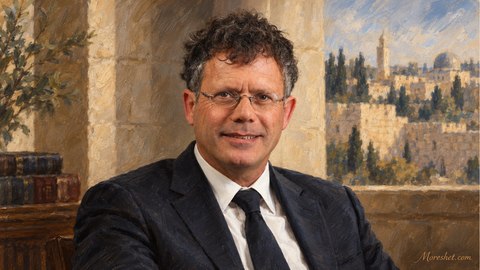
Eliad Shraga — AI-generated artistic portrait · Moreshet.com
Attorney, civic activist, and founder of Israel’s Movement for Quality Government
Eliad Shraga is an Israeli attorney and civic activist who founded the Movement for Quality Government in Israel and has led it since its establishment. For decades, he has worked at the intersection of law and public life, promoting governmental transparency, public accountability, and the use of legal and civic tools to confront corruption and strengthen the rule of law.
Jerusalem roots and service to the state
Shraga was born on May 26, 1959. On his mother’s side, he comes from a long-established Jerusalem family whose roots in the Old Yishuv extend across nine generations; on his father’s side, he is descended from the Ben-Gigi family of Moroccan Jewish origin. This combination reflects a central feature of Israeli society: the meeting of families rooted in the country for generations with Jewish communities that arrived from North Africa.
He enlisted in the Israel Defense Forces’ Paratroopers Brigade in November 1977. During the First Lebanon War, he served as an officer attached to the brigade’s combat engineering company. After leaving the IDF, he worked as a security officer at the Israeli Embassy in London on behalf of the Shin Bet. In the reserves, he rose to the rank of lieutenant colonel and served, among other positions, as a battalion commander in a reserve paratroopers brigade. During the Second Lebanon War, he served as a staff officer in the Fire Formation.
This path—from military and security service to law and civic activism—helped shape his continuing interest in authority, responsibility, and the protection of public institutions. He studied archaeology, geography, and law at Tel Aviv University, earned a master’s degree in law from the University of California, Berkeley, and completed a doctorate in law at the Hebrew University of Jerusalem in 2017 under the supervision of Professor Barak Medina.
Law as an instrument of public change
In 1991, Shraga founded the law firm Eliad Shraga & Co. Alongside his legal practice, he worked on professional writing in the field of administrative law. In 2009, the first two volumes of a planned six-volume series were published, co-authored with attorney Roy Shachar. Administrative law focuses on the relationship between citizens and public authorities: how decisions are made, how governmental power is limited, and why public bodies must act fairly, transparently, and according to law.
This expertise gave his civic work a practical foundation. Rather than treating good governance as an abstract ideal, the movement he established used petitions, public inquiries, monitoring of governmental decisions, and public advocacy to advance it. Shraga thereby helped turn principles such as transparency, institutional accountability, and the rule of law into tools that citizens and civil society organizations could use.
Founding the Movement for Quality Government
In 1990, Shraga was among the leaders of protests against governmental corruption following the political episode known as the “Dirty Trick.” He conducted a hunger strike outside the President’s Residence and protested the need to make coalition agreements available to the public. In the aftermath, he founded the Movement for Quality Government in Israel to combat governmental corruption through legal and civic means.
The movement became one of the Israeli organizations most closely associated with public oversight of government. It promoted the rule of law, recognized people who worked to strengthen it, and brought questions of integrity, institutional transparency, and the accountability of elected officials into public discussion. Its public inquiry hotline gives citizens a point of contact and handles hundreds of inquiries each year. Shraga’s work therefore extends beyond public speeches: it created a continuing institutional framework that connects legal knowledge with the concrete problems brought by citizens.
The movement’s creation also contributed to the development of Israeli civil society. It helped reinforce the idea that democracy is not limited to election day, but also depends on continuing oversight, the public’s right to know, legal action, and civic participation. Over the years, the organization became part of Israel’s network of public bodies working to promote good governance and protect democratic institutions.
Advocacy for prisoners and missing persons
Shraga also served as chairman of the Born Free Association, which worked to secure the release of Israeli navigator Ron Arad. This activity broadened his public involvement beyond governmental accountability to one of the most painful and enduring concerns in Israeli society: the state’s responsibility toward missing personnel and their families. Through this work, he joined a public effort to keep the fate of prisoners and missing persons on the national agenda.
Family life and public recognition
Shraga lives in Maccabim-Reut, is married to Dalit, and is the father of six children. In 2020, TheMarker magazine selected him as one of Israel’s one hundred most influential figures. The recognition reflected his prominent place in Israeli discussions of law, government, and civil society, even though much of his influence has been exercised outside the formal structures of government.
Why this legacy belongs in Moreshet
Eliad Shraga merits inclusion in Moreshet because his contribution is not limited to a personal legal career. He established a lasting civic organization that became a recognized address for public action against corruption and in support of the rule of law. He combined expertise in administrative law with sustained public engagement and helped make transparency and governmental accountability enduring subjects of Israeli civic discourse.
The legacy of this work can be seen both in the citizens who gained a channel through which to ask questions and demand accountability, and in public institutions required to explain their actions to the public. His story also belongs to the broader heritage of Jewish and Israeli public life: it shows how enduring values of responsibility, justice, and concern for the community can find expression through modern democratic and legal institutions. Moreshet and Moreshet.com preserve such stories because they illuminate how one individual can build a continuing public institution and influence the life of a country through law, persistence, and civic participation.