Eytan Stibbe
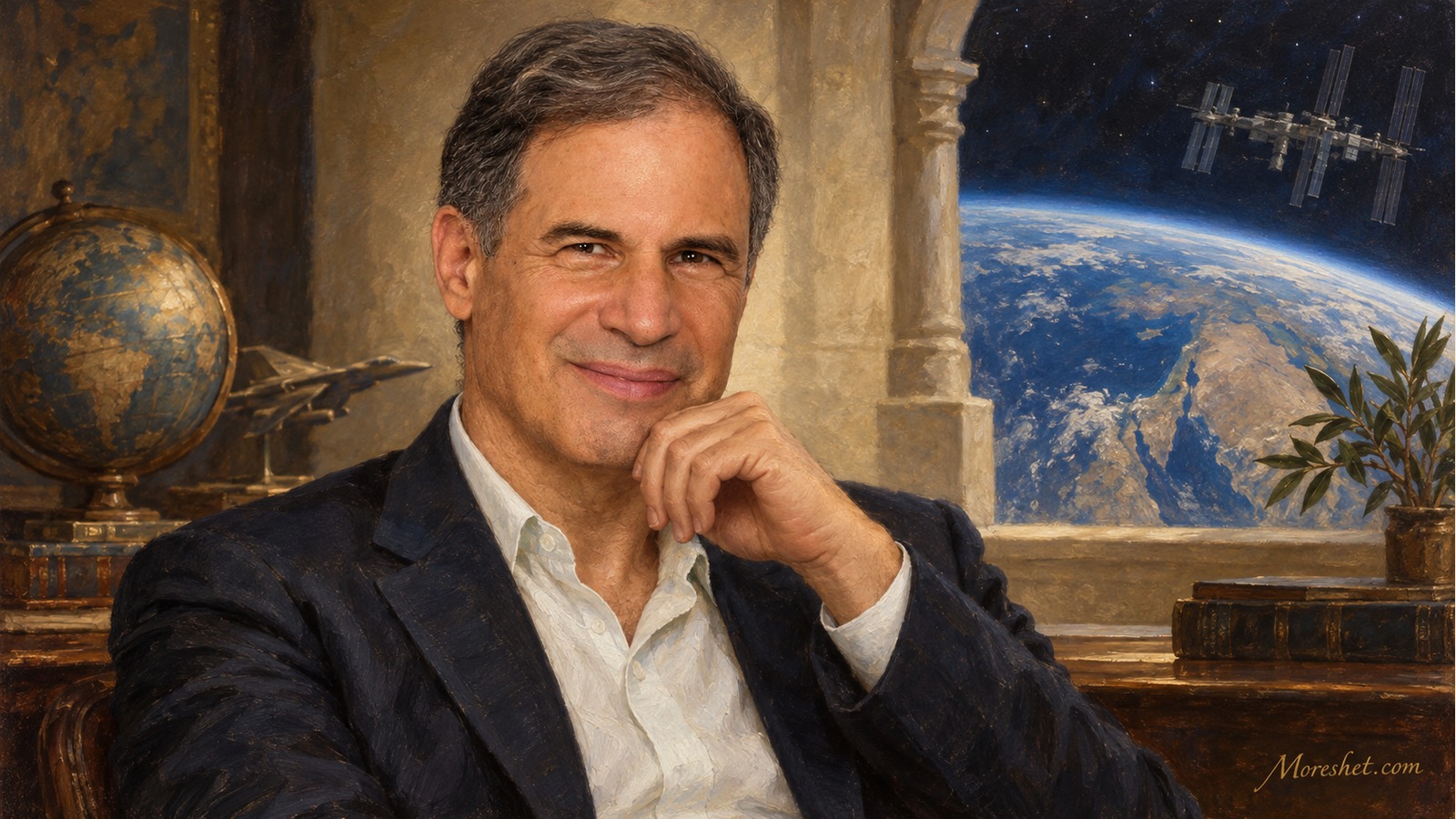
Eitan Steeber — AI-generated artistic portrait · Moreshet.com
Fighter pilot, entrepreneur, social investor and the first Israeli to visit the International Space Station
Eytan Stibbe is an Israeli entrepreneur, philanthropist and former fighter pilot who in 2022 became the second Israeli in space and the first Israeli to visit the International Space Station. His significance, however, extends well beyond the spaceflight. Across several decades he combined military service, international business, impact investing, education, healthcare, cultural initiatives and philanthropy. In the process, he supported practical projects in Israel and developing countries and turned a privately funded spaceflight into a national scientific and educational undertaking.
Early life and formation
Stibbe was born in Haifa. His parents, Alma and Ehud, met in Amsterdam while serving as counselors at Zionist youth movement summer camps. They completed their studies, married and immigrated to Israel in 1953. His mother worked as a clinical social worker at a mental-health clinic in Ramat Hen, while his father was a soil and water researcher at the Volcani Institute in Rehovot. When Eytan was four, the family moved to the United States during his father’s doctoral studies; they returned to Israel when he was seven and settled in Ramat Gan.
At Blich High School, Stibbe competed in athletics and handball, trained with Israel’s judo team and won the Israeli children’s championship twice. He was active in the Scouts and was sent by the movement to serve as a counselor at summer camps in the United States. These early experiences combined discipline and personal achievement with instruction, leadership and work with young people—qualities that later became central to his public activity.
Military service and fighter-pilot career
Stibbe entered the Israel Air Force flight academy in July 1976 and graduated in the fighter stream. He first flew Skyhawks with Squadrons 140 and 102, then Phantoms with Squadron 201, and later F-16s with Squadron 117. After leaving regular service in 1984, he continued serving in the reserves until 2012, retiring at the rank of colonel. From 2013 to 2019 he served as a flight instructor at the Air Force flight school, training cadets in the initial fighter track.
Over 43 years of flying in the Air Force, he accumulated thousands of flight hours. He received the Air Force’s Outstanding Reservist distinction and a flight excellence citation. His career reflects the importance of professional training, technological expertise and reserve service in Israel’s defense structure.
Combat record in the First Lebanon War
During the First Lebanon War in June 1982, Stibbe took part in aerial combat over Lebanon. On June 9, during Operation Mole Cricket 19, he shared responsibility for the downing of a Syrian MiG-23; it was recorded as half a victory because the engagement was shared with Eliezer Shkedi. On June 11, he participated in an air battle in which four F-16s from Squadron 117 downed nine enemy aircraft. Four of those victories were credited to Stibbe: two Su-22s, a MiG-23 and a Gazelle attack helicopter.
According to the supplied source, this made him one of four Israeli pilots to down four aircraft in a single sortie and the only F-16 pilot in the world recorded as having achieved four such victories in one sortie. The episode forms an important part of his military biography and of the wider history of Israel’s air power.
From defense technology to international infrastructure
After leaving the Israel Defense Forces, Stibbe joined a team of advisers to Israel Aerospace Industries working on the development of the Lavi aircraft systems. In 1985 he helped establish the LR Group, which operated internationally in areas including the sale and deployment of air- and sea-defense systems developed by Rafael and Elbit, infrastructure construction in developing countries, airport construction, cellular and satellite communications, agricultural development and the establishment of youth villages.
His principal responsibility in the group was developing financing structures for international projects in cooperation with banks and development institutions. His work therefore involved not only supplying technology but also building the financial arrangements that made large-scale infrastructure projects possible. He left the group in 2011 and sold his 33 percent stake. In 2012 he acquired a 35 percent stake in Mitrelli, a company active in related fields, and left that company in 2018.
Impact investing and sustainable development
In 2010 Stibbe founded Vital Capital, an impact-investment fund focused on improving the circumstances of underserved populations, particularly in Africa. The fund invested in industrial agriculture and food production, affordable housing, urban infrastructure, hospitals, renewable energy, water purification and wastewater treatment. Its approach sought to connect commercial investment with concrete solutions to essential community needs, working with local populations rather than treating development as an external enterprise.
The fund’s projects supported access to purified drinking water, electricity and healthcare and contributed to the creation of permanent employment. This work illustrates Stibbe’s belief that private capital can help expand basic services, create economic mobility and strengthen local economies. He also became involved with Israeli ventures in simulation, digital health and online education, including work related to personalized cancer treatment based on molecular genetic pathology and digital tools that help students study the sciences.
Stibbe has also addressed the relationship between investment and the climate crisis. He has advocated shifting resources from polluting fossil fuels toward renewable energy and viewing the climate emergency as an opportunity for long-term economic transformation. He is a member of the World Economic Forum and served on the advisory committee of Bridges Israel, an Israeli impact-investment fund.
Philanthropy, education and community building
Stibbe served for years under the command of Ilan Ramon, and that relationship continued to shape his public work. In 2010 he was part of the founding circle of the Ramon Foundation, established by Rona Ramon together with close family members and leading figures in Israeli society. Stibbe has supported the foundation’s educational work since its establishment and has served on its board. The foundation turned the legacy of Ilan and Asaf Ramon into an educational and social platform for children and young people.
Stibbe has helped establish or support social initiatives including Kiryat Adam in Lod, a learning, research and therapeutic center providing mental-health services to city residents; Zikaron BaSalon, a Holocaust remembrance initiative; the Center for African Studies at Ben-Gurion University; Derech LaGan; and IncludED, a network of inclusive schools. Together with his family, he established Anata, a public-benefit company supporting social and educational projects such as Unitaf, which operates daycare centers for refugee children, as well as preparatory programs, hospitals, academic initiatives and scholarships.
These activities reach different parts of society—children, refugees, students, patients and residents of underserved communities—and express a practical understanding of education, care, research and opportunity as foundations of a healthy society. Stibbe has also served on the steering committee of the Board of Governors of the University of Haifa. In 2016, he received an honorary fellowship from the Hebrew University of Jerusalem.
Art and the relationship between Israel and Africa
In his Tel Aviv office, Stibbe established the Gallery for African Studies, which presents exhibitions focused on African art and on the ways Africa and its people are represented and understood. The gallery has developed joint projects with Bezalel Academy of Arts and Design and Shenkar College. By bringing together art, research, design and education, it offers a setting for deeper engagement with African creativity and for examining cultural ties between Israel and Africa.
Rakia and the journey to the space station
On November 16, 2020, the Ramon Foundation announced that Stibbe would fly to space, becoming the second Israeli in space after Ilan Ramon and the first Israeli to visit the International Space Station. On April 8, 2022, he launched aboard SpaceX’s Dragon 2 as part of Axiom Mission 1, the first fully private mission to the International Space Station. The ten-day mission included a commander, a pilot and two mission specialists, including Stibbe.
Stibbe paid for his seat privately but agreed to turn the flight into a national project. Under the name Rakia, the mission included scientific experiments for Israeli institutions and linked a personal achievement in spaceflight with research, education and inspiration for younger generations. His arrival at the station also carried a strong symbolic meaning: it continued the legacy of Ilan Ramon, expanded Israel’s presence in space research and placed Israeli scientific and educational activity within the new era of private spaceflight.
Why this legacy belongs in Moreshet
Eytan Stibbe merits inclusion in Moreshet because his life connects several fields that have shaped Israel and its relationship with the wider world: security, aviation, technology, entrepreneurship, education, philanthropy and space exploration. His combat career forms part of the history of the Israel Air Force, while his business and philanthropic work demonstrates how Israeli expertise, capital and international partnerships can support infrastructure, healthcare, agriculture and education.
His involvement with the Ramon Foundation, Anata, Kiryat Adam, Unitaf, the Center for African Studies and inclusive education has affected children, families, students, patients and communities. The Rakia mission added a distinctly Israeli chapter to the history of the International Space Station and used space as a platform for research and inspiration. For these reasons, his profile belongs in Moreshet and on Moreshet.com: it records not only an extraordinary individual achievement, but also a broad pattern of work that has influenced Israeli society, Jewish and Israeli initiatives, and partnerships of significance beyond Israel.