Meir Amit
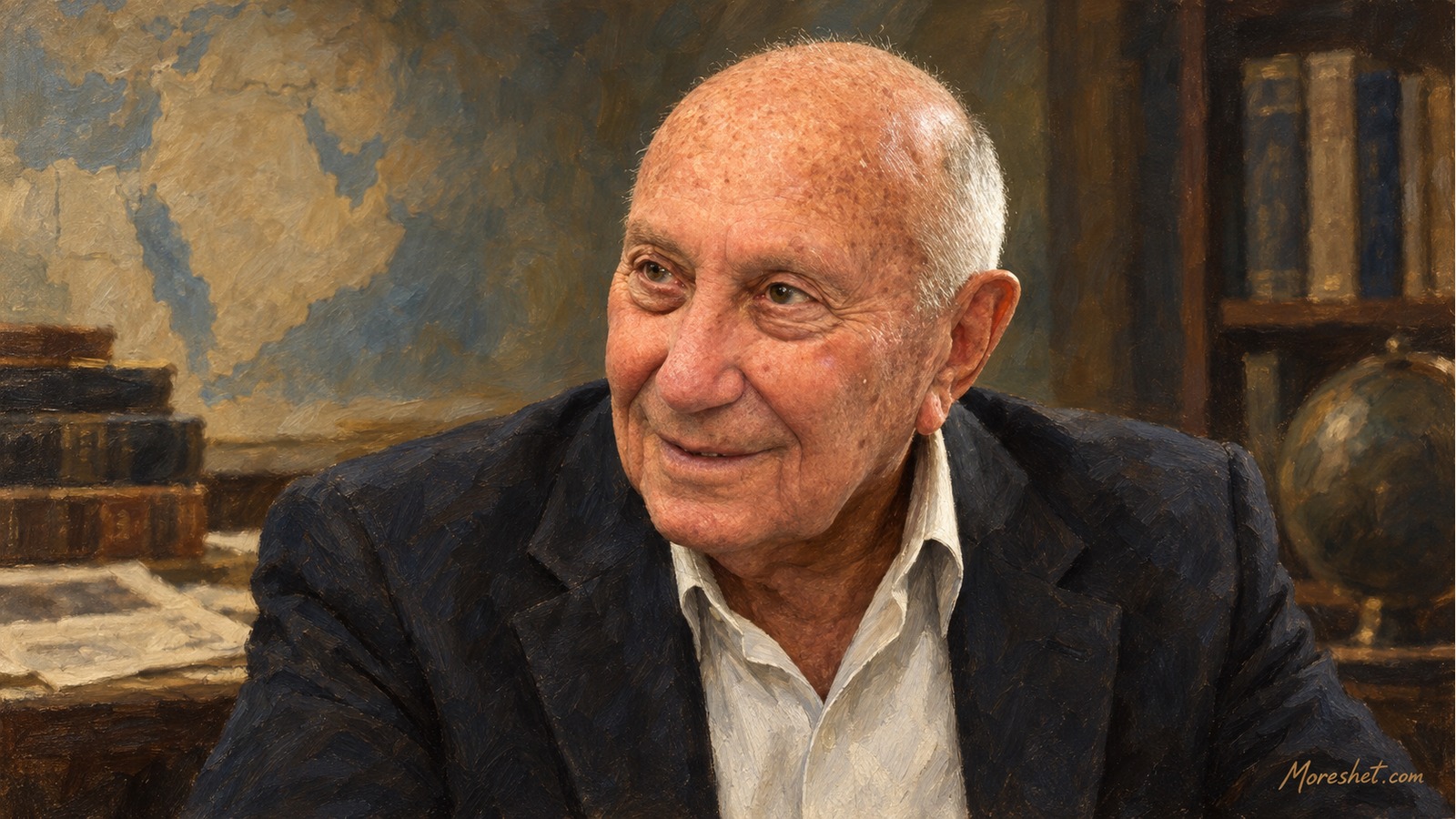
Meir Amit — AI-generated artistic portrait · Moreshet.com
From Haganah and IDF commander to Mossad director, cabinet minister, industrial leader and pioneer of Israeli satellite communications
Meir Amit Slutsky (17 March 1921 – 17 July 2009) was one of the figures who helped shape Israel’s security institutions, public life and economy during the country’s formative decades. He moved from the Haganah and the Golani Brigade to the IDF General Staff, headed Military Intelligence and the Mossad, and later served as a Knesset member, cabinet minister, industrial executive and pioneer of satellite communications. His career traces Israel’s transformation from a community fighting for survival into a state with established military, intelligence, industrial and civic institutions.
From the Haganah to the IDF
Amit was born in Tiberias to Haya and Shimon Slutsky, who had immigrated to Mandatory Palestine from Chernihiv in 1920. His family later lived in Jerusalem and Ramat Gan. He studied in Giv'atayim, Giv'at HaShlosha and at the Balfour Gymnasium in Tel Aviv. In 1939 he joined Kibbutz Alonim, where he remained a member until 1952. He entered the Haganah in 1936, while still a schoolboy, and later served in the Palestine Police auxiliary forces. These years gave him the field experience and command training expected of the generation that built the Jewish community’s defense forces.
Amit completed command courses at Ramat Yohanan and Ju'ara, commanded a Haganah field platoon and in 1947 became a regional company commander in the Dror Battalion of the Golani Brigade. During the 1948 War of Independence he fought at Mishmar HaEmek and in the Jezreel Valley, took part in the liberation of the Lower Galilee and was wounded in the battle for Jenin. In Operation Hiram he served as deputy commander of a battalion, and later commanded Golani’s mechanized battalion, based at Yavne'el. His soldiers took part in Operation Horev and, during Operation Uvda, were among the first Golani forces to reach Eilat.
Amit continued to help build the IDF after the war. He served as deputy commander and then commander of the Golani Brigade, including during the Battle of Tel Mutilla. He later headed the IDF Training Command and the Operations Branch, served as head of the Operations Directorate and commanded the Southern and Central Commands. As head of the Operations Directorate, he planned and directed the 1956 Sinai Campaign. A serious parachuting accident kept him hospitalized for more than a year. After recovering, he studied at Columbia University in New York and subsequently became head of Military Intelligence.
Building a national intelligence capability
On 26 March 1963, Amit was appointed director of the Mossad. For approximately nine months he held the position concurrently with the post of chief of Military Intelligence. Until his retirement in 1968, he worked to strengthen coordination between military intelligence and the Mossad and to integrate intelligence collection with special operations. During his tenure, Unit 188 was transferred from Military Intelligence to the Mossad and merged with the special-operations unit known as Mifratz, forming Caesarea. He also supported the intelligence use of Sayeret Matkal, helping shape the Israeli model of combining deep intelligence, covert operations and military capability.
One of the operations associated with his tenure was Operation Diamond, in which Iraqi pilot Munir Redfa defected to Israel in 1966 with a MiG-21. The aircraft provided Israel with valuable knowledge of a fighter then central to Iraq’s air force. The Mossad also pursued intelligence networks inside neighboring states, including Syria and Egypt, while Amit strengthened contacts with the Kurds in Iraq. On the eve of the Six-Day War, he traveled to Washington and returned with the assessment that the American administration would not oppose a preemptive Israeli strike against Egypt. After the war, he pressed for the release, as part of prisoner exchanges, of prisoners connected with the Lavon Affair who had been held in Egypt since 1954, as well as Wolfgang and Waltraud Lotz.
Intelligence work during this period involved substantial operational risk. Among the activities conducted under Amit’s leadership was the effort to locate the Nazi war criminal Herberts Cukurs. His tenure also included serious losses and failures, including the capture and execution of Eli Cohen in Damascus and the arrest of Wolfgang Lotz in Egypt. These events underscore the difficult and dangerous nature of the intelligence work carried out to protect Israel and Jewish lives.
From national security to industry and public service
After leaving the Mossad in 1968, Amit entered a major civilian role as director general of Koor Industries, the Histadrut’s industrial conglomerate and, at the time, Israel’s largest industrial group. Until 1977 he managed and developed a broad industrial enterprise, contributing to the country’s transition from a largely emergency-driven economy toward a more diversified productive system.
In 1977 Amit was elected to the Ninth Knesset on the Democratic Movement for Change list. He served on the Foreign Affairs and Defense Committee and then became minister of transport and minister of communications in Menachem Begin’s government, resigning both posts on 15 September 1978 after the party split. He later helped establish the Movement for Change and Initiative and joined the Labor Party in 1980. His political work brought the perspective of a commander, intelligence professional and manager into Israel’s civilian decision-making.
After leaving the Knesset, Amit remained active in business and technology. In 1981 he founded the General Satellite Services Company with Hezi Carmel and Jean Friedman. The company initiated the Amos communications-satellite project. Amit chaired the company and later the board of Spacecom, established in 1993 with Israel Aerospace Industries and other partners. The initiative formed part of Israel’s effort to develop independent satellite-communications capabilities with civilian, economic and security significance.
He also chaired the Israeli airline Maof Airways, served as a director of Israel Corporation and other companies, represented businessman Sami Shim'on in Israel, and served on the boards of Yachin-Hakal and Teva Pharmaceutical Industries. He represented Leo Rachman on Tadiran’s board after Tadiran acquired Elisra. Alongside his business activities, he held public roles at Tel Aviv University’s Jaffee Center for Strategic Studies, the Economic Planning Council, the Israel Center for Management and the Intelligence Heritage and Commemoration Center.
Recognition and commemoration
In 1997 Amit was named a distinguished citizen of Ramat Gan. In 2003 he received the Israel Prize for pioneering and varied Zionist activity, significant security service, and the advancement and development of Israel’s economy and industry. The citation reflected the breadth of his contribution: he was not only a commander and intelligence chief, but also a legislator, executive and institution-builder who helped strengthen a young state.
Meir Amit was survived by his wife, Yona née Kalman, three daughters and grandchildren. Streets in Netanya and Ramat HaSharon bear his name, and a neighborhood in Ramat Gan was named for him. The Amit Institute for Intelligence and Terrorism Research also carries his name and continues to disseminate research and information in a field to which he devoted much of his life.
Why this legacy belongs in Moreshet
Meir Amit merits inclusion in Moreshet because he worked in several arenas that shaped Jewish life and the State of Israel: he helped build the Jewish community’s defense forces, commanded troops in the War of Independence and later conflicts, developed capabilities in Military Intelligence and the Mossad, and contributed to Israel’s security and regional relationships. He then carried his experience into public service, industry and technology.
Amit’s historical importance also lies in the continuity between his security service and his civilian contribution. He helped develop intelligence and military institutions, managed one of Israel’s largest industrial groups and supported an initiative that led to Israeli satellite communications. His life therefore helps explain how leadership forged in the underground and wartime years was redirected toward building a state with durable security, economic and technological systems. Moreshet.com preserves this story as part of the documented heritage of people whose work shaped Israel and the wider legacy of the Jewish people.