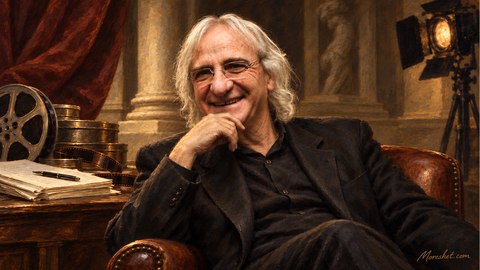
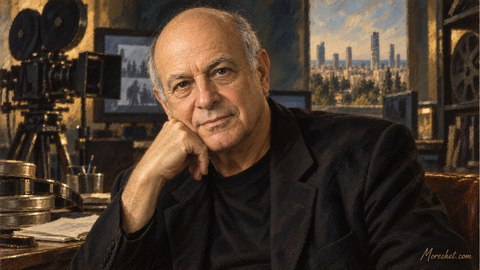
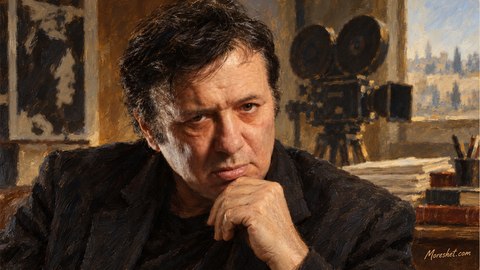
Alon Gour-Arieh
An Israeli director, screenwriter and comedy creator whose work connects cinema, television, radio, music and education
Alon Gour-Arieh, born on September 5, 1976, is an Israeli director, screenwriter, producer, actor, comedian, composer, content editor and radio broadcaster. For more than two decades, he has worked across cinema, television, radio, theater and education. His career connects independent filmmaking with popular entertainment, children’s programming with adult comedy, and creative production with the teaching of comedy’s history.
From music and Scouting to filmmaking
Gour-Arieh grew up in Rishon LeZion as the eldest of three children, in the family of Yoel and Vivian Gour-Arieh. He began studying piano at the age of six, drew comic strips, composed melodies and developed an early love of comedy films. In ninth grade, he won a national Scouts festival for a song he had written. He continued writing, directing and composing for Scouts festivals and musicals.
He postponed his military service for a year in order to establish Garin Etgar, a group that created Scouts chapters in Israel’s peripheral communities. During his service, he worked as an instructor in the Sharon information unit, which dealt with knowledge of the land and environmental quality. After leaving the army, he produced music for festivals and drew comics for the newspaper Rosh 1.
Between 1999 and 2003, he studied directing, editing and filmmaking at Camera Obscura School of Art. His early development already showed the combination that would define his career: comedy as a craft, music as a storytelling tool, and media as a way to build a shared experience.
Film work: from independent production to a broad audience
The Closed Institution
After four years of work, Gour-Arieh’s independent film The Closed Institution was released in 2007, starring Ron Shachar, Ilan Dar, Lena Ettinger and Eli Gorstein. It was initially intended as his graduation film, but after it was rejected in that context, he completed it as an independent production. The film premiered at the Jerusalem Film Festival and then received regular commercial screenings, especially at cinematheques. According to the supplied material, approximately 80,000 people had seen it by October 2018.
The film received awards and commendations at comedy and film festivals in the United States and Canada, including Best Director and Best Special Effects at the Houston Comedy Film Festival, the Audience Choice Award at the Toronto World of Comedy Film Festival, and awards at festivals in Los Angeles and Atlanta. Its festival reception demonstrated how an Israeli independent comedy could develop an audience beyond the country’s established production system.
Operation Egg
In 2017, Gour-Arieh directed Operation Egg, a comic musical adventure for the whole family, produced by United King Films. The story follows the transport of a rare eagle egg from the Ramat Gan Safari to Gamla Nature Reserve in the Golan Heights. The mission becomes a chase when two crooks try to steal the egg.
Shot at the safari and the nature reserve, the film combined live actors and animals with special effects, including a virtual elephant and a computer-generated boulder crushing a car. It expanded Gour-Arieh’s work into family cinema, using adventure and humor to create a shared Israeli experience for children and parents. The film’s theme song, “Spread Your Wings,” was composed by Gour-Arieh and performed by Adi Cohen.
The Institution
In 2019, Gour-Arieh released The Institution, an action comedy that expanded and reimagined the idea of The Closed Institution. The film parodies Israeli and international espionage and security culture. Its plot follows an Israeli Mossad agent competing with a CIA agent to save the world while an American millionaire is kidnapped in Jerusalem. The ensemble cast included Tzachi Halevy, Adi Himelbloy, Efrat Dor, Shlomi Koriat, Tal Friedman, Dvir Benedek, Gila Almagor, Ilan Dar and Tomer Sharon.
According to the supplied material, the film was Israel’s highest-grossing Israeli film of 2019 and sold approximately a quarter of a million tickets during that summer. It opened the Darom Film Festival, screened at festivals in Tallinn, Los Angeles, Mumbai, Pune, Monte Carlo, Brazil and Switzerland, and won Best Film at an international comedy festival in Canada. In 2020, it was sold to HBO. Gour-Arieh’s collaboration with David Zucker, a creator of Airplane!, Top Secret! and The Naked Gun, connected Israeli parody with an internationally recognized comic tradition and contributed to the development, writing and production of the film.
Writing, directing and creating for children
Gour-Arieh co-wrote the screenplays for Guavas and The Treasure Beyond the River with Kobi Machat, and wrote and directed the short films Malabi War, Singing with the Enemy and Effi the Guard. He also appeared as an actor in Film Zero.
In children’s media, he combined story, music, animation and comedy. He wrote and directed Gulgulenoa, two cinematic stage shows that combine a virtual character on screen with live actors. He created and directed Mysteries from the Fairy Tales, edited the script and directed actors in the third season of School for Wizards, and wrote and directed the series Whipped Cream and Strawberry. He also directed segments for Sesame Street and musical programs such as The Land of Rhythms.
His television work included writing and content development for children’s channels, Logi, Hop!, Channel 10, Channel 2, Israeli Educational Television and HOT. Among the programs and projects in which he participated were What Shlomo, Brainiac, Welcome to Grasshopper School, The Bell Is for Me, Nahshon Can Do Anything, How Much, How Much, Code 100, Maestro, Bible Quiz, Potato from Planet Potato and projects starring Miki Kam. This work brought original Hebrew-language comedy, music and storytelling to young audiences.
Radio, satire and popular culture
One of Gour-Arieh’s most distinctive projects was Hippopotamus, a radio program and sketch show created with Eyal Schindler, Nimrod Yizhar, Lior Avranel, Aviad Roter and other collaborators. It began at Rishon LeZion’s Rishonit station, returned after the creators’ military service on Radio Tel Aviv, and later continued in filmed internet versions for Flix and Nana10.
Hippopotamus was built around nonsense, absurd characters, jingles, fictional advertisements and audience challenges. Memorable sketches and segments included “Cinema-phone,” “Briefing for Soldiers Going Out,” “A Gift Shop for Men,” “The Lost Episode of Rechov Sumsum,” “Hippo-Musical” and “A Song for One Shekel.” The program also aired daily during the summer of 2000 and included guests, radio games and direct interaction with listeners.
Gour-Arieh later performed in Hippopotamus on Stage at the Tel Aviv Cinematheque, a monthly show that brought the radio and internet characters to a live audience. He also participated in The Beautiful and the Brave and Chat on the Net, working as writer, actor, director and broadcaster in projects that combined radio, video, interactivity and live performance.
As a comedy writer, he worked with many Israeli performers and creators. He wrote material for the group Ma Kashur, contributed to programs including Shavua Sof!, Game Over and The Back Bench, and co-wrote Miki Kam’s solo show One Foot Here, One Foot There. He also presented a regular satirical segment on Ad Kan.
Music and composition
Music has accompanied Gour-Arieh’s work from the beginning. He composed “The Agent’s Beloved Song,” performed by Miki Kam, and “The Mossad Anthem,” which also appeared in The Institution. He wrote opening themes and scores for children’s series including Welcome to Grasshopper School, The Bell Is for Me, Nahshon Can Do Anything, What Shlomo, Farm Fun and Bonbons.
This combination of music, script and direction allows him to create complete imaginative worlds rather than isolated jokes or scenes. In his films, television programs and stage shows for children, songs help build characters, move the story forward and create lasting cultural memories.
Lecturer, educator and interpreter of comedy
Gour-Arieh lectures on cinema and comedy history through his series The Crazy Film Club, presented at cinematheques in Tel Aviv, Jerusalem, Haifa, Rosh Pina and Sderot, as well as at Ben-Gurion University, the Eshkolot program, Beit Ariela, the Zionist House of America, the Avshalom Institute, the Magid Institute and the Third Ear.
His subjects include Monty Python, Woody Allen, the Marx Brothers, Bugs Bunny, Ephraim Kishon, the Lul troupe, Charlie Chaplin, Mel Brooks, South Park and Shaike Ophir. He presents the history of comedy in an accessible and entertaining way, connecting Israeli audiences with both local and international sources of the genre.
He has written a series of columns for Ynet about major comedy filmmakers and cinematic phenomena, taught comedy screenwriting at the Sam Spiegel School of Television and Film, and hosted cultural events and discussions at cinematheques and other institutions. These included meetings with the creators of Mivtza Savta and Ha-Parlament, an evening with director Avi Nesher and actor Adir Miller, and a meeting with Dr. Rafi Kishon concerning an English version of The Blaumilch Canal.
Through this combination of creation and teaching, Gour-Arieh does more than make comedies. He helps preserve the memory of Israeli cinema and humor, introduces that history to new generations and places Israeli popular culture within the wider history of comedy.
Public recognition
In 2019, Gour-Arieh was selected by Mako Culture as one of its fifty people of the year in culture and entertainment. He hosted Oscar broadcasts on Galatz between 2014 and 2016, appeared on radio and television programs, participated in Private Screening, a program about milestones in Israeli cinema, and continued to speak publicly about film and comedy.
Why this legacy belongs in Moreshet
Alon Gour-Arieh merits inclusion in Moreshet because his work documents and enriches an important part of Israeli culture: comedy as cinema, television, radio, music and education. He made films that reached broad audiences in Israel and festival audiences abroad, created programming for children, composed music, developed comic formats for radio and the internet, and made the history of comedy accessible to many different communities.
His legacy also lives in the institutions and audiences he reached — cinematheques, film schools, radio stations, children’s channels, theaters and cultural forums — and in the people who encountered Israeli creativity and the traditions that shaped it through his work. Moreshet.com is a natural place to preserve this distinctive combination of film, music, media, education and Israeli cultural life, as well as the example of a creator who turned a love of comedy into a sustained public contribution.