Ehud Yaari
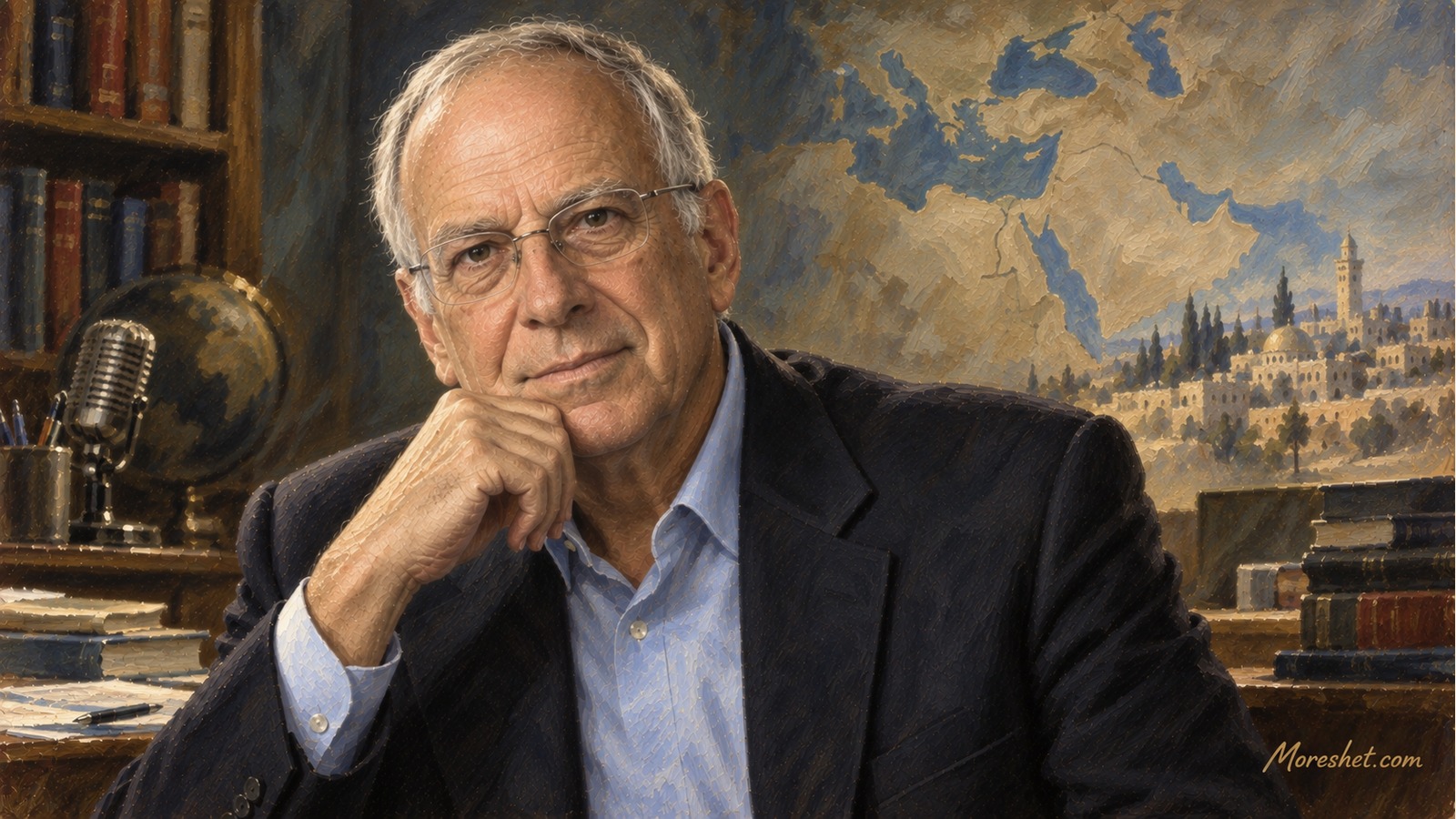
Ehud Yaari — AI-generated artistic portrait · Moreshet.com
The Israeli journalist and Middle East commentator who brought the Arab world into Israel’s public conversation
Ehud Yaari, born on 1 March 1945 in Metula, is an Israeli journalist, author, radio and television broadcaster, and commentator on the Middle East and the Arab world. For decades, he has been one of the most recognizable interpreters of regional politics in Israel. Through field reporting, interviews with leaders, books, and television analysis, he helped generations of Israelis understand the forces shaping war, diplomacy, terrorism, and the Arab–Israeli conflict.
Yaari’s work developed during periods when reliable information from the region was often difficult to obtain. His extended stays in Egypt and Lebanon, academic training in Middle Eastern studies, and access to senior political figures enabled him to place immediate events in a wider historical and strategic context. That combination made his reporting relevant not only to news audiences but also to scholars, policymakers, and readers seeking a deeper understanding of Israel’s surroundings.
Education and the beginnings of a journalistic career
Yaari attended Tichon Hadash in Tel Aviv. He earned a bachelor’s degree in Middle Eastern Studies from the Hebrew University of Jerusalem and a master’s degree in the same field from Tel Aviv University. In 1968, he worked as an assistant to Major General Shlomo Gazit, then Coordinator of Government Activities in the Territories at Israel’s Ministry of Defense. The experience gave him early exposure to the intersection of policy, security, and Arab society in the territories.
From 1969 to 1975, Yaari was the Arab-affairs correspondent for the newspaper Davar and Israel Army Radio. In 1975, he became a Middle East commentator for Israel’s Channel 1, where he established himself as a leading national voice on regional affairs. He spent extended periods reporting from Egypt and Lebanon, sometimes under dangerous conditions, and in 1997 served as Channel 1’s Washington correspondent.
Reporting from the region and access to its leaders
A defining feature of Yaari’s journalism was the combination of on-the-ground reporting and direct access to decision-makers. Over the course of his career, he interviewed major Arab leaders including Egyptian President Anwar Sadat, President Hosni Mubarak, Syrian President Bashar al-Assad, Lebanon’s Bachir Gemayel, King Hassan II of Morocco, Jordan’s King Abdullah II and his father King Hussein, Yasser Arafat, and Muammar Gaddafi. He also interviewed United States President Bill Clinton and foreign ministers from across the Arab world.
These interviews mattered because they brought Israeli audiences into direct contact with the perspectives of leaders whose decisions affected Israel’s security, diplomacy, and future. Yaari’s work did more than transmit statements: it examined how governments defined their interests, how they viewed Israel, and what lay behind their public positions. In this way, he helped make the political language of the region more intelligible to the Israeli public.
Books, research, and analysis
Yaari has published eight books and major studies on the Arab–Israeli conflict and Middle Eastern politics, several in collaboration with the journalist and analyst Ze’ev Schiff. His 1970 book Fatah examined the history and ideology of the movement that stood at the foundation of the Palestine Liberation Organization. Other works addressed Egypt’s policy toward Israel in the 1950s, Egyptian society, the First Lebanon War, and the First Intifada.
Among his notable books are The Year of the Dove, written with Ze’ev Schiff and Eitan Haber about the Israeli–Egyptian peace agreement; Israel’s Lebanon War, written with Schiff; and Intifada, also written with Schiff, about the First Palestinian uprising. These works turned complicated political and military developments into accessible accounts, preserving knowledge of decisive moments in Israel’s modern history and providing a reference point for journalists, researchers, students, and policymakers.
Yaari has also written for publications including The New York Times, The Washington Post, The Wall Street Journal, Atlantic Monthly, Al-Hayat, and The Jerusalem Report. In 1987, he became a fellow at the Washington Institute for Near East Policy, and in 1990 he began writing for The Jerusalem Report. In July 2008, he joined the Adelson Institute for Strategic Studies at the Shalem Center as a senior fellow.
Television, radio, and public understanding
In 1996, Yaari hosted the television program Moked. In 1997, he presented the three-part documentary series The Kingdom of the Khazars. Both projects reflected his ability to connect history, identity, politics, and current affairs, and to bring subjects of regional and historical complexity to a broad audience.
In 2000, Yaari joined the news company then broadcasting on Channel 2 as its Arab-affairs commentator. He became one of the most familiar voices in Israeli television coverage of the Middle East. His analysis accompanied the public through wars, terrorist attacks, peace initiatives, changes of government in the Arab world, and regional upheavals. His influence rested not simply on his long presence on screen, but on his habit of explaining the background of an event and considering its possible consequences for Israeli society.
Professional recognition and public influence
In 1978, Yaari was named Journalist of the Year by the Editors’ Committee for his coverage of the Israeli–Egyptian peace agreement. In 1982, he received the Sokolov Award for his coverage of the First Lebanon War, and in 1991 he received the Israel Broadcasting Authority Award for his coverage of the Gulf War. These honors recognized a form of journalism requiring speed, accuracy, historical knowledge, and an understanding of regional systems.
Yaari was also one of the prominent and consistent Israeli voices opposing the Oslo Accords. That position became part of the public debate over Israel’s relationship with the Palestinians and reflected his role as an analyst with an independent political perspective, rather than merely a transmitter of official statements. He continued to write and lecture on the region, Palestinian society, and the strategies of Middle Eastern governments and organizations.
Why this legacy belongs in Moreshet
Ehud Yaari merits inclusion in Moreshet because his work documented, interpreted, and helped shape the way generations of Israelis encountered the Arab world and the regional reality surrounding Israel. For more than five decades, he combined field reporting, interviews with leaders, research, and public commentary to make questions of war, peace, security, and identity part of Israel’s informed civic conversation.
His books and articles preserved knowledge of turning points in Israeli and Middle Eastern history, while his radio and television appearances brought that knowledge to a mass audience. Even where his positions were debated, his contribution to documenting the region and explaining its politics remains substantial. Moreshet.com can therefore present Yaari as an example of how journalism can influence public memory, political culture, and a society’s ability to face a complex reality through evidence, context, and interpretation.