Dudu Topaz
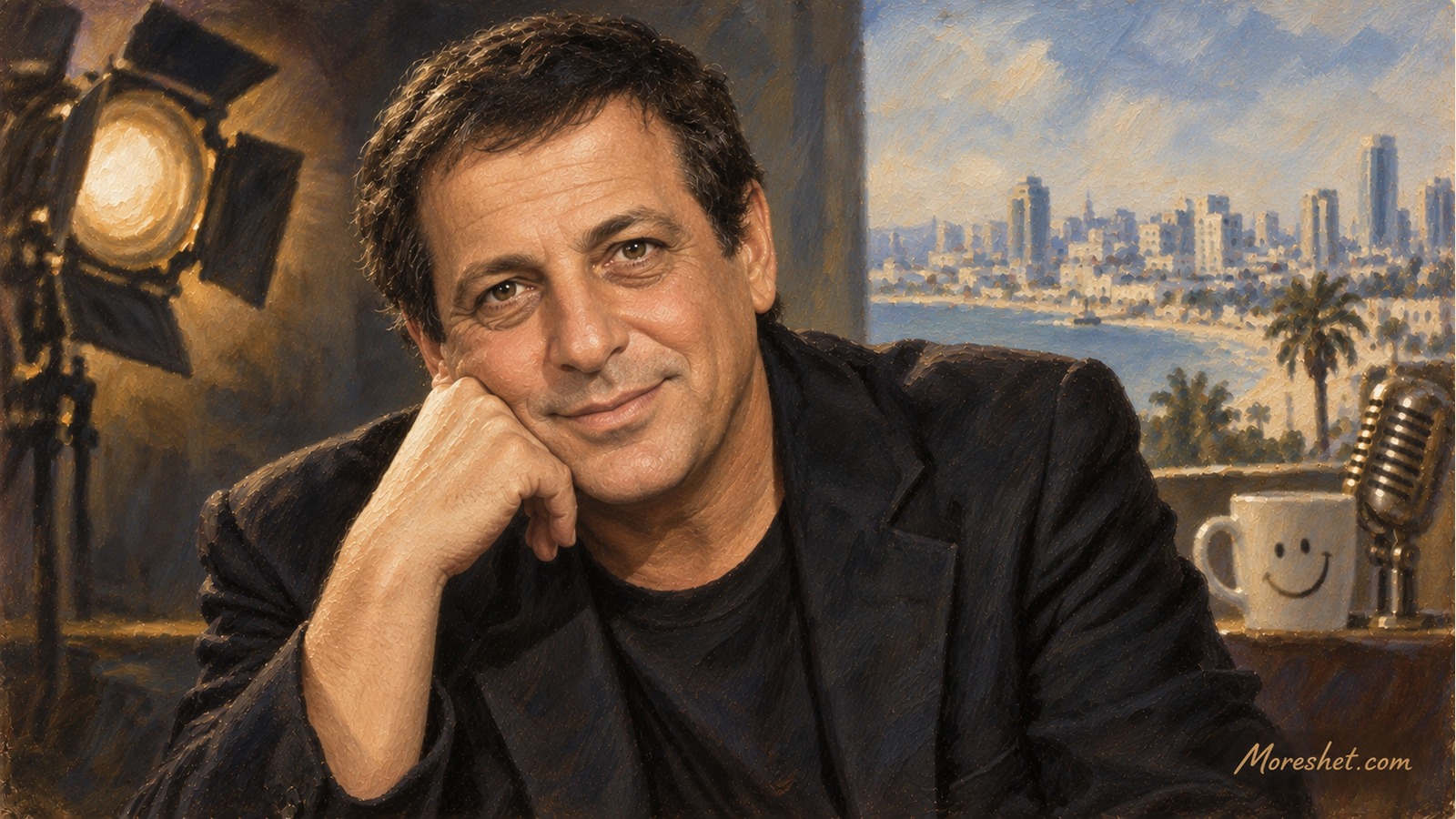
Dudu Topaz — AI-generated artistic portrait · Moreshet.com
The entertainer who brought Israeli television closer to the public
Dudu Topaz (September 20, 1946 – August 20, 2009), born David Goldenberg, was one of the most recognizable figures in Israeli entertainment. Over more than four decades he worked as an actor, comedian, screenwriter, playwright, author, radio broadcaster and television host. His career moved between theater, film, radio and television, but his greatest influence came from his ability to establish an immediate, informal relationship with large audiences. His flagship program, HaRishon BaBidur, became a defining institution of Israeli commercial television.
The title “The First in Entertainment” became so closely associated with Topaz that it functioned almost as a public identity. The media also called him “the rating king,” reflecting his commercial success and his ability to turn live entertainment into a national event. His legacy is not only a matter of audience figures. He helped shape the modern television host, gave early exposure to comedians who later became major Israeli performers, and brought the experiences of ordinary people into the center of popular broadcasting.
From Theater and Radio to Television
Topaz was born in Haifa to Lili and Eliyahu Goldenberg. His father was a radio announcer, actor and theater director, and Topaz grew up close to the worlds of performance and storytelling. During his military service he performed with the Gadna entertainment troupe. After leaving the army, he studied acting in London and returned to begin a career at Haifa Theater while also appearing in comedy shows throughout Israel.
During the 1970s he became a prominent participant in the radio comedy program Latzon Nofel Al Latzon, alongside Dudu Dotan, Yoel Rifel, Dalit Ormian, Avshalom Kor and others. Radio taught him to create character, timing and intimacy through voice alone, skills that remained central to his television work. His first television job was as an English teacher on the Educational Television program Everyman's English. He also contributed to the scripts for the children’s series Rega Im Dudli.
Topaz also appeared in Israeli films, including Jaco and the Whores, From New York with Love and Tel Aviv–Los Angeles. In the last of these he played the lead character, Modi Gazit, and wrote the screenplay. Its autobiographical elements reflected his own ambition to become a successful entertainer in Israel and beyond.
The Early Television Years
At the beginning of the 1980s, Topaz began hosting game and entertainment programs on Israel’s public Channel 1. The program most closely identified with him was Play It, which made him a familiar presence in homes across the country. He received the Kinnor David Award for the program, sharing the honor with producer Itzik Kol. The show’s popularity also made it a subject for self-parody: Topaz appeared in a Yehuda Barkan film prank, in an episode of Zehu Ze!, and in sketches showing the jokes that supposedly could not be told during the regular broadcast.
He went on to host Tze Meze, Ten Kav, Hapes T'Pips, the dating show Zeh Ma Yesh, and the Miss Israel competition. These programs helped establish the conventions of Israeli television entertainment at a time when the public channel was still the country’s central broadcasting institution. Topaz brought a fast, accessible and highly personal style to the screen, turning the host from a presenter into the event’s central performer.
Satire, Solo Shows and Everyday Hebrew
In 1984 Topaz launched the solo comedy show Peletat Peh, one of the most successful stage productions of his career. It was framed as a monologue by an Israeli waiting at Ben Gurion Airport and debating whether to leave the country. Through this story, Topaz combined criticism of Israeli society with affection for its daily life, ultimately presenting the country’s virtues as strong enough to make him stay.
The show included sketches about “small and irritating things,” satirical songs, imitations of politicians and public figures, and comic observations about spoken Hebrew and Israeli habits. The sketch A Family on a Trip, written by Menachem Zilberman, became a cultural hit. Lines such as “Only Moshe wanted orangeade” and “Can’t you throw garbage out of the window like civilized people?” circulated widely, were repeatedly played on the radio and were quoted in other works. Yoel Rifel, Amnon Dankner and Topaz also contributed to the writing, while musician Yossi Sidi accompanied Topaz throughout his career.
The success of Peletat Peh led to further solo productions, including Bli Heshbon, launched in 1987, Zura Lanu and Betipul Nimrat. These shows combined comedy, music, impersonation and political satire. Topaz addressed counterfeit dollars, imaginary future news, economic policy and elected officials, making the stage a place where current affairs could be discussed in a direct and popular language.
The Audience Connection in the Channel 2 Era
In the late 1980s and early 1990s, Topaz continued to host programs including Dudu Mesaper Legolo, Toto Mishpachti and Sofashavua. The last of these introduced several performers to television audiences, among them Shalom Asayag, Israel Katourza, Avi Greinik, Idan Alterman, Tzvika Hadar, Naor Zion and Orna Banai. Topaz was therefore not only a star in his own right; he also served as a gateway for comedians and performers who later became central figures in Israeli culture.
With the beginning of commercial Channel 2 broadcasts, Topaz began hosting Rashut HaBidur in 1994. The program was later renamed HaRishon BaBidur. It initially aired as a recorded Friday-night show and later moved to live Sunday broadcasts. Topaz sought an informal relationship with viewers: he and his crew surprised people in their homes, brought ordinary citizens into the studio, arranged reconciliations between estranged relatives and gave substantial prizes to people facing hardship.
The format was deliberately unpredictable. It combined practical jokes, celebrity guests, sketches, surprises, personal stories and live performance. The show also gave early exposure to comedians including Eli Finish, Mariano Idelman and Adir Miller. In one episode built around a supposedly extraterrestrial landing, with Tzipi Shavit in disguise, the program reached a reported 46.8 percent audience share, then a record. The number mattered not merely as a commercial achievement: it showed how Topaz could turn a weekly entertainment program into a shared national viewing experience.
Radio, Film and Personal Creativity
Topaz’s relationship with the public also extended to radio. In 1993 he hosted Abba Sheli Miyuchad on Kol Yisrael, a program devoted to his father, Eliyahu Goldenberg, fifteen years after his death. Family members and artists who had known his father took part, including Miki Goldenberg, Shmulik Segal, Shmulik Atzmon, Yossi Yadin, Yitzhak Artzi and Moshe Timor. Topaz also hosted Tziforei Layla Mesochachot, in which listeners called to discuss their experiences and personal problems.
He continued to write and act. His work included screenplays, stage pieces, songs and books such as Lama Lo? – Songs for the Light Wave, Stagdam, Birthmark, Ad HaEtzem, Life Is Not What They Promised Me and Sweet Dreams. In 1998 he wrote the screenplay for the short film Hitchhikers and appeared in it, and he also acted in Super Boy.
Later Projects and a Changing Media Landscape
For approximately five years, documentary filmmaker Doron Tsabari followed Topaz’s life for the film The Rating King, completed in 2001 and screened at the Jerusalem Film Festival. It was first broadcast on television only after Topaz’s death, in 2013. After his period on HaRishon BaBidur, he returned to television with Hakol Zaz Im Dudu Topaz, which began airing in 2005 and achieved strong ratings for its time slot. The program helped people, distributed prizes, hosted celebrities and included a segment in which Topaz told children bedtime stories.
In 2006 he moved to Channel 10 and hosted Hakol Eser Im Dudu Topaz. The following year he announced that he did not intend to continue hosting programs of that type and wanted to pursue new ideas. He created and presented the autobiographical documentary series Dudu Searches for Love in 2007. He also appeared in the television drama Dolls, his final television role.
Topaz continued to seek larger creative forms. In 2005 he wrote the biblical musical Moses, a modern adaptation of the Exodus story, and contributed his voice to the production. Although the musical closed after a short run, the project reflected his desire to move beyond television into large-scale theatrical work. That same year he presented the solo show I Don't Have Time, drawing on his professional and personal life; it toured successfully in Israel. His final entertainment show, The Taste of Life, opened in late 2008 and closed after only a few performances.
The End of His Life and Public Memory
In 2009 Topaz was arrested and charged in connection with a serious criminal case involving the ordering of attacks on media figures. He died by suicide on August 20, 2009 while in detention. His death abruptly ended a public life that had been part of Israeli entertainment for decades.
The case and his death received extensive media and documentary treatment, later appearing in films, investigative programs and books. In 2020 the television series The Dudu Topaz File revisited the investigation and his final years. The tragic ending should neither be concealed nor allowed to erase the cultural history that preceded it. Topaz’s life contained both the extraordinary rise of a performer who reached the heart of Israeli mainstream culture and a devastating personal and public collapse.
Why Dudu Topaz Belongs in Moreshet
Dudu Topaz merits inclusion because his career helps explain the transformation of Israeli popular culture from radio and public broadcasting to commercial television. He worked across theater, film, radio, live comedy and television, and in each medium he developed a direct relationship with broad audiences.
His influence can also be seen in the performers he introduced and in the formats he helped shape. His programs promoted young comedians, made the stories of ordinary people central television material, and brought spoken language, surprise and audience participation into the heart of Israeli entertainment. His sketches, songs and catchphrases remained part of the cultural memory of several generations.
For Moreshet and Moreshet.com, Topaz’s story matters not because it is simple or without contradiction, but because it documents a decisive chapter in Israeli cultural history: the power of mass media to bring audiences together, offer a platform to new talent and turn entertainment into a shared public experience. Alongside the tragic end of his life, his creative work and lasting impact on Israeli television, radio and comedy justify preserving his story as part of Israel’s cultural legacy.