David Witztum
A journalist, editor and broadcaster who brought international affairs, Jewish history and European culture into Israeli public life
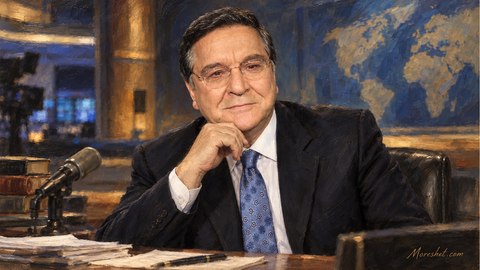
David Witztum, born on January 17, 1948, is an Israeli journalist, editor, broadcaster, commentator and documentary filmmaker whose work has spanned radio, television and the press. Drawing on studies in international relations, political science, philosophy, European affairs and music, he developed a distinctive form of public journalism: informed, contextual and attentive to the historical forces behind the news.
Witztum did more than report events. As an editor and presenter, he helped Israeli audiences understand the institutions, conflicts, societies and cultural memories shaping the world beyond Israel. Programs such as Ro'im Olam (“Seeing the World”), Mehayom Lemachar (“From Today to Tomorrow”) and Globus brought international affairs into the center of Israeli television. His documentary work also explored Jewish communities in Europe and the experience of German-speaking Jews who immigrated to Israel.
Family roots, music and a broad education
Witztum's father, Yaakov, immigrated to Mandatory Palestine from Berlin. He and his brother, Witztum's uncle, were the only survivors of the Holocaust among their large family. His mother, Mathilda Frisch, came from a family that had moved from Russia to Chernivtsi in Ukraine before immigrating to Israel. His parents married in Tel Aviv. The history of European Jewry, the Holocaust and immigration was therefore part of the family background from which Witztum emerged.
When he was two, the family moved to the Ahuza neighborhood on Mount Carmel in Haifa. He studied at the Reali School while also studying music at the Haifa Conservatory. He played cello with Uzi Wiesel in Tel Aviv and Natan Almosnino in Haifa, and performed in a string quartet under Professor Zvi Rotenberg. In 1964 he joined the Gadna Orchestra, which undertook concert tours in North America and Europe. In 1966 he traveled with the orchestra through Belgium, France and the Netherlands, where the musicians received the harp of Queen Juliana of the Netherlands. In 1967, following the Six-Day War, the orchestra undertook an extended tour of Europe and the Americas with the American Jewish comedian Danny Kaye.
Alongside his orchestral work, Witztum played cello in the Haifa Chamber Orchestra under Dalia Atlas and took part as a composer in Israel Music Week during his school years. Music remained an important part of his intellectual and cultural formation, helping shape the breadth and discipline he later brought to journalism.
Military service, academic training and journalism
From 1966 to 1969, Witztum completed compulsory military service as a meteorologist in the Israel Air Force. During his reserve service he worked as a film director, lecturer and television broadcaster. He then studied international relations and political science at the Hebrew University of Jerusalem, completing his undergraduate degree between 1969 and 1972. He continued at the College of Europe in Bruges, Belgium, graduating in advanced European studies in 1974, and studied philosophy at Oxford University from 1974 to 1977. He also studied in the theorists’ program at the Jerusalem Academy of Music.
This combination of political science, international relations, philosophy, European studies and music gave Witztum an unusually broad foundation for public communication. In 1971 he began working as an editor and reporter for Kol Yisrael News. While studying abroad, he worked as a freelance correspondent in Belgium and Britain. After returning to Israel in 1977, he edited the radio program Yoman Hashavua (“The Weekly Journal”), hosted by Yitzhak Ro'eh. The program received the Radio Director’s Award. Witztum also edited classical-music programs and news broadcasts.
Reporting from Europe and explaining the wider world
From 1982 to 1985, Witztum served as the Israel Broadcasting Authority’s correspondent in Europe, reporting from several European capitals. In Moscow, in May 1985, he became the first official Israeli correspondent to receive an entry visa and permission to report. The assignment enabled him to provide Israeli audiences with direct reporting from a society that was then highly restricted to foreign journalists.
His radio work demonstrated his ability to join immediate reporting with historical and cultural explanation. He did not merely describe European events; he helped listeners understand the institutions, memories, tensions and identities that shaped them. In doing so, he broadened Israeli public knowledge of Europe and of the relationship between Israel and the continent.
Ro'im Olam and a deeper television journalism
After returning to Israel, Witztum moved to Israeli television. From 1987 to 1991 he served as foreign-news editor in the news division and created, edited and hosted Ro'im Olam (“Seeing the World”), first broadcast on August 20, 1988. The program won the Israel Broadcasting Authority’s “Golden Apple” award twice as viewers’ favorite news program.
Ro'im Olam reflected the conviction that international news deserved more than a brief headline. Through editing, interviews and broad context, the program made events abroad accessible to Israeli viewers. It expanded the scope of Israeli television journalism and gave public value to knowledge, curiosity and the effort to understand long-term processes rather than simply react to immediate developments.
In 1987 Witztum also wrote for the weekly magazine Roshit Koteret. From 1991 to 1994 he was a foreign-affairs commentator for Yedioth Ahronoth and a television broadcaster on several programs, from the experimental Channel 2 to the program Hadash (“New Evening”). Moving among newspapers, radio and television enabled him to reach different audiences while preserving his emphasis on explanation and interpretation.
Documenting European Jewish life and German-speaking Israelis
Witztum directed documentary films and helped create the television series Po-Lan-Ya: One Thousand Years of Polish Jewry, serving as presenter and interviewer alongside director Amnon Teitelbaum. By addressing a thousand years of Polish Jewish life, the series presented Jewish Poland as a broad historical, cultural and communal world, not only through the tragedy of its destruction during the Holocaust.
He also directed two documentaries about German Jews who immigrated to Israel, as well as Stopping the Fleeting Moment and Nahariya, produced by the Museum of the History of German-Speaking Jewry in Tefen. These works helped preserve the memories, voices and experiences of the Yekkes in Israel, a community that contributed significantly to the country’s science, law, culture, music, academia and public life. Witztum’s documentaries therefore preserved more than historical information: they recorded human experiences of migration, loss, integration and rebuilding.
Mehayom Lemachar, Globus and cultural programming
In 1994 Witztum returned to television as an editor and presenter of news programs. Several months later, he and Emmanuel Halperin created Mehayom Lemachar (“From Today to Tomorrow”), which Witztum edited and hosted. He also worked as an editor and broadcaster in the news division, served as a European-affairs commentator, and edited programs including Ha'Olam Be'Einei Atzmo (“The World in Its Own Eyes”), based on documentary material from around the world, and Opera Aheret (“Another Opera”), a cultural program.
Mehayom Lemachar remained on the air for 18 years and became one of the defining examples of explanatory journalism on Israeli television. After it left the schedule in May 2012, Witztum began presenting Erev Tov Israel (“Good Evening Israel”) with Michal Rabinovich. From 2000 he has presented Globus, edited by Oren Nahari. Across these programs, he maintained a durable connection between news, geography, history and culture, making international affairs more intelligible and meaningful within Israeli life.
Teaching, research and cultural public service
Beginning in 1995, Witztum taught as an adjunct lecturer in history and communications at the Hebrew University, in political science at Tel Aviv University, and at the Open University. From 1999 to 2002 he completed a master’s degree in political science at the Hebrew University under Professors Avraham Diskin and Moshe Zimmermann. His thesis examined “The Image of Germany on Israeli Television, 1989–1993,” a subject that brought together media, historical memory and Israel’s changing relationship with Germany.
Alongside his teaching, Witztum served voluntarily on the boards of the Israel Council on Foreign Relations, the Leo Baeck Institute and the Israel Music Institute. He also served on the intergovernmental committee on Germany–Israel relations established in 2008. These activities extended his contribution beyond broadcasting into institutions concerned with foreign relations, German-Jewish history and Israeli music.
Why this legacy belongs in Moreshet
David Witztum merits inclusion in Moreshet because his career stands at the meeting point of journalism, education, culture and Jewish memory. Through radio and television, he made the wider world more accessible to Israeli audiences. Through documentaries and historical programming, he helped preserve the stories of Polish Jewry, German-speaking Jews and the Yekkes in Israel. Through teaching and institutional service, he carried knowledge and context to students, viewers and listeners.
His importance lies not only in the number of programs he edited or presented, but in the standard he brought to public journalism: intellectual curiosity, historical awareness and the understanding that Israeli life is also part of a Jewish, European and global story. For that reason, his work has a natural place on Moreshet.com—not because the archive created his legacy, but because it preserves and presents the contribution of a communicator who helped a broad public see that legacy more clearly.