David Ben-Gurion
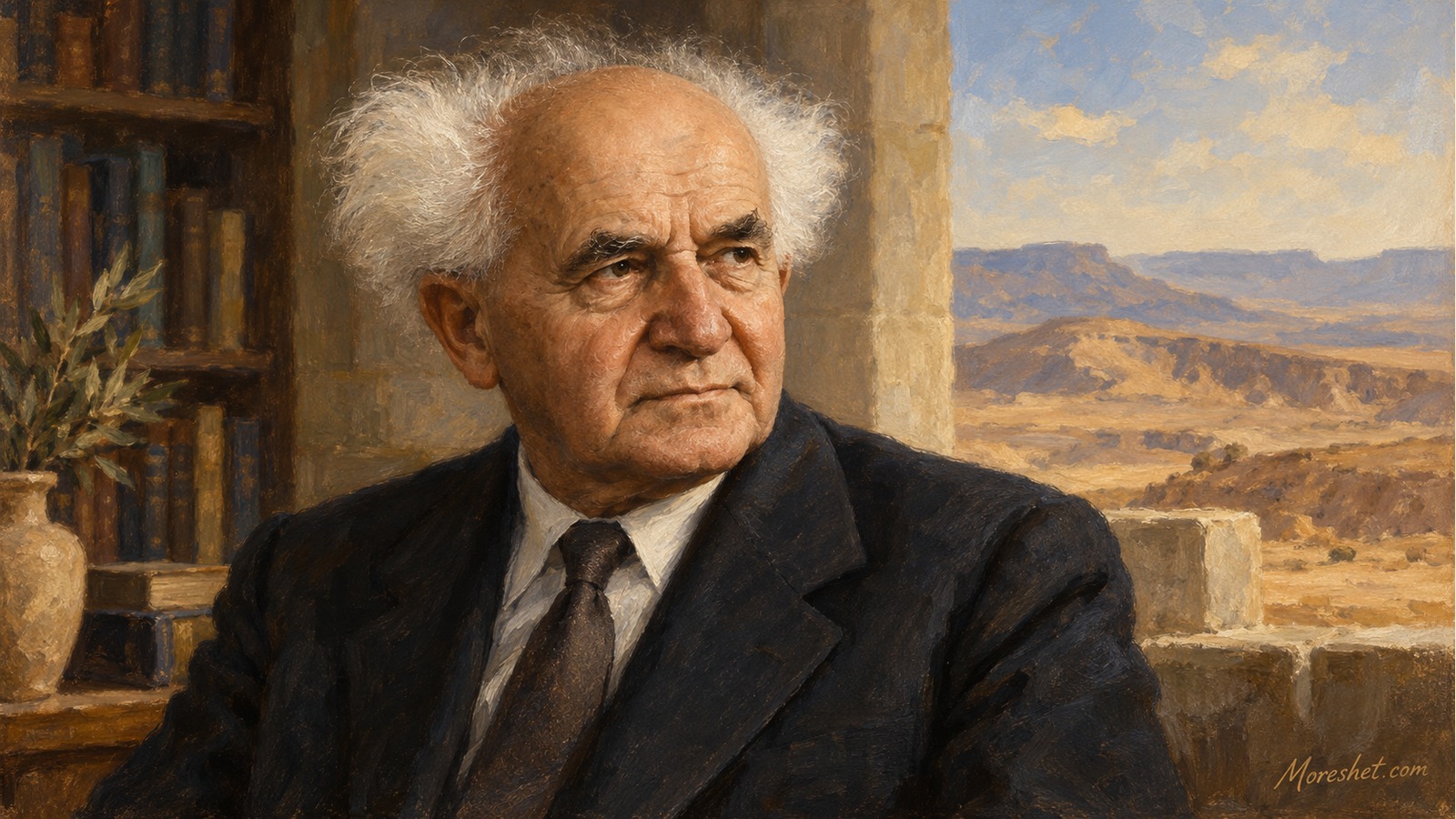
David Ben-Gurion — AI-generated artistic portrait · Moreshet.com
Israel’s first prime minister, declarer of independence, leader of the Yishuv and Labor Zionism, architect of Israeli statehood and one of the central Jewish figures of the 20th century
David Ben-Gurion, born David Yosef Grün, was the first prime minister of the State of Israel, its first minister of defense, the leader of the Jewish Yishuv in Mandatory Palestine, and the man who read the Declaration of Independence and proclaimed the establishment of Israel on May 14, 1948. His place in modern Jewish history is enormous. Ben-Gurion was not only a politician; he was an institution-builder, a maker of historic decisions, a founder of Israeli statehood and a leader who guided the passage from a Jewish community under foreign rule to a sovereign state responsible for army, immigration, economy, education and security.
His life brings together many of the great chapters of modern Jewish history: the Second Aliyah, the revival of Hebrew, Labor Zionism, the founding of the Histadrut, the leadership of the Jewish Agency, the struggle against the British Mandate, the United Nations partition decision, the War of Independence, the creation of the Israel Defense Forces, mass immigration, state institutions, Israel-Diaspora relations, development of the Negev and the centrality of security in Israeli life. Even where his decisions remain debated, Israel cannot be understood without Ben-Gurion: his courage to decide, his vision, his hardness, his belief in action and his willingness to carry historical responsibility.
Płońsk, Hebrew and early Zionism
Ben-Gurion was born on October 16, 1886, in the town of Płońsk in Congress Poland, then part of the Russian Empire. His father, Avigdor Grün, was a local public figure, Hebrew-minded activist and supporter of Hovevei Zion; his mother, Scheindel, died when David was a child. The home in which he grew up joined Jewish tradition, Hebrew education and early Zionist longing. From childhood he studied in traditional and modernized Jewish schools, encountered Hebrew and national ideas, and grew up in an atmosphere in which the Land of Israel was not only a religious memory but a historical destination.
In 1900, while still very young, he founded the Ezra society with Shlomo Zemach and Shlomo Lavi. The group was dedicated to promoting spoken Hebrew and preparing young Jews for aliyah to the Land of Israel. The choice of Hebrew mattered deeply. Ben-Gurion understood early that national revival was not only a matter of borders and institutions, but also of language, culture and education. Hebrew became, for him, an instrument of independence, national discipline and the creation of a new society.
The death of Theodor Herzl in 1904 affected him deeply. Young Ben-Gurion saw in Herzl a rare figure who had given the Jewish people political direction, but his own path later moved toward a more practical form of Zionism: not only diplomacy and charter, but immigration, labor, settlement, workers’ organization and the creation of real power in the land itself.
The Second Aliyah and the making of a man of action
In 1906, at the age of twenty, Ben-Gurion immigrated to the Land of Israel as part of the Second Aliyah. He landed in Jaffa and immediately walked to Petah Tikva, where he worked in demanding agricultural labor: preparing land, planting, digging and working in orchards. The life of a Jewish laborer in Palestine was harsh, marked by malaria, hunger, unemployment and insecurity, but it shaped his conviction that the land would be built not by slogans but by daily labor, settlement and the creation of a rooted Jewish majority.
Ben-Gurion moved among Petah Tikva, Kfar Saba, Rishon LeZion, Rehovot, Sejera, Kinneret, Menahemia, Yavne’el and Zikhron Ya’akov. In Sejera he experienced guarding and the security problems of the Yishuv. The killing of his friend Shimon Melamed and the clashes in the Galilee left a deep mark on him. From this period grew his conviction that the Jewish community could not rely only on foreign protection; it needed Hebrew self-defense, organization and the capacity to defend itself.
In those years he was active in Poale Zion in the Land of Israel. He attended conferences, spoke in Hebrew, organized Jewish workers and wrote for the newspaper Ha’ahdut. In 1910 he began signing with the name Ben-Gurion, taken from figures of the Jewish revolt against Rome. The name change was not merely biographical. It expressed his wish to enter the new Hebrew history, to leave behind the exilic identity of David Grün and to build himself as a Hebrew leader in the Land of Israel.
Istanbul, Ottomanization and the regional horizon
In the years before the First World War, Ben-Gurion developed the idea of Ottomanization: Jews in Palestine should take Ottoman citizenship so they could act within the empire’s legal framework and influence the future of the land. Together with Yitzhak Ben-Zvi he went to Salonika to study Turkish and then to Istanbul to study law. He did not complete the degree, but the period was important for his understanding of state, law, language and governing systems.
Ben-Gurion was not a Zionist leader looking only toward Europe. He understood that Zionism’s future would also be decided inside the Middle Eastern sphere, under Ottoman rule, in relation to the Arabs of the land and in interaction with regional forces. He began to understand that Zionism did not act in an empty space. The land had an Arab population with deep attachment to it, and relations with that population would not be a secondary matter but a central problem of the national project.
When the First World War broke out, Ben-Gurion and Ben-Zvi tried to remain in the country through Ottoman loyalty, but in 1915 the Ottoman authorities deported them. The deportation took them to the United States, opening a new chapter in Ben-Gurion’s life: work among American Jewry, writing in Yiddish, mobilizing support for Zionism and learning the power of Jewish communities in the Diaspora.
America, the Jewish Legion and Paula
Ben-Gurion arrived in New York in 1915 and worked among Poale Zion circles. With Ben-Zvi he tried to establish a pioneering movement that would immigrate to the Land of Israel, wrote and lectured, and helped produce the book Eretz Israel, which presented American Jews with the land, its history, its settlement and the possibility of building a new Hebrew society there. During this period he learned to address a wider Jewish public, not only in Hebrew but also in Yiddish, the language of the Jewish masses of Eastern Europe and America.
In New York he met Paula Munweis, a Jewish nurse born in Minsk, and the two married in 1917. Paula became his life partner for decades, a strong presence inseparable from his personal environment. They had three children: Geula, Amos and Renana. Ben-Gurion’s family life was often subordinated to his public mission, but Paula, his Tel Aviv home and later the hut at Sde Boker became part of the Israeli mythology surrounding him.
After the Balfour Declaration in 1917, Ben-Gurion changed his position toward military service alongside Britain and joined the Jewish Legion in the British Army. His actual military service was short and limited, but the act of enlistment symbolized the recognition that the Jewish national struggle also required open Hebrew military force. That idea would later stand at the center of his security and state-building worldview.
Histadrut, Ahdut HaAvoda and Mapai
After the First World War, Ben-Gurion was among the founders of Ahdut HaAvoda and one of the key figures in the creation of the Histadrut, the General Federation of Jewish Labor in the Land of Israel, in 1920. In 1921 he was elected its general secretary, a role he held for about fifteen years. He saw the Histadrut as much more than a trade union. To him it was infrastructure for the state-in-the-making, capable of creating factories, health services, educational systems, agricultural settlements, security frameworks, cultural institutions and organized political power.
As a labor leader, Ben-Gurion built a broad social base that made the labor movement the center of political life in the Yishuv. He worked to unite workers’ parties, and in 1930 Mapai, the Workers’ Party of the Land of Israel, was established and became the leading force in the Zionist movement and the Yishuv. Ben-Gurion understood that to lead the Jewish people in the land, ideological purity was not enough. The labor movement had to become a broad national force.
The Histadrut and Mapai gave him an organizational base unlike any other: workers, kibbutzim, moshavim, cooperatives, press, youth movements, funds and public institutions. This base later enabled him to compete for leadership of the entire Zionist movement and to create continuity between party, Yishuv, Jewish Agency and state.
Leader of the Yishuv and the Jewish Agency
In 1935 Ben-Gurion was elected chairman of the Jewish Agency Executive and of the Zionist Executive. From that point he became, in practice, the leader of the Jewish Yishuv in Palestine. The role required an extraordinary combination of diplomacy toward Britain, internal leadership of the Jewish community, response to the Arab revolt, relations with the Diaspora, political struggle within the Zionist movement and preparation for the possibility of large-scale military conflict.
During the 1930s Ben-Gurion confronted the question of relations with the Arabs of Palestine. He gradually recognized that Zionism faced an Arab national movement, not merely outside incitement. He met secretly with Palestinian and Arab leaders, including Musa al-Alami and others, in an effort to explore possible arrangements, but the talks did not produce a breakthrough. At the same time, during the Arab revolt, he supported the policy of restraint, Havlagah, seeking to preserve the strength of the Yishuv, avoid uncontrolled revenge and establish the Haganah as a responsible force.
The British White Paper of 1939, which restricted Jewish immigration and land purchase on the eve of the Holocaust, was in his eyes a grave betrayal of the promise of a Jewish national home. During the Second World War he formulated the famous principle that Jews should help the British fight Hitler as if there were no White Paper, and fight the White Paper as if there were no war. The sentence expressed his ability to hold two historical obligations together: the struggle against Nazism and the struggle to keep the gates of the land open to Jews.
From Holocaust to independence
The Holocaust years confronted Ben-Gurion with one of the greatest tragedies in Jewish history. The Yishuv in Palestine was small and limited in power, but he understood that the Holocaust strengthened decisively the demand for Jewish sovereignty and Jewish control over immigration. He supported illegal immigration, the creation of Hebrew military force within the British framework, and the shift of Zionist policy toward an explicit demand for a Jewish state.
In 1942 the Biltmore Program adopted the demand for a Jewish commonwealth in Palestine. After the war, the struggle against Britain intensified around immigration, displaced persons, detention camps and the continuation of the Mandate. Ben-Gurion had to navigate between the Haganah, Irgun and Lehi, between limited cooperation and resistance to the British, and between preserving Yishuv unity and recognizing that British rule was nearing its end.
On November 29, 1947, the United Nations General Assembly adopted the partition plan. Ben-Gurion supported accepting the decision, despite difficult borders and obvious military danger. He saw it as a historic opportunity that might not return. From that moment he worked to prepare the Yishuv for war, organize military power, secure resources and create a state leadership capable of assuming full responsibility when the British left.
Declaration of the state and the War of Independence
On May 14, 1948, in Tel Aviv, Ben-Gurion read the Declaration of Independence and proclaimed the establishment of the State of Israel. He was the first to sign the declaration. The proclamation was not only a ceremony. It was a daring political decision at a moment when Jerusalem was under siege, settlements were cut off, Arab armies were preparing to invade, and the new state still lacked recognized borders, a unified army and stable instruments of government.
During the War of Independence, Ben-Gurion led the effort to create one state army. He signed the order establishing the Israel Defense Forces, worked to dismantle the underground organizations, integrated the forces of the Haganah, Palmach, Irgun and Lehi into one state framework, and made difficult decisions in the Altalena affair and the dismantling of the Palmach command. In his view, without a state monopoly on armed force, no real state could exist. The IDF was to be the army of the people and the state, not the arm of a party, underground or faction.
The war ended with Israeli victory and the creation of a sovereign state, but also with a deep Palestinian disaster: the flight and expulsion of hundreds of thousands of Palestinian Arabs and the creation of a refugee question that continued to shape the conflict. Ben-Gurion saw the war as an existential struggle for Jewish independence after the Holocaust, but the history of 1948 also includes the human and political cost of war in a land inhabited by two peoples. A responsible historical profile must hold both dimensions together: the birth of the Jewish state and the tragedy of the war.
Prime minister, minister of defense and builder of the state
After the establishment of the state, Ben-Gurion served as prime minister and minister of defense. He led Israel through its early years, when a young and poor state had to absorb hundreds of thousands of immigrants, build an army, create an education system, shape a civil service, stabilize an economy, develop agriculture and industry, and forge a shared civic identity among Jews arriving from Europe, the Islamic world and many other communities.
His policy of mamlakhtiyut, or state-centered responsibility, sought to transfer the center of gravity from movement, party and underground to the state. He demanded loyalty to state institutions, the IDF, the law and the elected government. This concept shaped Israel for generations: one army, one system of government, state education, civil service and the priority of public authority over sectarian centers of power. Alongside these achievements, the processes of absorption and state-building also involved hardship, inequality, austerity and deep social tension.
Ben-Gurion led the reparations agreement with West Germany, one of the most painful decisions in Israeli society after the Holocaust. Opponents saw it as an offense to the memory of the murdered, but Ben-Gurion argued that the young state needed resources for its construction and that Germany had to bear material responsibility for Nazi crimes. The agreement contributed to Israel’s economy, infrastructure and immigrant absorption, and became one of the major policy decisions of the 1950s.
Security, the Sinai Campaign and strategic depth
As minister of defense and prime minister, Ben-Gurion placed national security at the center of his worldview. He believed that Israel was small, surrounded by enemies and lacking strategic depth, and therefore had to build a high-quality army, advanced technology, intelligence, deterrence and international partnerships. He supported reprisal operations against infiltrations and attacks, and in 1956 led Israel into the Sinai Campaign alongside Britain and France against Nasser’s Egypt.
The Sinai Campaign ended with Israel’s conquest of the Sinai Peninsula and later withdrawal under American and Soviet pressure, but it strengthened Israel’s deterrence and freedom of navigation for a period. The episode also expressed Ben-Gurion’s understanding that Israel had to operate within an international system, identify strategic opportunities and combine military power with diplomacy.
Under his leadership, long-term security projects were advanced, including the scientific and nuclear infrastructure at Dimona. Ben-Gurion saw science, technology and security as part of one system of survival and sovereignty. In his eyes, a Jewish state could not rely only on courage or morality. It needed real power to defend itself in a hostile and changing world.
The Negev, Sde Boker and renewed pioneering
One of the deepest symbols in Ben-Gurion’s life was his relationship to the Negev. He saw the desert not as a geographical margin but as a historical test of Zionism: would the state concentrate only on the coastal plain and major cities, or would it dare to develop arid spaces, create settlements, research water, build industry and expand the national imagination?
In 1953 he temporarily resigned as prime minister and moved to Kibbutz Sde Boker. The act was both educational and political: a former prime minister choosing a hut in the desert in order to tell the younger generation that pioneering had not ended with independence. Even after he returned to power, Sde Boker remained central to his public identity, and after his final retirement he went back to live there.
Ben-Gurion’s Negev vision connected security, settlement, science, agriculture and education. He believed Israel’s future depended on its ability to turn natural limitations into national challenges. In that sense, the Negev was not only a place for him, but an idea: the continuation of pioneering inside an already established state, and proof that Zionism does not end with declaration but continues through building.
Retirement, Rafi and final years
In 1963 Ben-Gurion resigned as prime minister and transferred leadership to Levi Eshkol. Disagreements over the Lavon Affair, questions of security responsibility and political tensions inside Mapai led him in 1965 to leave his party and establish Rafi. The move showed that even after decades of national leadership, Ben-Gurion found it difficult to accept political compromises that seemed to him contrary to historical truth or to the state responsibility as he understood it.
In 1970 he retired from the Knesset and from active political life. His final years were spent mainly in Sde Boker, reading, writing, meeting visitors and thinking about the historical memory of the state he had helped create. He died on December 1, 1973, shortly after the Yom Kippur War, and was buried beside Paula at Midreshet Ben-Gurion, facing the landscape of Nahal Zin.
His death marked the end of the founders’ generation in its deepest sense. Ben-Gurion left behind a living, strong, wounded, argumentative state with functioning institutions. He was not a leader of simple consensus, but of decisions; not a soft figure, but a founding one. His historical power lay in the ability to turn vision into action, action into institution, and institution into state.
Why this legacy belongs in Moreshet
David Ben-Gurion merits inclusion in Moreshet because he is one of the few figures whose influence is visible in almost every layer of modern Jewish and Israeli life. He was a Second Aliyah pioneer, leader of the labor movement, builder of the Histadrut, head of the Yishuv leadership, declarer of independence, founder of the IDF, first prime minister and minister of defense who shaped Israel’s approach to security, immigration, statehood and development.
Moreshet.com documents Ben-Gurion because modern Jewish and Israeli heritage cannot be understood without him. The creation of the State of Israel, the absorption of mass immigration, the building of state institutions, the transformation of the Jewish people from a dispersed people into a sovereign political actor, and the effort to give Zionism a practical state form all bear his imprint. David Ben-Gurion’s place in Moreshet rests on the fact that he did not only dream of a Jewish state; he made the decisions, built the institutions and carried the responsibility of turning it into historical reality.