Menachem Ussishkin
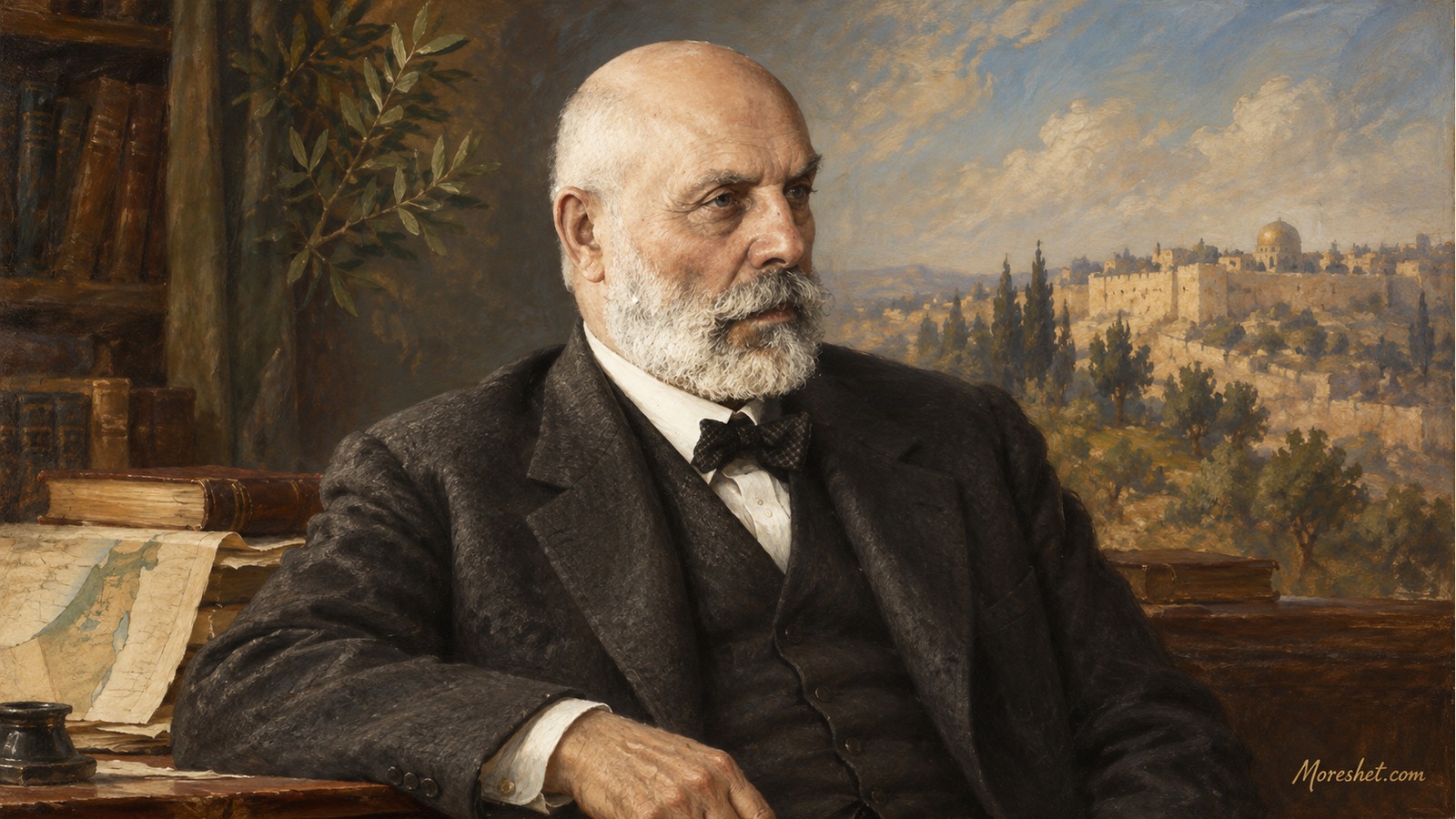
Menachem Ussishkin — AI-generated artistic portrait · Moreshet.com
The Zionist leader who turned national purpose into land, Hebrew education, settlement and enduring institutions
Avraham Menachem Mendel Ussishkin (August 14, 1863–October 2, 1941), commonly known as Menachem Ussishkin, was one of the Zionist movement’s most consequential institution-builders. An early Hovevei Zion activist, a participant in the First Zionist Congress and later president of the Jewish National Fund, he spent more than five decades working to give Jewish national revival a practical foundation in the Land of Israel.
Ussishkin’s importance rests on the connection he made between political advocacy and construction on the ground. He promoted immigration and agricultural settlement, organized Hebrew educators, fought for Hebrew as a language of public and academic life, helped advance the Hebrew University of Jerusalem and led the Jewish National Fund during a formative period of land acquisition and development. His career illustrates how the Zionist movement evolved from scattered associations into a network of representative, educational and land-holding institutions capable of sustaining a growing Jewish community.
From Moscow student to Hovevei Zion organizer
Ussishkin was born in Dubrovno in the Russian Empire, now in Belarus, and raised in a traditional Jewish family. After the family moved to Moscow, he also received a secular education. He studied at the Moscow Higher Technical School and graduated as an engineer in 1889. That training suited the practical cast of his public life: he approached national revival as something that required organization, resources and durable structures.
As a young man, Ussishkin was drawn to the literature of Jewish national renewal and became active in circles encouraging immigration to the Land of Israel. He helped lead Bnei Zion and the Moscow branch of Hovevei Zion and later joined Bnei Moshe, the cultural-national society founded by Ahad Ha’am. By 1885 he was serving as secretary of Hovevei Zion in Moscow, taking part in movement conferences and publishing articles about Zionist ideas and practical work in Palestine.
He first visited the Land of Israel in 1891. The journey reinforced a conviction that remained central throughout his life: diplomacy was necessary, but Jewish national aspirations would endure only if they were supported by communities, education, land and institutions in the country itself.
The Zionist Congresses and the primacy of the Land of Israel
Before the First Zionist Congress, Ussishkin met Theodor Herzl and Max Nordau. At Basel in 1897 he served as the congress’s Hebrew secretary and sat on its presidium. He subsequently became a member of the Zionist General Council, a leading Zionist representative in southern Russia and a regular participant in almost every major congress and conference of the movement.
His role as Hebrew secretary carried meaning beyond procedure. Ussishkin regarded Hebrew not simply as the language of inherited texts but as the shared language of a modern Jewish public. His efforts to expand its use in Zionist institutions formed part of the larger transformation that restored Hebrew to daily, political and intellectual life.
The 1903 Palestine assembly
In 1903, in the aftermath of the Kishinev pogrom and amid an intense debate over Zionism’s direction, Ussishkin made an extended visit to Palestine. At Zikhron Ya’akov he convened the gathering known as the Eretz-Israel Assembly, attended by 67 representatives of the Jewish community. Its attempt to create a single representative framework did not last, but several initiatives associated with the gathering proved historically significant.
The assembly adopted a pioneering resolution affirming women’s equal right to vote and stand for election within its framework. Ussishkin also promoted the unification of Hebrew teachers in Palestine. The resulting teachers’ association developed into the organization now known as the Israel Teachers Union. This was a concrete contribution to Hebrew education: teachers gained a professional network through which they could shape curricula, defend Hebrew instruction and help educate a generation for whom the language would be part of ordinary public life.
Opposing the Uganda proposal
Ussishkin became a leading opponent of the proposal to establish a temporary Jewish refuge in East Africa, commonly called the Uganda Plan. For him, the Land of Israel was not interchangeable with another territory. It was the geographical focus of Jewish historical memory and the setting in which national language, culture and political life could be rebuilt together. At the Seventh Zionist Congress in 1905, the movement reaffirmed Palestine as the focus of its program.
That year Ussishkin published Our Zionist Program, one of his most important statements. He argued for a combination of diplomatic action with immigration, labor, settlement, land acquisition and institution-building. The approach helped define synthetic Zionism: political recognition and practical development were not rival strategies but mutually reinforcing parts of the same undertaking.
Hebrew as a language of science, education and public life
Ussishkin treated Hebrew education as an essential form of national infrastructure. During the “War of the Languages,” he opposed plans to make German the principal language of instruction at the new technical institute that became the Technion. Supporting Hebrew in higher technical education was both a cultural and practical decision. It helped establish that the revived language could serve engineering, science and advanced professional training rather than remaining confined to religion and literature.
He was also an active proponent of the Hebrew University of Jerusalem. Before the university opened in 1925, he advocated its creation and worked to secure land for it on Mount Scopus. Together with Chaim Weizmann and other Zionist leaders, he helped advance a university that would train scholars, teachers and professionals, develop Hebrew academic terminology and connect the Jewish community in Palestine with international research.
After the First World War, Ussishkin played a central role in the Zionist Commission, which represented the Zionist movement before the British authorities and assisted in organizing the Yishuv. He influenced the development of the Assembly of Representatives and the Va’ad Leumi, institutions through which the Jewish community managed important aspects of its public life before statehood. He also pressed for official recognition of Hebrew as a national language.
Paris, immigration and Zionist leadership in Jerusalem
In February 1919, Ussishkin represented the Zionist movement at the Paris Peace Conference. He delivered a speech in Hebrew calling for recognition of the Jewish people’s national rights in the Land of Israel. Speaking Hebrew before an international diplomatic audience was itself a statement: a language preserved across centuries had returned as the public voice of a modern national movement.
Later in 1919, Ussishkin immigrated to Palestine and settled there permanently. He headed the Zionist representation in Jerusalem and in 1921 became chairman of the Zionist Executive in the city. Working among the world Zionist leadership, the British administration and the institutions of the Yishuv, he helped guide the transition from wartime uncertainty to a more permanent structure of communal government.
Leading the Jewish National Fund
In 1923, Ussishkin became president of the Jewish National Fund and remained in office until his death in 1941. This position gave him the principal arena for his practical Zionism. During his tenure, the JNF expanded its work in purchasing and preparing land, planting forests and supporting settlement. Acquisitions in the Jezreel, Hefer and Beit She’an valleys and elsewhere enlarged the areas in which Jewish agricultural communities could be established and developed.
For Ussishkin, land acquisition was not an abstract measure of ownership. Land made it possible to absorb immigrants, establish farms and villages, develop water systems and roads, and create communities with schools and local institutions. He therefore regarded a secure land base as indispensable to the long-term growth of the Yishuv and opposed Mandatory regulations that restricted Jewish land purchases.
The group of northern communities called the “Ussishkin Fortresses”—including Dan, Dafna, She’ar Yashuv and Beit Hillel—became a prominent geographical expression of this settlement policy. Established in a sensitive frontier region, they strengthened Jewish agriculture and communal life in the Upper Galilee and helped shape the human landscape of northern Israel.
Ussishkin remained active in the Zionist congresses while leading the JNF and was elected president of the Zionist General Council in 1935. He consistently argued that national sovereignty needed a substantial human and institutional foundation: immigration, economic capacity, education, land and a community capable of managing its own affairs.
Family, burial and commemoration
Ussishkin was married to Esther Paley. Their daughter Rachel married Friedrich Simon Bodenheimer, an entomologist and son of Zionist leader Max Bodenheimer. Their son Samuel was a lawyer and an active participant in Zionist institutions. Ussishkin’s grandson, David Ussishkin, became a distinguished archaeologist whose work contributed to the study of the ancient Land of Israel.
Menachem Ussishkin died in Jerusalem on October 2, 1941, at the age of 78. At his request, he was buried in Nicanor’s Cave in the botanical garden on the Hebrew University’s Mount Scopus campus. He had hoped to make the site a national pantheon and arranged for the remains of Hovevei Zion leader Leon Pinsker to be brought from Odesa for reburial there. Ussishkin and Pinsker ultimately remained the only two national figures buried at the site; after Israel’s establishment, the national burial plot was developed on Mount Herzl.
Ussishkin was commemorated in the geography and institutions he had helped build. Kibbutz Kfar Menahem and the Ussishkin Fortresses were named for him during his lifetime. His name later appeared on streets and schools across Israel, on the largest auditorium at Jerusalem’s International Convention Center and on a literary prize formerly awarded by the JNF. Beit Ussishkin Museum at Kibbutz Dan preserves the natural history, archaeology and human story of the Hula Valley region.
Why Menachem Ussishkin belongs in Moreshet
Ussishkin merits a prominent place in Jewish and Israeli heritage because his influence is visible in functioning institutions rather than in rhetoric alone. He helped organize Hebrew teachers, strengthened Hebrew as a language of advanced education, advanced the Hebrew University, participated in building the Yishuv’s representative bodies and led the Jewish National Fund while land and settlements were being developed for a growing population.
Moreshet includes Menachem Ussishkin because his life shows how historical memory can be translated into durable public action. This profile on Moreshet.com records the work of a leader who devoted decades to enabling Jews to learn, settle, organize and conduct public life in Hebrew. The landscapes, educational institutions and civic structures connected with his career remain part of Israel’s physical and cultural inheritance—and of the wider Jewish story of language revival, collective organization and national renewal.