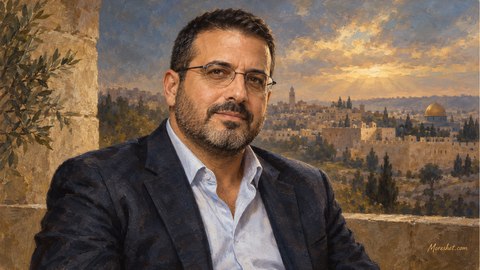
Aryeh Shenkar
A pioneer of textile manufacturing in Palestine and founder of Israel’s Manufacturers Association
Aryeh Shenkar (1877–October 3, 1959) was an industrialist, Zionist entrepreneur, and a formative figure in the development of organized industry in the Land of Israel. By turning the Lodzia textile factory into a major enterprise and founding the Association of Industrialists in the Land of Israel, he helped create more than a successful business. He helped establish the economic, employment, and organizational foundations of the Jewish community that was taking shape in Palestine.
Family background and early Zionist activity
Shenkar was born in 1877 near Prohobisht, in the Vinnytsia region of Ukraine, into a Hasidic family. His father, Bentsion, was associated with the Ruzhiner Hasidic tradition, and the family belonged to the religious and communal world of Eastern European Jewry. As a young man, Shenkar was active in Zionist organizations in his hometown. That experience connected his Jewish identity with a practical understanding of national renewal: building not only a political vision, but also the workplaces, enterprises, and institutions required to sustain an independent society.
Building a textile industry in the Land of Israel
Shenkar immigrated to the Land of Israel from Russia in 1924. At the time, the country’s industrial base was small, while private entrepreneurs had to work with limited capital, infrastructure, and local demand. Shenkar chose to invest in manufacturing. In 1925, he purchased the Lodzia House at 43 Nachmani Street in Tel Aviv and developed it into a successful textile factory.
The factory demonstrated that Jewish enterprise in Palestine could move beyond small-scale workshops and create production with a substantial commercial reach. In 1935, Lodzia was relocated to the Agrobank neighborhood, later incorporated into Holon. There it became one of the most prominent factories in Mandatory Palestine and employed hundreds of workers. Its products were shipped to markets in Asia and Europe. For an economy developing within a small domestic market and under difficult infrastructural conditions, this international reach was an important achievement.
The factory also influenced the growth of urban communities. Following Lodzia’s relocation, Shenkar’s nephew, Bentsion Shenkar, moved with his family to Holon and later became one of the city’s founders. Aryeh Shenkar’s industrial work was therefore connected not only to manufacturing, but also to the emergence of new residential and civic communities.
Founding an industrial organization
Shenkar understood that industry could not develop for long through isolated enterprises alone. He established the Association of Industrialists in the Land of Israel, later known as the Manufacturers Association of Israel, and served as its first president. The organization gave industrialists a shared framework for representation, cooperation, and discussion of the needs of a sector still in its formative years.
His contribution consequently extended beyond the success of Lodzia. Shenkar helped lay the institutional foundations for an organization that represented industry before the public, workers, and national institutions. His approach to business was practical and independent, emphasizing production and the strengthening of the Yishuv’s economic base. In the 1930s, he also spoke against the Syrian boycott of products made by the Jewish community in Palestine. He worked with Meir Dizengoff on the economic development of Tel Aviv, linking private enterprise with the growth of the country’s leading urban center.
Legacy and commemoration
Shenkar died in Tel Aviv in 1959 and was buried in the Trumpeldor Cemetery. His name remained associated with places and institutions that express the importance of industry, professional education, and innovation in Israel. The Kiryat Aryeh industrial zone in western Petah Tikva, as well as a street within it, were named after him. In 1970, Shenkar College of Engineering and Design was established in Ramat Gan in his honor, connecting his industrial legacy with the education of engineers, designers, and other professionals.
A building of the Faculty of Physics and Chemistry at Tel Aviv University was also named for him, as were streets in the Haifa Bay area, Holon, and Herzliya Pituach. Since 1980, the Manufacturers Association has awarded the Aryeh Shenkar Industry Award to veteran industrialists in recognition of their contributions to the development of industry in Israel. These memorials do more than preserve the name of one entrepreneur. They acknowledge the role of factories, professional training, and business leadership in building Israeli society.
Why Aryeh Shenkar belongs in Moreshet
Aryeh Shenkar merits inclusion in Moreshet because he turned Zionist aspiration into practical economic construction. He built an industrial enterprise, created employment, expanded the reach of locally manufactured goods, and helped establish a national organization representing Israeli industry. Lodzia offered tangible evidence that the Jewish community in the Land of Israel could manufacture, employ, and trade on a scale extending beyond its immediate local market.
His influence can also be seen in the generations and institutions that followed: in Holon’s development around residential and industrial communities, in the continuing work of the Manufacturers Association, and in Shenkar’s role in educating engineers and designers. His story therefore belongs not only to the biography of an individual industrialist, but also to the wider history of Jewish economic institution-building and Israel’s practical independence. Moreshet.com preserves this legacy for readers in Israel and around the world, remembering a person who transformed a Zionist vision into factories, livelihoods, and institutions with an enduring public impact.