Aryeh Makhlouf Deri
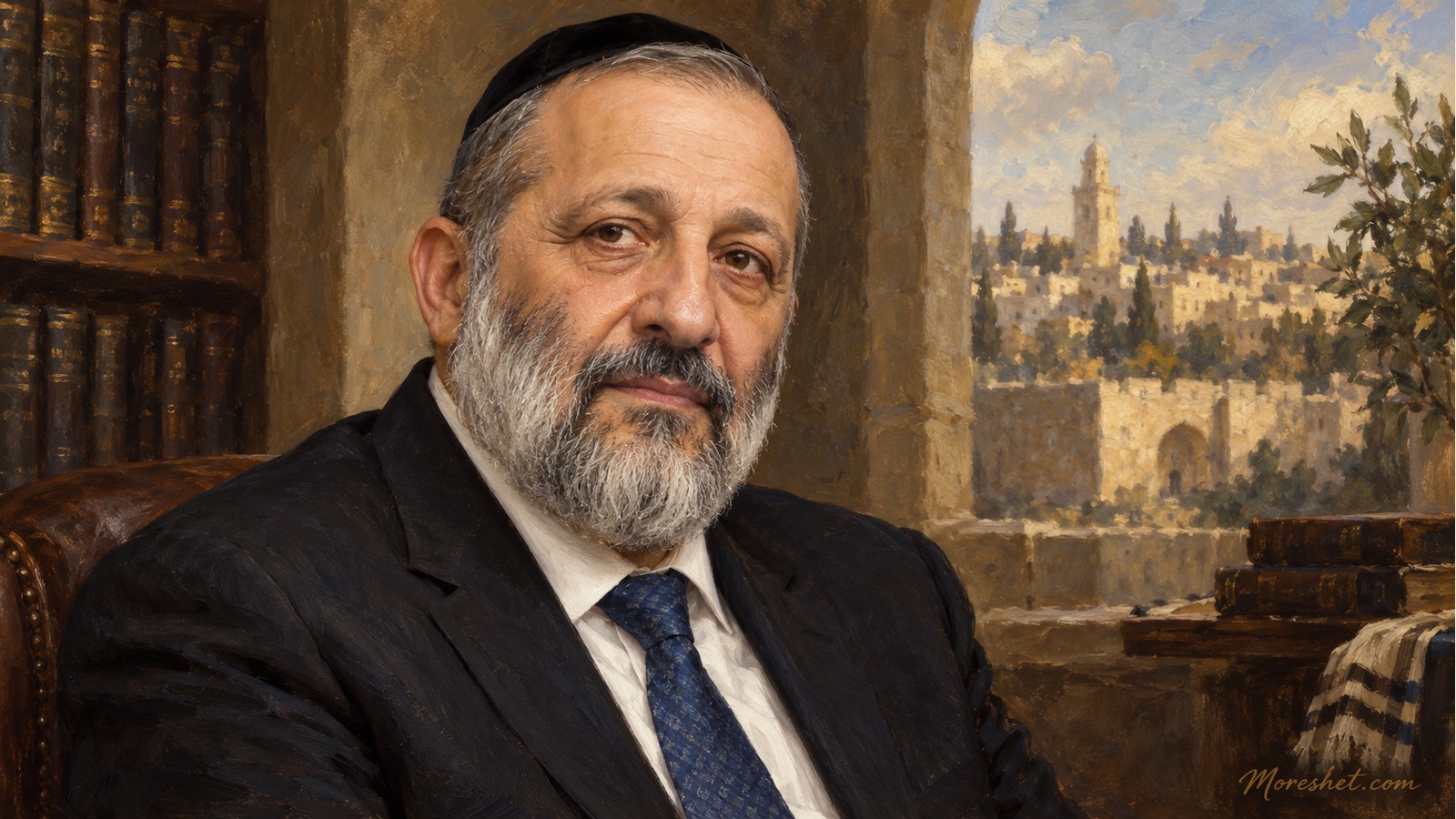
Aryeh Deri — AI-generated artistic portrait · Moreshet.com 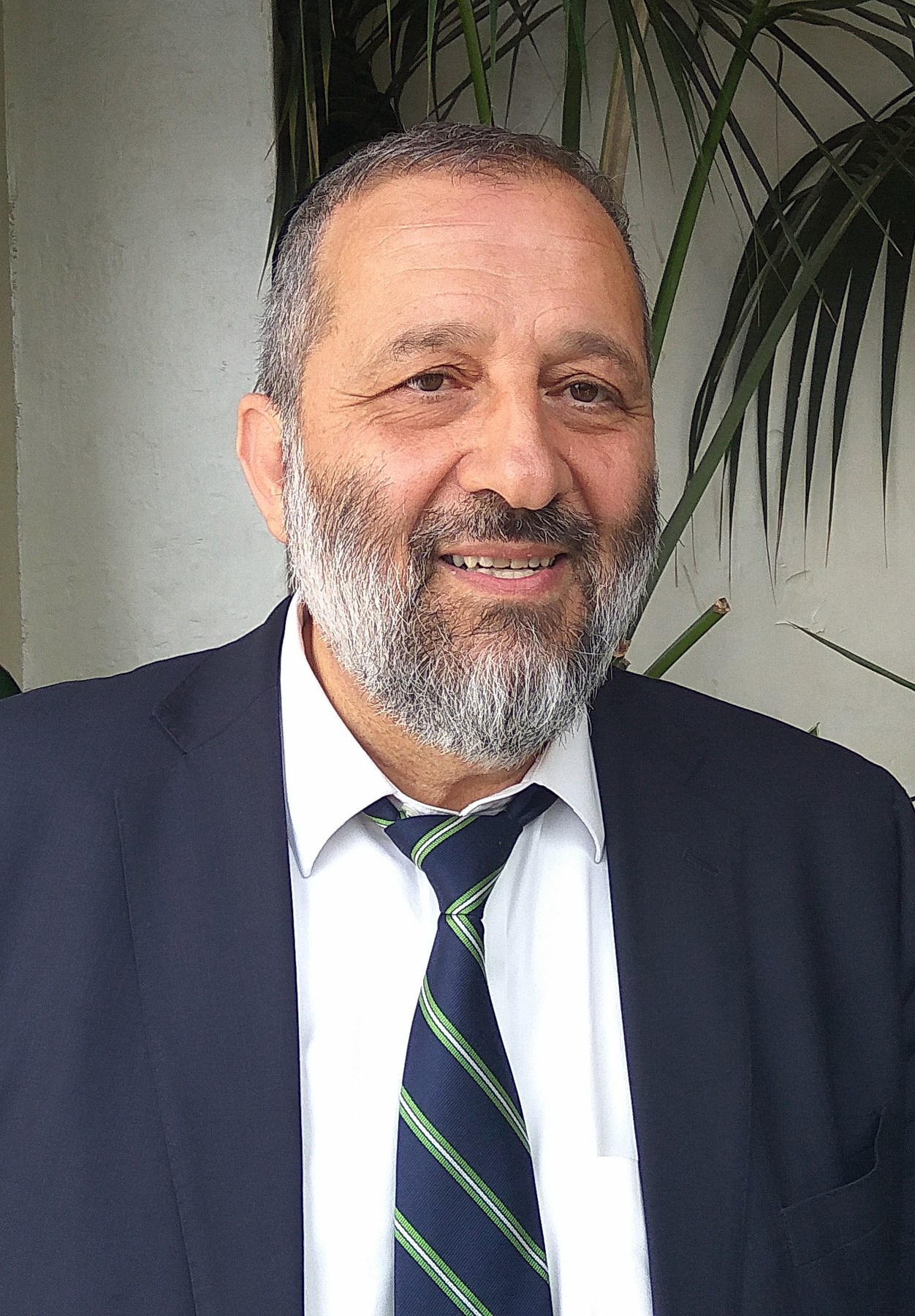
Aryeh Deri. Photograph by רווח הפקות ©, via Wikimedia Commons (CC BY-SA 3.0).
Israeli politician, Shas co-founder and longtime leader, and a central figure in Sephardi-Mizrahi ultra-Orthodox representation in Israeli politics
Aryeh Makhlouf Deri is an Israeli politician, co-founder of the Shas movement, chairman of the party and one of the most influential figures in the history of Sephardi, Mizrahi and ultra-Orthodox politics in Israel. Since the 1980s, he has stood at the center of the intersection among religion, ethnicity, welfare, coalition politics, educational institutions, local authorities and identity struggles in Israeli society. Deri has served as a member of Knesset, Minister of Interior, Minister of Economy, Minister for the Development of the Negev and Galilee, Minister of Health and Vice Prime Minister, and for decades has been considered one of the key figures in forming governments and negotiating coalitions.
Deri’s importance does not come only from his official offices. He was among the people who turned Shas from a new party of Sephardi Torah scholars into a national political, social and religious movement with deep influence. Shas gave political voice to many publics that felt excluded from Israel’s older centers of power: Sephardi Haredim, traditional Mizrahi voters, families in the periphery, immigrant communities and supporters who saw the movement as a framework of identity, dignity, education, charity and welfare. Deri, whether viewed positively or critically, became one of the clearest symbols of the Mizrahi-Haredi transformation in Israeli politics.
Childhood in Meknes, aliyah to Israel and Torah education
Deri was born in Meknes, Morocco, on February 17, 1959, as Aryeh Makhlouf Deri, to Eliyahu and Esther Azougi Deri. His family belonged to traditional Moroccan Jewry, and he began his education at Ozar Hatorah, a school combining religious and general studies. His early childhood was shaped inside a Moroccan Jewish world in which tradition, family, community, French, Moroccan Arabic and Jewish identity existed together.
In 1968, when he was nine, his family immigrated to Israel and settled in Bat Yam. The move from Morocco to Israel was not only geographic; it was a meeting with new social hierarchies, cultural gaps, absorption difficulties and the need to find a place in an Israeli society that had already built Ashkenazi, secular and state-oriented centers of power. Deri was sent to religious and Haredi educational frameworks and later studied at Porat Yosef and Hebron Yeshivas, important institutions in the Sephardi and Lithuanian-Haredi Torah worlds.
This biography became inseparable from his public message. Deri did not enter politics merely as an individual, but as a representative of a generation: children who came from the lands of Islam, entered Haredi educational institutions, experienced the tension between Mizrahi tradition and Israeli power centers, and sought to build a new political language of dignity, Torah, identity and budgets.
Early public work and the founding of Shas
After yeshiva, Deri began public and organizational work. He served as secretary of the Haredi settlement of Ma’ale Amos and as a member of the Gush Etzion Regional Council, and was later appointed administrative manager of the Lev Banim Yeshiva. Already at that stage he stood out as someone who understood organization, budgets, institutional relationships, management and public mechanisms.
In 1984, with the founding of Shas, Deri served as secretary to the movement’s Council of Torah Sages. The following year he was an assistant to Interior Minister Rabbi Yitzhak Peretz, and by the end of 1985 he had been appointed secretary-general of Shas. These roles placed him at a sensitive crossroads: rabbis, yeshivas and Torah institutions on one side; politics, government, budgets, local authorities and state machinery on the other.
Shas was born from a sense of double exclusion: Mizrahi exclusion within general Israeli society, and Sephardi exclusion within an ultra-Orthodox world largely dominated by Ashkenazi institutions. Deri understood that grievance and translated it into effective political language. Under his practical leadership, alongside the spiritual leadership of Rabbi Ovadia Yosef, Shas became a movement that offered not only a vote at the ballot box, but a political, educational and social home.
The youngest interior minister in Israeli history
After the 1988 election for the twelfth Knesset, Deri was appointed Minister of Interior in the government of Yitzhak Shamir. He was only 29, making him the youngest cabinet minister in Israel’s history. The appointment itself was dramatic: a young Moroccan-born Haredi, born outside Israel and educated in Torah institutions, entered one of the most important ministries in the state, responsible for local government, population registry, municipal budgets and foundational questions of civic identity.
As interior minister, Deri received broad public coverage unusual for a Haredi politician at the time. He was seen as young, brilliant, fast, sharp and deeply connected to the political system. One action associated with his early tenure was the abolition of censorship of theater plays, a step showing his ability to act even in areas not directly connected to the Haredi world.
In this office he also built his reputation as a coalition operator. During the 1990 political crisis known in Israel as the “dirty trick,” Deri was involved in contacts to create a Labor-Haredi government. The move failed after sharp rabbinic and political opposition, but it already showed Deri’s role as a player who could move between camps, negotiate and understand how a relatively small party could become a balance of power.
Shas as a movement of Torah, welfare and Mizrahi identity
Shas’s major achievement during Deri’s era was the construction of a social and cultural infrastructure touching the daily life of a broad public. The movement built and expanded educational networks, Torah institutions, charity systems, local political activity and a national political apparatus. In the eyes of its supporters, it restored dignity to Sephardi-Mizrahi tradition and proved that a public pushed to the margins could build organized power inside the state.
Deri was one of the central formulators of that language. He presented Shas as a movement of “restoring the crown to its former glory,” but also as a social movement seeking to help weaker families, students, the elderly, peripheral towns and those later described as “the invisible.” That phrase mattered because it described not only economic poverty, but also a feeling of social erasure: people living in Israel but not feeling seen by the political, legal, cultural and media elites.
Through Shas, Deri turned religious-ethnic politics into institutional power. He did not operate only on the margins or in protest, but inside governments, budgets, committees, coalition agreements and ministries. In doing so, the place of the Sephardi-Haredi public in Israel changed: from dependence on other parties to independent representation with real bargaining power.
Law, convictions and public controversy
Alongside his political rise, Deri’s legal case became one of the defining episodes in the relationship among law, politics, ethnicity and public trust in Israel. In 1993 he was indicted, and in 1999 the Jerusalem District Court convicted him of bribery, fraud, breach of trust and obtaining something by fraud under aggravated circumstances. The Supreme Court later accepted part of his appeal and reduced his sentence, but the conviction remained. Deri served a prison term and was released in 2002.
For many of his supporters, the trial and imprisonment were seen as part of the persecution of an old elite against a Mizrahi-Haredi leader who had risen too quickly and redistributed power and budgets. For his critics, the convictions were grave evidence of governmental corruption and a breach of public trust. These two perceptions have accompanied Deri for decades and made him a focus of deep disagreement.
In 2003 Deri was also convicted of one count of breach of trust in a separate case, and in 2022 he was convicted of tax offenses under a plea agreement, fined and given a suspended sentence. After his return to government in 2022 as Interior Minister, Health Minister and Vice Prime Minister, Israel’s Supreme Court ruled in January 2023 that his ministerial appointment was extremely unreasonable because of his criminal record and the representations made in the plea agreement. Following the ruling, he was dismissed from his ministerial posts.
The legal chapters are not a side detail in his story; they are part of the historical record of his public life. Yet they do not alone explain his influence. The fact that Deri returned to the leadership of Shas after prison and convictions reveals the strength of the bond between him and his supporters, the weight of group identity in Israeli politics, and the deep gap between communal trust and institutional trust.
Return to politics and renewed Shas leadership
After his release from prison, Deri spent a period away from formal politics, worked in consulting and gradually sought to return to public life. Ahead of the election for the nineteenth Knesset, he was brought back into Shas leadership, and in 2013 he was again appointed chairman of the movement. His return came amid internal rivalry with Eli Yishai and after the death of Rabbi Ovadia Yosef, an event that profoundly shaped the movement.
Leading Shas after Rabbi Ovadia Yosef required Deri to play a different role from the one he had filled in the 1980s and 1990s. Previously he had been the political executor of an enormous spiritual authority. Now he had to preserve the cohesion of the movement, the loyalty of its voters, the standing of the Council of Torah Sages and Shas’s bargaining power inside a much more polarized Israeli politics.
In the 2015 election he led a campaign based on Mizrahi identity and the concept of the “invisible.” He later continued to lead Shas as part of the right-wing camp and the bloc supporting Benjamin Netanyahu. Across the repeated elections of 2019–2022, Shas maintained relatively stable electoral strength, reinforcing Deri’s status as one of the most durable political figures in Israel.
Ministerial roles, the periphery and local government
Upon returning to government in 2015, Deri was appointed Minister of Economy and Minister for the Development of the Negev and Galilee. He later resigned from the Economy Ministry around the natural-gas framework issue, but continued to serve in major government positions. In 2016 he was again appointed Minister of Interior, returning to the ministry where his political rise had begun in the 1980s.
In his later ministerial terms, Deri dealt with areas directly connected to Shas voters and local authorities: peripheral budgets, subsidized summer camps, public transportation, municipal services, support for weaker populations, relations with Arab and Haredi local authorities, and emergencies such as the coronavirus pandemic. In April 2020 he was appointed to coordinate the response to coronavirus outbreaks in the Haredi and Arab sectors, a field requiring familiarity with communities that sometimes struggle to trust general state instructions.
His work as interior minister repeatedly connected him to local government. In Israel, the Interior Ministry is one of the ministries through which the state touches daily life: municipalities, councils, budgets, municipal boundaries, civil identity and basic services. For Deri, it was both an instrument of public representation and a political lever.
Religion, military service, coalitions and the State of Israel
As one of the leaders of the Haredi parties, Deri has long stood at the center of debates over religion and state. Questions of Shabbat, conversion, yeshiva budgets, Haredi education, the rabbinate, military service for yeshiva students and welfare allowances are not merely technical issues for Shas; they are part of a worldview in which Torah, tradition and the Sephardi-Haredi community are basic components of the Jewish identity of the state.
The issue of military service for yeshiva students became one of the most acute questions of the twenty-fifth Knesset, especially after October 7 and the Swords of Iron War. Deri worked to advance an arrangement that would preserve the status of Torah learners, presenting it as a religious and public obligation toward the yeshiva world. Many other parts of Israeli society saw the matter very differently, as an intolerable gap between the burden of war and long-standing exemption from military service. The dispute shows the place where Deri operates: between loyalty to a Haredi public and a state in deep security and social crisis.
At the coalition level, Deri has long been considered one of Israel’s most experienced and effective negotiators. He knows how to speak with right and left, religious and secular Israelis, Haredim and traditional voters, government figures and local leaders. Even when he does not hold a formal ministerial office, his influence comes from experience, relationships, party power and deep understanding of coalition structure.
The Swords of Iron War and informal security influence
After the Hamas attack of October 7, 2023 and the Swords of Iron War, Deri served as an observer in the war cabinet and later remained involved in smaller security and diplomatic forums. That status was unusual: a Haredi party leader, not serving as a minister after the Supreme Court ruling, participating in sensitive security discussions because of political trust and coalition experience.
This fact illustrates his distinctive place in the system. Deri is not a military officer or professional diplomat, but prime ministers and political partners have viewed him as someone with judgment, political understanding and an ability to balance public, religious and coalition considerations. Even many critics recognize him as one of the most experienced people in Israeli politics.
During the same period, the disputes around him sharpened, especially over the draft issue, Shas’s role in the coalition and the balance between security needs and protection of the yeshiva world. This chapter shows that Deri’s public life does not belong only to the earlier history of Shas; it remains part of Israel’s largest decisions in an era of war, polarization and crisis of trust.
Family, language and personal identity
Deri has been married to Yaffa Cohen since 1981, and the couple has nine children. The family lives in Jerusalem. Yaffa Deri founded the social-assistance organization Mifalot Simcha, and additional family members have been involved in public, educational and communal activity.
Deri speaks Hebrew, Moroccan Arabic and French, reflecting the worlds of identity in which he grew: Moroccan Jewry, Israeliness, Haredi life, Sephardi tradition, Hebrew politics and connection to a wide public of immigrants and peripheral communities. His brother Rabbi Yehuda Deri served as chief rabbi and head of the rabbinical court of Beersheba, linking the family also to Israel’s rabbinic establishment.
Deri’s personal identity is built from gaps and tensions: yeshiva student and politician, Haredi leader and coalition operator, Mizrahi figure from the social periphery and one of the most connected people in the centers of power, a man who carried a banner of exclusion and repair alongside criminal convictions that became an inseparable part of the public record. Precisely this complexity explains why he is historically important.
Editorial note on inclusion
Aryeh Deri is included on the site even though this person and their public record are controversial among broad sections of the public. Inclusion does not determine whether the influence is positive or negative; it reflects the significant place this figure holds in shaping the lived experience, culture and way of life of the public. Naturally, some regard this activity as positive and even heroic, while others see it as contrary to their worldview. The very existence of opposing assessments is part of the historical record that justifies including this significant and influential figure in the heritage of the Jewish people.
Why this legacy belongs in Moreshet
Aryeh Makhlouf Deri merits inclusion in Moreshet because his story connects immigration from Morocco, Torah education, Mizrahi identity, the founding of Shas, political representation of the Sephardi-Haredi public, a struggle over social dignity, welfare, religion and state, Israeli coalitions and deep legal and public controversy. He is one of the figures without whom it is difficult to understand Israeli politics since the 1980s and the place occupied within it by tradition, ethnicity, Torah and the periphery.
Moreshet.com documents Deri because Jewish and Israeli heritage includes not only consensual leaders or figures without controversy, but also people who actually shaped institutions, communities, identities and systems of power. Aryeh Deri’s place in Moreshet rests on the way he helped turn the Sephardi-Haredi and Mizrahi public into an organized political force, on his influence over welfare policy, religion and local government, and on the fact that his story reflects one of the central tensions of the State of Israel: the attempt to combine tradition, social justice, ethnic representation, rule of law and public responsibility inside one democratic system.