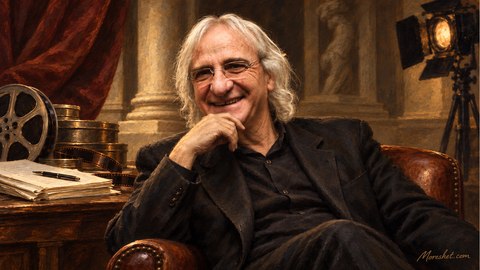
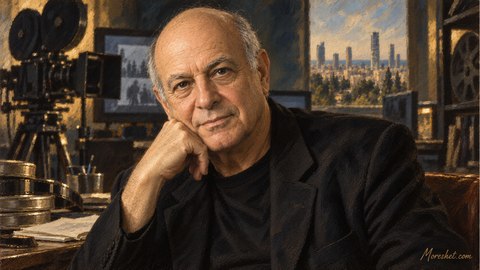
Aharon Goldfinger
A pioneering producer and format creator who helped shape Israeli television, public broadcasting and cultural conversation
Aharon “Araleh” Goldfinger, born on July 12, 1944, is one of the important producers in the history of Israeli television and film. Over more than five decades, he helped establish Israeli television, produced national and international broadcasts, created entertainment and current-affairs programs, and developed formats that influenced how Israelis experienced culture, news and public debate.
His work can be seen both in landmark broadcasts that became part of the country’s shared memory—among them the first broadcast of Israel’s Channel One and the Eurovision Song Contest from Jerusalem—and in weekly programs that became part of family life. Goldfinger brought together journalism, entertainment, music, politics and demanding live production, helping transform television from a new medium into a central cultural institution in Israeli society.
From Immigration to Film Production
Goldfinger was born and raised in Kraków, Poland, the son of Shaul and Rachel and the brother of Nili Harkavi-Goldfinger. He immigrated to Israel in 1950. At the age of 16, he went to study in London; after completing his studies, he enlisted in the Israel Defense Forces and served in the Artillery Corps. He later trained at a school of photography and cinema in Jerusalem, gaining a practical understanding of both visual storytelling and production.
His first significant entry into the industry came through the Hollywood production Cast a Giant Shadow, starring Kirk Douglas, Frank Sinatra and Senta Berger. The film was shot largely in Israel, and during the production Goldfinger was asked to assist the crew. His abilities were recognized, and he was invited to work on additional productions. He subsequently produced Blazing Waters, Just Today, starring Ze'ev Revach, and Shoe Compote. This early film experience prepared him for large-scale work at a time when Israel’s broadcast industry was still being built.
Building Israeli Television
At the end of the 1960s, Goldfinger joined the team that established Israeli television, later known as Channel One. He participated in the station’s first broadcast: a live transmission of the Israel Defense Forces parade on Israel’s twentieth Independence Day in May 1968. He was therefore present at the moment when television entered the center of Israel’s public and family life.
Goldfinger went on to produce and edit national broadcasts and special events, including Independence Day programs, the Maccabiah Games and coverage of Egyptian President Anwar Sadat’s historic visit to Israel. These were not merely technical productions. For viewers across the country, the broadcast was a way to experience together events that shaped Israel’s identity and its relationship with the wider world.
He also served as studio manager for Mabat Rishon and initiated, edited or produced hundreds of broadcasts in news, current affairs, sports and entertainment. His work connected producers, directors, editors, presenters, performers and technical crews, helping establish a professional culture of live broadcasting and studio production in Israel.
Programs That Became Part of Israeli Culture
Goldfinger was behind some of the best-known entertainment and talk programs of Israeli television’s formative years. He produced Sha'ah Tova, hosted by Meni Pe'er and Meir Shalev, which aired from 1979 to 1984, and Weekend with Yaron London. He was also the producer of the flagship talk and entertainment program Siba LaMesiba, featuring Meni Pe'er, Gidi Gov, Eli Goralitzky, Sefi Rivlin, Dudu Dotan and Rivka Michaeli, along with a satirical segment by Shlomo Nitzan.
These programs created a shared space for viewers throughout Israel. They combined interviews, music, humor and satire, bringing a wide range of artists and voices into the national living room. The Closed Wing, written by Ephraim Sidon and featuring Tuvia Tzafir, Osnat Vishinsky, Rivka Michaeli and others, also contributed to the development of Israeli television satire.
At the same time, Goldfinger worked on musical productions with leading Israeli artists, including Shalom Hanoch, Yehudit Ravitz, Shlomo Artzi, Arik Einstein and Naomi Shemer. These collaborations strengthened the connection between television and Israeli music, giving major performers and songs a broad national platform.
Popolitika and the Public Arena
One of Goldfinger’s most distinctive contributions was the conception and production of Popolitika, hosted by Dan Margalit. The program brought a changing panel of speakers with differing political and social views into the studio. Participants included Tommy Lapid, Amnon Dankner and Israel Eichler, and the format combined political discussion with live musical performances.
The innovation of Popolitika lay in presenting public disagreement as a live, accessible and dynamic television event. Rather than simply reporting on politics, the program made argument and encounter between different groups in Israeli society central elements of the broadcast. Its format influenced the language of Israeli current affairs and the way later programs used panels, interviews, confrontation and real-time response.
Goldfinger was also associated with the creation and production of other political and current-affairs programs, including Mishal Ham, hosted by Nissim Mishal; The Cabinet with Dana Weiss; Politika with Yaakov Ahimeir; and Mo'etzet HaHakhamim and HaMateh HaMerkazi with Nadav Perry. Together, these programs reflect his ability to adapt production to a changing media landscape and to create new settings for public conversation.
Documentary Film, International Events and a Full Circle
Goldfinger also produced documentary films, including Yoel, Israel and the Pashkvils, directed by Lina Chaplin, and Achziv State—A Place of Love, directed by Eti Wizeltir. Broadcast on Channel 8, the films expanded television’s engagement with distinctive people, places and stories in Israeli society.
In 1999, Goldfinger produced and edited the Eurovision Song Contest broadcast from Jerusalem. According to the supplied biographical material, the European Broadcasting Union described the broadcast as the most beautiful transmission of that year. The production demonstrated Israel’s ability to present a complex international television event while also showcasing Jerusalem and local culture to a worldwide audience.
Goldfinger left the Israel Broadcasting Authority in 2006 and continued producing films and programs for Channel 8, Channel 10, Channel 2 and Channel One. In 2017, 49 years after participating in the opening of Channel One’s broadcasts, he produced Siba LaMesiba with Rivka Michaeli—the final program broadcast on Channel One before the closure of the Israel Broadcasting Authority. The moment completed an extraordinary professional circle, from the institution’s first broadcast to its last.
Public Cultural Service and Professional Recognition
Alongside his production career, Goldfinger took part in Israel’s public cultural life. He served on the interdisciplinary section of the Israel Council for Culture and Arts, on the executive board of Musrara, the Naggar Multidisciplinary School of Art and Society in Jerusalem, and on the executive board of the Interdisciplinary Arena. He also served on Jerusalem municipal culture committees and is a member of the Israeli Academy of Film and Television.
Goldfinger received the David’s Violin Award twice. The supplied source material also states that he received a commendation connected with the Rose d’Or for producing Tuvia on the Roof at an international television-program competition held in Montreux, Switzerland, in 1992, and that he received an Israel Prize from the Jewish Agency for special broadcasts intended to bring different sectors of Israeli society closer together. The precise details of these awards, especially the international recognition, should still be checked against primary institutional or journalistic sources.
Why Aharon Goldfinger’s Legacy Belongs in Moreshet
Aharon Goldfinger merits inclusion in Moreshet because his work stood at the meeting point of communication, culture and public life in Israel. He did more than produce successful programs: he helped build Israeli television, turned national broadcasts into shared experiences, gave Israeli music and satire a national platform, and developed formats that changed the country’s current-affairs conversation.
His influence can be traced through the institutions and people with whom he worked and through the broad audiences that encountered his productions over several decades. Programs such as Siba LaMesiba, Sha'ah Tova and Popolitika document important chapters in the development of Israeli culture, while his national broadcasts and the Eurovision production in Jerusalem demonstrate how television production can shape public memory and represent Israel abroad. For these reasons, Moreshet.com preserves Goldfinger’s story as part of the larger history of Israeli media, culture and society.