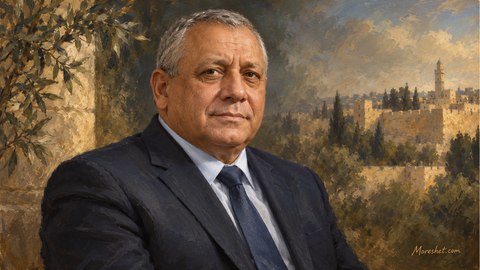
Avraham Yair Stern
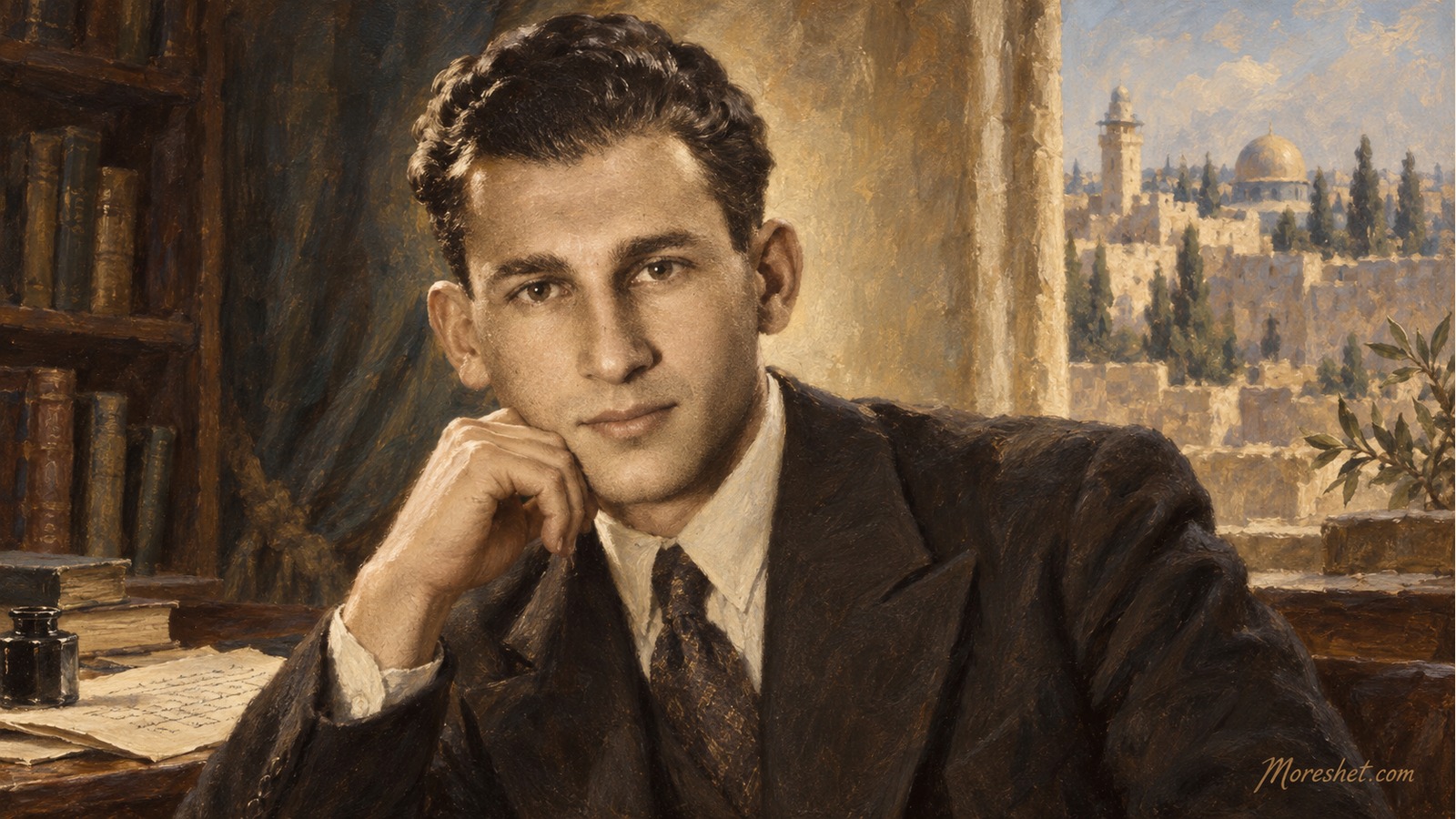
Abraham Stern — AI-generated artistic portrait · Moreshet.com
Jewish underground fighter, Hebrew poet and founder of Lehi, one of the most radical and consequential figures in the struggle against British Mandatory rule in Palestine
Avraham Yair Stern, known by his underground name Yair, was a Jewish underground fighter, Hebrew poet, radical Zionist ideologue and the founder of Lohamei Herut Israel, Lehi. Born in Suwałki in Russian Poland in 1907, he immigrated to Mandatory Palestine in 1925, studied at the Hebrew University in Jerusalem, was active first in the Haganah and later in the Irgun, and in 1940 led the group that broke away to form a new underground committed to continuing the struggle against British rule even during the Second World War.
Stern was one of the most charged and dramatic figures in the history of the Yishuv. On one side, he was a powerful Hebrew poet, an outstanding student and a man with an uncompromising vision of full Hebrew sovereignty. On the other, his underground path was radical, violent and sharply disputed even within the Jewish community itself. His historical importance does not rest on broad agreement with all his actions, but on his influence in shaping a distinctive underground current in the struggle for independence, on ideas of freedom and sovereignty among parts of the national movement, and on the later memory of Lehi in the State of Israel.
Childhood in Suwałki and the First World War
Avraham Stern was born on December 23, 1907, in Suwałki, then in the Russian Empire and today in Poland. His father, Mordechai Stern, was a dentist, and his mother, Hadassah-Leah, was a midwife and the daughter of Raphael Grushkin-Lifshitz, one of the Jewish maskilim of Lithuania. The Stern home was secular, Jewish and educated, with learning, language and culture at its center. Avraham had a younger brother, David, and the two grew up in an Eastern European Jewish world in which education, nationalism and questions of identity were part of public life.
When the First World War began, Suwałki was occupied by the Germans. Stern’s father was arrested, and his mother fled with her sons into Russia, to her sister’s home in Saransk. A childhood broken by war, displacement and separation from home left him with an intense sense of existence. From a young age he learned to adapt to hardship, distance and insecurity, experiences that later shaped him as a man who did not see exile as a tolerable or stable condition.
In Saransk he studied at a Russian gymnasium and did well academically. At the same time, he received private Hebrew lessons and maintained a connection to Jewish and national culture. After the war his mother returned to Suwałki with David, while Avraham remained for a time with his aunt in order to complete his studies. After the Bolshevik Revolution he decided to return to his family, continued his studies at the Hebrew gymnasium in Suwałki, and was influenced by Polish Romantic literature and the national atmosphere surrounding the younger generation.
Aliyah and the Hebrew University
In 1925, at the age of eighteen, Stern immigrated to the Land of Israel. He completed his studies at the Hebrew Gymnasium in Jerusalem and then studied in the humanities faculty of the Hebrew University on Mount Scopus. At the university he became known as an outstanding student, with strong linguistic and artistic talents in recitation, writing, acting and drawing. He was drawn to the classical world, Hebrew literature and national ideas, while supporting himself through scholarships and private lessons.
Stern was not only a student. He quickly entered the political and security life of Jerusalem. During the 1929 riots in Palestine, when Jewish communities were attacked, he served in the Haganah and stood guard on the roof of a synagogue in the Old City. That experience strengthened his conviction that Jewish sovereignty would not be achieved only through public institutions or diplomacy, but would require independent Hebrew force.
In those years Stern founded the student association Hulda, named for the Jewish settlement and its defenders during the 1929 violence. The association’s regulations expressed a commitment to the revival of the Hebrew nation and to a new Hebrew state. Already at this stage the main axis of his life was visible: the combination of higher education, poetry, Hebrew culture and underground military thought.
Poet of underground and freedom
Stern wrote dozens of poems of homeland, love, death, sacrifice and struggle. His poetry was not a decorative addition to his biography; it was part of the way he understood himself and his role. He wrote in a language of national pathos, romantic sacrifice and total Hebrew vision, in which the unknown soldier seeks no fame but is ready to disappear underground for the rebirth of the land.
His best-known poem, Unknown Soldiers, was written after the events of 1929 and became first the anthem of the Irgun and later the anthem of Lehi. The poem expressed the image of fighters without uniforms and without official recognition, enlisted for life in a national mission from which only death releases them. In its severe language, the song shaped the self-image of the underground: small, pursued, secret and ready to die for the freedom of Israel.
In 1933 Stern completed a master’s degree at the Hebrew University and received a scholarship for doctoral study at the University of Florence in Italy, on eros in ancient Greek literature. His stay in Italy was short but significant: he pursued classical research and also edited his poems. Ultimately he gave up a promising academic path when called back to underground work. In doing so, he chose political and military struggle over a career as scholar and poet alone.
From the Haganah to the Irgun
During his activity in Jerusalem, Stern became close to David Raziel, despite the difference in their backgrounds. Both first served in the Haganah under Avraham Tehomi and Avraham Kritchbersky. When Tehomi broke from the Haganah and formed Haganah Bet, which later became the Irgun Zvai Leumi, Raziel and Stern joined him. In their view, the Jewish national movement needed an independent fighting force, not subject to the labor movement and not limited to defensive restraint.
In the Irgun, Stern became a central figure during the 1930s. He took part in ideological work, writing, organization and operational logistics. In 1934, he was summoned back from Florence by Avraham Tehomi to work on arms procurement in Poland and the transfer of weapons to Palestine. Stern accepted the mission, effectively abandoned his doctoral career and committed himself fully to the underground.
The Arab revolt of 1936–1939 sharpened disputes inside the Irgun and between the Irgun and other Zionist leaderships. Stern believed that a Hebrew state would not arise without an independent national military force and without direct action against foreign rule. This position put him on a collision course with those who believed that the British struggle against Nazi Germany required temporary Jewish cooperation with Britain.
The mission to Poland and the Forty Thousand plan
During the 1930s Stern traveled to Poland as an Irgun emissary, seeking to build a broad infrastructure of trained Jewish fighters. He worked to establish secret cells, arrange military training under Polish officers, acquire weapons and smuggle them to Palestine. His major plan, known as the “Forty Thousand” plan, imagined a trained Jewish force that would sail to Palestine and launch a war of liberation against the British.
The plan was bold and nearly impossible, but it reveals Stern’s worldview. He did not see Zionism only as gradual immigration and settlement, but as an organized national revolt. In his eyes, the Jews of Europe should not remain a defenseless public, but become an independent Hebrew fighting force. Prewar Poland appeared to him as a place from which people, weapons and training could be mobilized for the coming struggle in Palestine.
The German invasion of Poland and the outbreak of the Second World War ended the effort. Immigration routes were cut, training stopped, and European Jewry entered a catastrophe that could no longer be shaped through underground plans. Stern was in Palestine at the time and was arrested with the Irgun high command on the night the war began.
The Second World War and the split from the Irgun
The outbreak of the Second World War created a severe crisis inside the Irgun. David Raziel and Ze’ev Jabotinsky supported suspending operations against the British and joining the war effort against Nazi Germany. Stern fiercely opposed this. He believed that Britain, which ruled Palestine and restricted Jewish immigration through the 1939 White Paper, remained the direct enemy of Hebrew independence even while fighting the Nazis.
After his release from detention in 1940, Stern led a group that broke away from the Irgun. The group formed a new organization, later named Lohamei Herut Israel, Lehi. The split was not merely organizational but moral and strategic: should the anti-British struggle stop during the world war in order not to undermine the fight against Nazism, or should British rule still be treated as the immediate obstacle to Jewish sovereignty and Jewish rescue?
Stern’s choice isolated him from the mainstream of the Yishuv, from the Haganah, the Jewish Agency and most of the Revisionist movement as well. To many in the Jewish community, his position seemed dangerous and reckless; to Stern, it was absolute loyalty to a single goal: removing the British from the Land of Israel and creating an independent Hebrew state.
Principles of Revival and Hebrew sovereignty
Stern formulated Lehi’s program in the document known as Principles of Revival. It presented a broad national vision of Hebrew revival: ingathering of exiles, conquest of the land from foreign rule, Hebrew sovereignty, the building of military power, control over the Land of Israel and the creation of a new national society. Some clauses also included a traditional and symbolic dimension, including reference to the Temple as a symbol of Hebrew independence.
Stern was not religious in the ordinary sense, but he used Jewish, biblical and historical language to give depth to the national struggle. His underground name, Yair, was chosen after Eleazar ben Yair, one of the leaders of the revolt against Rome and commander of the zealots at Masada. The choice shows how he sought to connect the modern underground to an ancient memory of revolt, zealotry and freedom.
Stern’s ideology included elements of extreme nationalism, Hebrew anti-colonialism and a view of the Land of Israel as an indivisible space of sovereignty. It attracted people from different ends of the political spectrum, and later Lehi included figures whose post-independence paths diverged sharply, from nationalist right to peace-oriented left. This shows that Lehi was not only an operational underground, but an unusual ideological focus within the Yishuv.
Controversial contacts with Britain’s enemies
One of the most difficult and charged chapters in Stern’s life was his attempt to establish contact with Britain’s enemies during the Second World War. From his view that Britain was the power that had to be removed from the land, and from the desire to find a force that might assist Jewish immigration from Europe and the establishment of a Jewish state, efforts were made to contact Fascist Italy and Nazi Germany. In January 1941 a document was delivered to the German embassy in Turkey offering political and military cooperation against Britain in return for support for establishing a Jewish state and moving Jews from Europe to Palestine.
The contacts produced no result, and the document remained at the embassy in Ankara and was found after the war. Historically, this chapter placed Stern in sharp opposition to almost all mainstream Zionist currents, including Ze’ev Jabotinsky, who regarded Britain as an opponent in Palestine but demanded Allied victory over the Nazis. The attempt to approach Nazi Germany, even from an extreme anti-British logic and not from identification with Nazism, remains one of the most complex and troubling aspects of Stern’s legacy.
A responsible historical profile should not hide this chapter and should not make it the only center of the person. It reveals Stern’s strategic extremity, political isolation and willingness to seek alliances that the Yishuv regarded as immoral and dangerous. At the same time, his declared purpose remained the creation of independent Hebrew power and the bringing of Jews to Palestine, not participation in Nazi ideology itself.
Lehi under siege
In its first years Lehi was small, pursued and isolated. It lacked money, printing equipment, arms, storage and broad public support. Its members tried to publish underground newspapers, operate clandestine broadcasts, raise funds and carry out actions against British targets. Some actions deteriorated into robberies, shootouts and the killing or wounding of British and Jewish policemen. This intensified both Yishuv opposition and the British manhunt.
Stern moved between safe houses in Tel Aviv and its surroundings, carrying a suitcase and a folding bed. In the suitcase he kept a Bible, a Hebrew dictionary and a few personal items. He continued writing, issuing instructions, encouraging his followers and trying to keep the underground alive even when it seemed close to destruction. He rejected offers to hide until the end of the war, believing that an underground leader could not save himself while his people were being hunted.
By early 1942 the manhunt had tightened. His photograph was published and a financial reward was offered for his capture. Lehi actions, including the operation at 8 Yael Street in which Jewish and British officers serving in the Palestine Police were killed, shocked the public and increased police and communal pressure on the group. Stern found himself nearly cut off, but continued to see the struggle against the British as the mission of his life.
Final days and death in Tel Aviv
During the last three weeks of his life, Stern hid in the apartment of Tova and Moshe Svorai at 8 Mizrahi Bet Street in the Florentin neighborhood of Tel Aviv. Moshe Svorai was himself wanted and wounded, and Tova Svorai risked her life by sheltering Stern. Hisia Shapiro served as his courier and brought him messages. In the apartment Stern wrote, read, formulated ideas and answered letters, knowing that the manhunt was closing in.
On February 12, 1942, British detectives arrived at the apartment. Stern hid in a wardrobe but was discovered during the search. After he was handcuffed and guarded by British policemen, officer Geoffrey Morton arrived. The circumstances of the shooting remain disputed: the British version claimed that Stern tried to escape or endanger the officers, while Lehi members, Tova Svorai and other witnesses claimed that he was shot when he had no ability to flee. In either case, Stern was shot dead at the scene, at the age of 34.
His funeral was held that evening at Nahalat Yitzhak Cemetery, under heavy security and with only a small number of family members present. His death immediately turned him into a mythic figure for Lehi. Several months later his son was born and named Yair after his father’s underground name. Yair Stern later became a senior journalist and television figure, and Stern’s grandson Shay Stern became a media and cultural personality.
Commemoration and influence after death
After Stern’s death, Lehi continued to operate and became one of the underground organizations fighting British rule in Palestine. Later Lehi leaders, including Yitzhak Shamir, Natan Yellin-Mor and Israel Eldad, represented very different political and intellectual paths after the creation of the State of Israel. This reflects the complexity of Stern’s inheritance: not only an organization, but an ideological nucleus that attracted people who understood Hebrew freedom in sharply different ways.
His poems and writings were published after his death, including Book of Poems, In My Blood You Shall Live Forever and Letters to Roni. The poems continued to shape Stern’s image not only as a fighter but as a Hebrew underground poet. The tension between lyricism, love of the land, sacrifice and death remains one of the defining features of his memory.
The State of Israel commemorated Stern in several ways: streets were named after him, the town of Kochav Yair bears his underground name, the safe house where he was killed became the Lehi Museum known as Beit Yair, and in 1978 an Israeli postage stamp was issued in his memory as part of a series marking thirty years of Israel’s independence. Every year, a state memorial ceremony for fallen Lehi members is held near his grave in Nahalat Yitzhak Cemetery.
Why this legacy belongs in Moreshet
Avraham Yair Stern merits inclusion in Moreshet because he embodies a fierce, difficult and influential chapter in the Jewish struggle for sovereignty in the Land of Israel. He was a student, poet, underground fighter and founder of Lehi who turned the idea of Hebrew freedom into an absolute demand against any foreign rule. Even though his path provoked deep opposition and moral and political controversy, the history of the Yishuv, the underground movements and the struggle against the British Mandate cannot be understood without his life and influence.
Moreshet.com documents Stern because Jewish and Israeli heritage includes complex, pursued and controversial figures whose effect on history is measured not only by agreement with them but also by the force of the questions they left behind. Avraham Yair Stern’s place in Moreshet rests on the combination of Hebrew poetry, underground ideology, anti-British struggle, a vision of Jewish sovereignty, the founding of Lehi and the way his memory continued to shape political, cultural and historical currents in the State of Israel.