Samuel Strickman
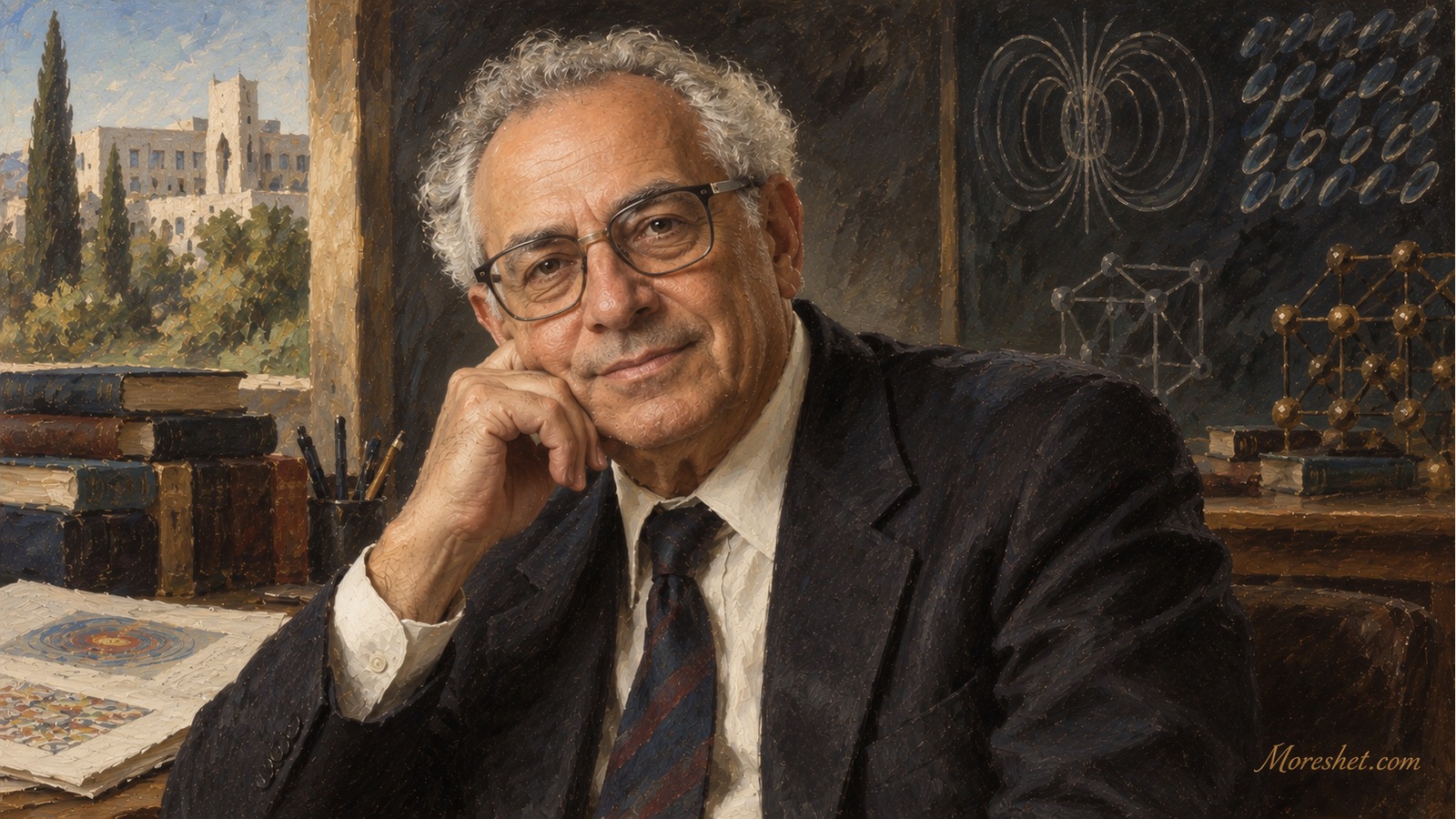
Samuel Strickman — AI-generated artistic portrait · Moreshet.com
Israeli physicist, pioneer in composite-materials research, and Israel Prize laureate
Samuel “Mula” Strickman was an Israeli physicist, a professor at the Weizmann Institute of Science, and a member of the Israel Academy of Sciences and Humanities. His research advanced the understanding of composite materials and contributed to several areas of condensed-matter physics. His technological work also served Israel’s defense system. In 2001, he received the Israel Prize for Physics.
From Poland to Israel’s scientific community
Strickman was born on October 21, 1930, in Brest-Litovsk, Poland, to Avraham and Esther Strickman. His mother was the sister of Pinhas Sapir, one of the central figures in Israel’s economic and industrial development. In 1934, Strickman immigrated to Mandatory Palestine with his family. They first lived in Kfar Saba and moved to Tel Aviv a year later.
During Israel’s War of Independence, he served in the Israel Air Force as a bombardier. That early experience connected him directly with the needs of the young state, a connection that continued through his later technological contributions to Israel’s security.
In 1950, Strickman began studying electronic engineering at the Technion. After completing his studies in 1954, he joined the Electronics Department at the Weizmann Institute of Science, where he carried out his doctoral research. He received his electronic-engineering degree from the Technion in 1958. In 1967, he became a full professor at the Weizmann Institute, and from 1981 to 1982 he headed the institute’s Department of Electronic Physics.
Research in physics and materials science
Strickman’s scientific work covered several important areas. He studied the behavior of particles under the influence of magnetic fields, worked on liquid crystals, and investigated composite materials—materials made from components with different properties and a non-uniform internal structure.
A major part of his work concerned the calculation of the elasticity of composite materials: predicting how such materials deform and respond to stress. He pursued this research with Professor Zvi Hashin of Tel Aviv University. Their joint work is regarded as a breakthrough in the field, was cited approximately 1,500 times in the professional literature, and was selected as one of the 100 most important papers of the twentieth century in mechanics.
The significance of this research extended beyond theory. Understanding the relationship between a material’s internal structure and its mechanical behavior is essential for designing and using advanced materials. Strickman therefore helped establish knowledge that enables scientists and engineers to analyze complex materials and make more precise use of their properties.
Science, technology, and Israel’s security
Strickman received the Israel Security Prize twice for technological contributions to the defense system. These recognitions reflect the productive connection between academic research and the practical needs of the state. His career exemplified a central feature of Israeli science: the ability to develop fundamental knowledge while applying it to urgent national challenges.
In 1968, he received the Weizmann Prize for research in the exact sciences from the Tel Aviv municipality. In 1994, he was elected a member of the Israel Academy of Sciences and Humanities, affirming his standing among Israel’s leading scientists and his contribution to the country’s research and higher-education institutions.
The Israel Prize and a lasting scientific legacy
In 2001, Strickman was awarded the Israel Prize for Physics. His illness prevented him from attending the ceremony, and his granddaughter Or accepted the prize on his behalf. The award crowned a career spanning decades of influential research, technological service, and participation in the development of Israel’s scientific community.
Samuel Strickman died of cancer on November 11, 2003. His brother was the biochemist Professor Nathan Sharon. Strickman’s career remains part of the broader story of Israeli science: the story of researchers who helped build the country’s institutions, connected scientific inquiry with public and security needs, and placed Israeli research on the international map.
Why Samuel Strickman belongs in Moreshet
Samuel Strickman merits inclusion in Moreshet because his legacy joins major scientific achievement with tangible service to Israel and sustained participation in the construction of the country’s research institutions. His work on the elasticity of composite materials achieved exceptional international influence, while his defense-related technological contributions demonstrated how physics could serve the practical needs of a young state.
His life also records an important chapter in Israel’s development: the transformation from a new country struggling for survival into a nation with advanced scientific institutions and research of worldwide significance. Moreshet.com preserves this kind of legacy by documenting the people whose work built Israel’s scientific, technological, and intellectual foundations.