Shlomo Avineri
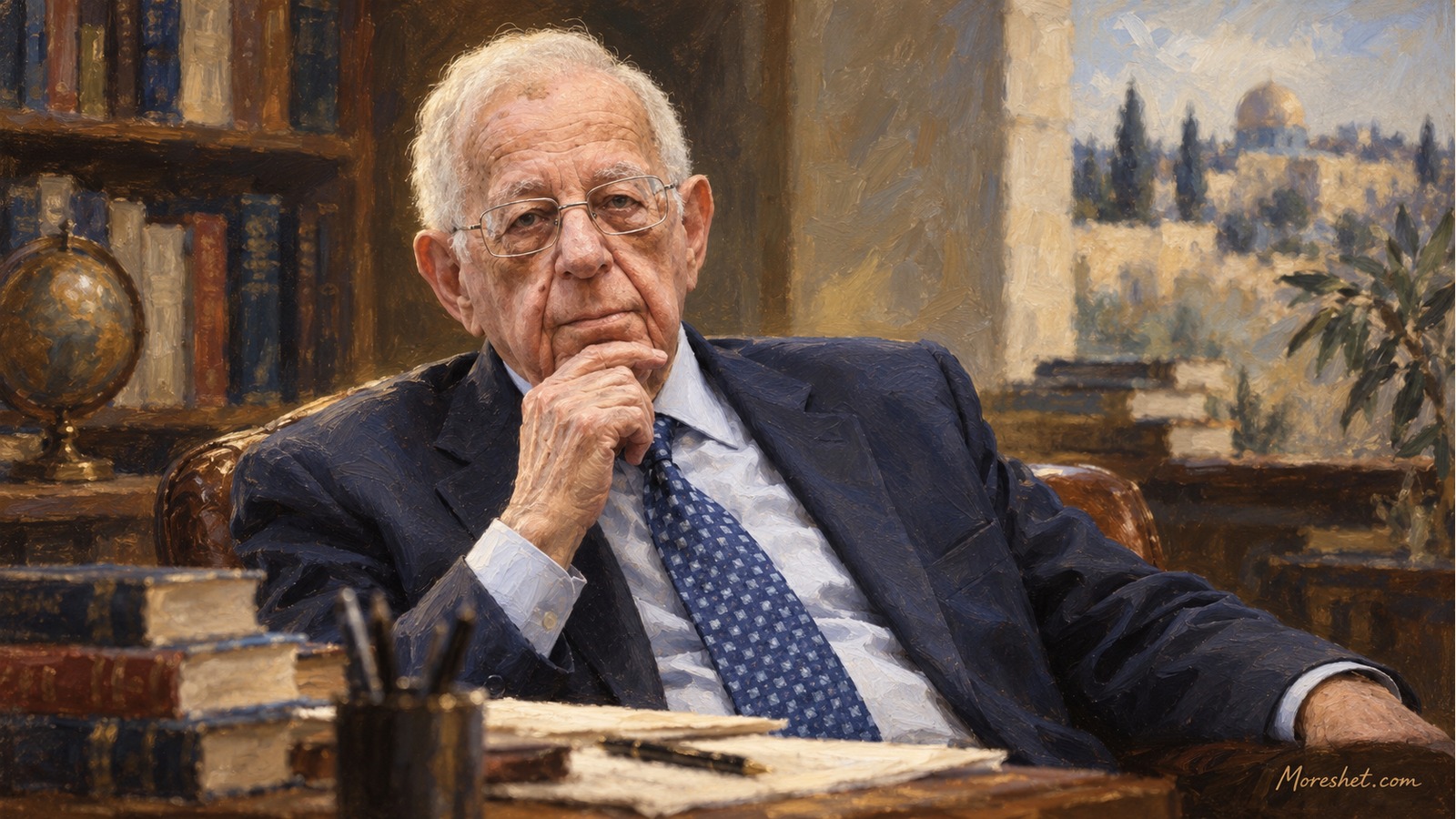
Shlomo Avineri — AI-generated artistic portrait · Moreshet.com
Political scientist, historian of political thought and Israel Prize laureate whose scholarship reshaped the study of Zionism, Hegel, Marx, Herzl, Moses Hess and the modern Jewish state
Professor Shlomo Avineri was one of Israel’s leading scholars of political science, political philosophy and Zionist thought, an Israel Prize laureate, member of the Israel Academy of Sciences and Humanities, professor at the Hebrew University of Jerusalem and former Director-General of Israel’s Ministry of Foreign Affairs. Across more than five decades, he connected close study of Hegel, Karl Marx, Moses Hess, Theodor Herzl and socialist thought with fundamental questions about Zionism, nationalism, civil society, democracy, the State of Israel and the Israeli-Palestinian conflict.
Avineri’s distinctive strength was his ability to read political ideas inside the history that produced them. He did not treat Zionism as one doctrine with one cause, but as a family of responses shaped by Jewish emancipation, European nationalism, socialism, antisemitism, modern self-determination and the search for a viable form of Jewish political life. His work on Hegel and Marx placed him in the international scholarly conversation on the modern state and civil society, while his studies of Hess and Herzl showed how broad European intellectual developments acquired specifically Jewish and Zionist forms.
From Bielsko to Jerusalem
Avineri was born Jerzy Wiener on August 20, 1933, in Bielsko, Poland. In 1939, on the eve of World War II, he immigrated with his parents to Mandatory Palestine. His life therefore began in the world of European Jewry and continued in the Hebrew-speaking society that was building national institutions and, eventually, a state.
Jerusalem became his intellectual home. He studied at the Hebrew University of Jerusalem and at the London School of Economics and Political Science. He received a master’s degree from the Hebrew University in 1960 and completed his doctorate there in 1964 under historian Jacob Talmon.
From the beginning, his interest in politics reached far beyond elections and parties. His central question was how ideas about freedom, society, nation, class, revolution and political authority become institutions and historical forces.
Building political science at the Hebrew University
Avineri joined the Hebrew University faculty in 1964 and eventually became a full professor of political science. He held major academic leadership positions, including head of the Department of Political Science, director of the Eshkol Research Institute, dean of the Faculty of Social Sciences and later director of the university’s Institute for European Studies.
These appointments made him more than an individual scholar. He helped build an academic environment in which Israeli political science engaged political theory, intellectual history, state institutions, nationalism, international affairs and the distinctive problems of Israeli society.
Avineri also taught and conducted research at leading institutions abroad, including Yale, Cornell, Oxford, Northwestern University and the Australian National University, and held research appointments at the Brookings Institution, the Carnegie Endowment for International Peace and other centers. In the early twenty-first century he was a recurring visiting professor in nationalism studies at Central European University in Budapest. Through this international activity, Israeli scholarship on Zionism, nationalism and political thought entered a much wider academic conversation.
Marx: philosophy, society and historical change
One of Avineri’s earliest major areas of scholarship was Karl Marx. His The Social and Political Thought of Karl Marx established him internationally as a scholar of socialist political thought. Rather than treating Marx merely as the ideological ancestor of twentieth-century Communist regimes, Avineri examined him as a thinker of modernization, alienation, civil society, industrialization and social transformation.
He also edited Karl Marx on Colonialism and Modernization and translated Marx’s early writings into Hebrew. This translation work had particular significance in a young Hebrew-speaking academic culture: it made foundational texts of modern European political thought available in precise modern Hebrew.
Decades later Avineri returned to Marx in Karl Marx: Philosophy and Revolution, published in 2019. The return showed that Marx was not simply an early scholarly interest but a continuing lens through which Avineri examined the relationship between political ideas, social structures and revolutionary change.
Hegel and the modern state
Avineri made another major contribution through his study of Georg Wilhelm Friedrich Hegel. In Hegel's Theory of the Modern State, he challenged interpretations that treated Hegel primarily as a precursor of authoritarian or totalitarian state power.
Avineri emphasized instead Hegel’s attention to civil society, institutional pluralism and the relationship between private interests and political community. In this reading, Hegel was not simply a philosopher of state supremacy, but a thinker trying to understand how individual freedom, family, economic life, civil society and political institutions could coexist within a modern order.
This work won Avineri the Naphtali Prize and strengthened his international standing as a historian of political philosophy. It also demonstrated his method: return to the texts, reconstruct their historical setting and resist turning a complex thinker into a political slogan.
The Making of Modern Zionism
For Jewish and Israeli intellectual history, Avineri’s most influential contribution was his study of Zionism. The Making of Modern Zionism, published in Hebrew as HaRa'ayon HaTzioni LeGvanav, presented Zionism not as a single answer to a single problem but as a diverse intellectual tradition.
Avineri examined major Zionist thinkers and showed how each responded to a somewhat different challenge. Moses Hess connected socialism with Jewish nationhood; Herzl confronted the limits of emancipation and argued for political self-determination; Ahad Ha’am emphasized cultural and spiritual renewal; Jabotinsky stressed sovereignty, force and national dignity; and other thinkers joined Zionism to labor, religion, culture or social revolution.
A central contribution of the book was to locate Zionism within the broader history of modern nationalism. Avineri rejected the idea that Zionism was only a reaction to antisemitism. He argued that it also belonged to the modern age in which peoples across Europe were seeking political self-determination, national cultures, representative institutions and responsibility for their own collective future.
The book was translated into numerous languages and became an important text in the study of Zionism and nationalism. It therefore influenced not only how Israelis understood the origins of Zionism, but also how international readers and students encountered Jewish nationalism as part of modern political history.
Moses Hess: between socialism and Zionism
Avineri devoted special attention to Moses Hess, an early thinker who linked socialist universalism with Jewish national revival. In his books and editions devoted to Hess, Avineri recovered a figure who recognized that the Jewish question could not be reduced entirely to class, religion or emancipation.
Hess allowed Avineri to demonstrate that political Zionism did not suddenly appear with Herzl at the end of the nineteenth century. It developed out of earlier European arguments about nationhood, socialism, emancipation and Jewish historical identity.
Herzl beyond the Dreyfus myth
Avineri also wrote a major intellectual biography of Theodor Herzl. He challenged the popular narrative that the Dreyfus Affair was the principal event that converted Herzl to Zionism. Instead, he emphasized political developments within the Austro-Hungarian Empire, the crisis of liberalism and Herzl’s growing realization that European Jewish emancipation had not solved the problem of Jewish political insecurity.
This interpretation restored Herzl to his actual Central European intellectual setting and presented his Zionism as a response to the broader problem of modern nationalism. Avineri also emphasized Herzl’s conception of civic equality within a future Jewish polity, resisting one-dimensional portrayals of the founder of political Zionism.
Avineri wrote the historical introduction to a Hebrew edition of Herzl’s diaries as well, helping bring the primary texts of political Zionism back into public and scholarly discussion.
Arlosoroff and Zionism as practical politics
Avineri’s political biography of Chaim Arlosoroff connected intellectual history with the institutional history of the Yishuv and the Zionist movement. Arlosoroff, one of Labor Zionism’s most gifted leaders and head of the Jewish Agency’s Political Department, allowed Avineri to examine Zionism not merely as a philosophy but as diplomacy, economic organization and political action.
This interest reflected a larger pattern in Avineri’s work. Whether writing about Hegel, Marx or Zionism, he repeatedly returned to the question of how ideas become institutions and how institutions in turn reshape ideas.
From the university to the Foreign Ministry
From 1975 to 1977 Avineri served as Director-General of Israel’s Ministry of Foreign Affairs in the first government of Prime Minister Yitzhak Rabin. His appointment brought a scholar with an independent intellectual profile into one of Israel’s most senior diplomatic positions.
As a public official, Avineri followed the government’s official policy, which at the time favored a Jordanian framework for resolving the Palestinian question, and he participated in meetings with King Hussein. At the same time, in his scholarship and internal memoranda, he argued that the Israeli-Palestinian conflict should be understood not only as a security problem but as a conflict between two national movements. Long before mutual recognition between Israel and the PLO became official policy, he was asking under what conditions negotiations might become possible.
His Foreign Ministry service also placed him inside immediate crises. During the 1976 Entebbe hostage crisis, Avineri was among the senior officials who presented decision-makers with the hijackers’ demands and diplomatic information received from foreign governments. It was an unusually concrete test of the difference between thinking about states in theory and bearing responsibility inside a state operating under extreme pressure.
Peace with Egypt and international public service
Avineri continued to participate in international affairs after leaving the Foreign Ministry. In 1979 he served on the joint Egyptian-Israeli commission that negotiated the cultural and scientific agreement between the two countries following the peace treaty.
This role fit his conviction that peace could not be reduced to diplomatic signatures. Relations between states also require academic, cultural and social ties through which former adversaries can gradually develop durable forms of recognition and cooperation.
Democratization after communism
After the collapse of Communist regimes, Avineri participated in international missions connected with democratization and the observation of early free elections in Central and Eastern Europe and the former Soviet sphere. His Hebrew University biography records work in the early 1990s with missions assisting countries emerging from one-party rule.
The work connected his academic interests with a remarkable historical moment. A scholar of Hegel, Marx, civil society, nationalism and political institutions was able to observe societies attempting to create competitive parties, elections, legislatures and independent civic institutions after decades of Communist government.
Nationalism, the Soviet experience and civil society
Avineri also wrote about nationalism after 1989 and about the historical roots of Soviet authoritarianism. He stressed Russia’s weak civil society and strong state traditions as factors that helped shape the repressive development of the Soviet system.
More broadly, he resisted treating nationalism as merely irrational or artificial. Nations, in his view, are historically constructed, but they are built from inherited memories and social realities as well as deliberate political imagination. This approach allowed him to analyze Zionism within the general history of modern nationalism without dissolving its specifically Jewish historical character.
Israeli democracy as an institutional tradition
In his later public work Avineri often examined the resilience of Israeli democracy. He argued that democratic institutions in Israel did not suddenly appear with statehood in 1948. Important traditions of elections, parties, unions, representation and internal argument had developed within the pre-state Yishuv and earlier Jewish communal structures.
This historical perspective also shaped his understanding of democratic responsibility. Democracy depends not only on constitutional rules but on parties, civil society, compromise and the willingness of rival groups to recognize one another as legitimate participants. In his final years he wrote about the weakening of traditional political parties and the rise of populist movements across Western democracies, placing Israel within a wider crisis rather than treating it as an isolated case.
A public intellectual beyond the university
Alongside his books and academic articles, Avineri wrote extensively for readers outside the university. His essays and commentary appeared in Israeli and international publications including Haaretz, Foreign Affairs, Dissent and The New York Review of Books, and he served on the editorial board of Jewish Review of Books.
Public writing was not secondary to his academic career. It reflected his belief that scholars of society should help readers identify historical contexts, compare institutions and resist political slogans that erase complexity. He wrote about Israel and the Palestinians, Europe, Russia, nationalism, democracy and Israeli politics, repeatedly placing immediate events within longer historical processes.
Honors and recognition
Avineri received the Israel Prize in Political Science in 1996, one of the central recognitions of his contribution to Israeli scholarship and public life. In 2006 the Israel Political Science Association honored him for his contribution to the discipline in Israel and abroad. He also received the Hebrew University’s Solomon Bublick Award, an honorary doctorate from the Weizmann Institute of Science and the EMET Prize in Political Science in 2013.
He was elected to the Israel Academy of Sciences and Humanities, joining a small body of scholars chosen for outstanding achievement. His books were translated into numerous languages, including French, German, Italian, Spanish, Portuguese, Polish, Hungarian, Czech, Russian and Japanese, extending the reach of Israeli scholarship on political thought and Zionism.
A legacy of students, books and concepts
Avineri’s influence cannot be measured simply by the number of books he published. Across decades of teaching, he trained students, helped develop political science in Israel and gave public debate a vocabulary for discussing nationalism, Zionism, democracy and civil society without reducing them to slogans.
His books remain valuable because they place Zionism in two frames at once: as a development within Jewish history and memory, and as a powerful example of the modern politics of national self-determination. This dual perspective helps explain why Zionism was at once deeply Jewish and profoundly connected to modern European political thought.
Personal life and final years
Avineri was married to attorney Dvora Nadler until her death in 2022. They had a daughter, Maayan Avineri-Rebhun. After a long professional life centered in Jerusalem, Shlomo Avineri died on November 30, 2023, at the age of ninety and was buried at Har HaMenuchot.
The Israel Academy of Sciences and Humanities remembered him as a distinguished political scientist, historian of political philosophy and engaged public intellectual who influenced social and political life in Israel and abroad. The description captures the unusual unity of his career: scholarship, teaching and public service were not separate worlds, but different forms of sustained inquiry into political life.
Why this legacy belongs in Moreshet
Shlomo Avineri merits inclusion in Moreshet because his scholarship gave historical and philosophical depth to one of the central transformations of modern Jewish history: the movement from a dispersed people without sovereignty to a national movement and a Jewish state. Through his work on Moses Hess, Herzl, Zionism, Hegel and Marx, he showed how ideas about freedom, nationalism, society and political institutions became part of the lived Jewish and Israeli story.
Moreshet.com documents Avineri because intellectual heritage is measured by the tools it leaves to later generations. He gave Israelis and Jewish readers around the world a richer language for thinking about Zionism, democracy, nationalism, civil society and relations between Jews and Palestinians. His place in Moreshet rests on the rare combination of internationally influential scholarship, teaching and institution-building, senior diplomatic service and public writing that repeatedly demonstrated why understanding the present requires serious engagement with the history and ideas that shaped it.