Menachem Begin
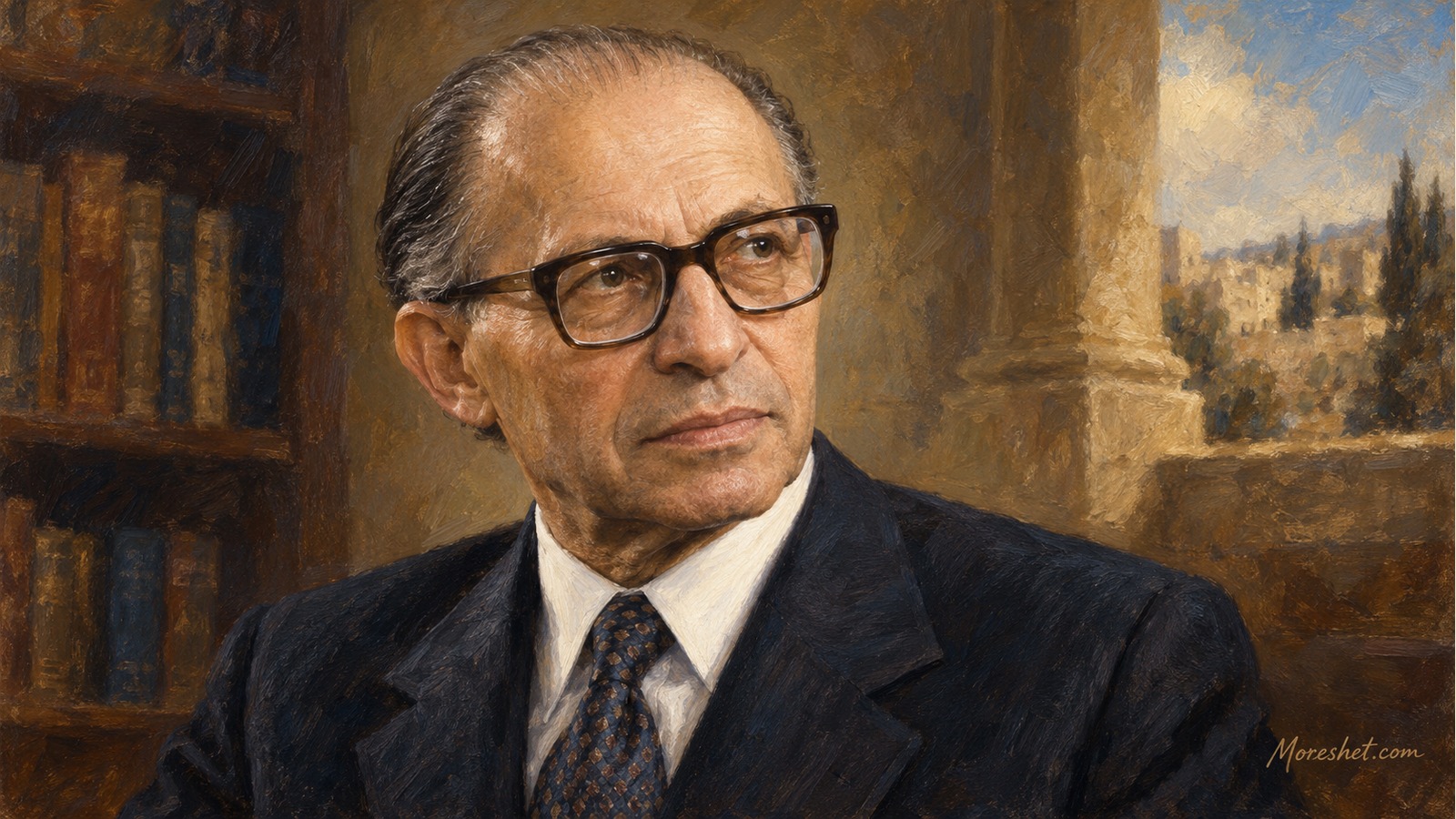
Menachem Begin — AI-generated artistic portrait · Moreshet.com
Israel’s sixth prime minister, commander of the Irgun, founder of Herut and leader of Likud, architect of the 1977 political upheaval, signatory of the Israel-Egypt peace treaty and Nobel Peace Prize laureate
Menachem Begin was the sixth prime minister of the State of Israel, commander of the Irgun during the struggle against the British Mandate, founder of the Herut movement, a central leader of Gahal and Likud, long-serving opposition leader, architect of the 1977 political upheaval, and the Israeli leader who signed the peace treaty with Egypt. In 1978 he shared the Nobel Peace Prize with Egyptian President Anwar Sadat for their role in the process that led to the Camp David Accords and the first peace treaty between Israel and an Arab state.
Begin stands at a central junction of Jewish and Israeli history: Eastern European Jewry, Revisionist Zionism, Betar, the Holocaust, the Soviet gulag, the Hebrew underground, the founding of the state, parliamentary opposition, Israel’s struggles over identity, the rise of Likud, Israel-Egypt relations, the future of Judea and Samaria, national security, Holocaust memory and the place of Jews from Islamic lands in Israeli society. Whether admired or opposed, Israel cannot be understood without Begin: his language, historical sensitivity, sense of national dignity, loyalty to Ze’ev Jabotinsky, deep Jewish consciousness and ability to turn a marginalized movement into a ruling force.
Brest, a Zionist Jewish home and Betar
Menachem Begin was born on August 16, 1913, in Brest-Litovsk, Brisk, then in the Russian Empire. His parents were Zeev Dov Begin, secretary of the local Jewish community and an ardent Zionist, and Hassia née Kosowski. He was the youngest of three children. The home in which he grew up combined Jewish tradition, Zionism, education and deep respect for Theodor Herzl. His name, Menachem, was connected with Shabbat Nachamu, on which he was born, and from childhood he absorbed a world in which Judaism and national hope were inseparable.
Begin’s childhood and youth unfolded amid the upheavals of Eastern Europe: the First World War, family displacement, the return of Brest to Poland, antisemitism, political struggle and the search for a new Jewish path. He first studied in a traditional Jewish framework and at the Hebrew-religious Tachkemoni school, and later in a Polish state gymnasium. As a boy he joined a Zionist youth movement, and in adolescence he was captured by the ideas of Betar after hearing Ze’ev Jabotinsky speak in his city.
Betar gave Begin an ideological, disciplinary and rhetorical framework. It educated toward Jewish pride, hadar, Hebrew national dignity, self-defense, aliyah and a Revisionist understanding of political and military Zionism. Young Begin was not only an enthusiastic member; he quickly became a commander, organizer and speaker. He studied law at the University of Warsaw, completing his degree in 1935, but never pursued an ordinary legal career. His true field was the Jewish national movement.
Betar leader in Poland and the encounter with Jabotinsky
During the 1930s Begin rose through Betar’s leadership. He served as commander of the Betar nest in Brisk, district commander, officer in the movement’s Polish leadership and eventually head of Betar in Poland, the movement’s largest and most important center. He organized conferences, wrote articles, spoke before young Jews and worked to prepare them for aliyah, self-defense and a life of national mission.
Begin was a disciple of Ze’ev Jabotinsky, but not a quiet follower. At Betar conferences he argued fiercely about the movement’s path and the need to move from political Zionism alone toward military and practical Zionism. Jabotinsky sometimes objected to the sharpness of his pupil’s tone, yet recognized his rhetorical talent, passion, ideological discipline and unusual leadership ability. The relationship between them became one of the foundations of Begin’s identity.
In 1939 Begin married Aliza Arnold, from a Revisionist family in Galicia. Aliza became his life partner, source of strength and closest companion throughout a stormy public career. The couple had three children: Ze’ev Binyamin, Hassia and Leah. The depth of their bond would later become inseparable from his retirement and seclusion after her death.
World War II, Soviet arrest and the gulag
After Germany invaded Poland in September 1939, Begin fled Warsaw eastward with his wife and comrades from the Revisionist camp. He reached Vilna, where he tried to continue organizing Betar and aliyah to Palestine. But after Lithuania was incorporated into the Soviet Union, Begin, as a Revisionist Zionist leader, became suspect in the eyes of Soviet power.
In September 1940 Begin was arrested by the NKVD, interrogated in Lukiškės Prison in Vilna and convicted of Zionist activity that Soviet authorities treated as counterrevolutionary. He was sentenced to eight years in a labor camp and sent to Pechora in northern European Russia. He later described the interrogation, humiliation, cold and hard labor in his memoir White Nights. The Soviet experience deepened his hostility to every totalitarian regime and strengthened his belief in the freedom of the individual and the nation.
In 1941, after the Sikorski-Mayski agreement between the Soviet Union and the Polish government-in-exile, Polish prisoners were released, and Begin joined Anders’ Army. Through Iran and Iraq he reached Palestine with the Polish army in 1942. During this period he learned that his parents and brother had been murdered by the Nazis after the conquest of Brest. The Holocaust was never an abstract historical concept for him; it was a family, national and spiritual loss, and it would accompany his political language and Jewish sense of responsibility for the rest of his life.
Palestine, the Irgun and the revolt against Britain
After arriving in Palestine, Begin renewed his ties with Betar and the Irgun. He refused to desert the Polish army without formal release, but after receiving indefinite leave and not returning to its ranks, he joined the Irgun leadership. In December 1943 he became commander of the organization, and in February 1944 he proclaimed an open revolt against British Mandatory rule.
In Begin’s eyes, the 1939 White Paper, which closed the gates of Palestine to Jews during the destruction of European Jewry, made continued British rule a moral and historical obstacle to Jewish rescue and Jewish statehood. Under his leadership, the Irgun attacked British administrative, police and military targets, and later participated in major operations including the King David Hotel bombing, the Acre Prison break, the hanging of the British sergeants and the battle for Jaffa.
The Irgun’s actions were and remain the subject of historical and moral debate, and the British at the time regarded Begin as the leader of a dangerous underground. From Begin’s perspective, however, the struggle was meant to break Mandatory rule and open the path to Jewish sovereignty. He saw himself as continuing Jabotinsky’s path and as duty-bound to turn the Jewish right to a state from idea into reality.
No civil war: the Saison and Altalena
One of the most important chapters in shaping Begin’s public image was his decision to prevent a Jewish civil war. During the Saison, when the Haganah cooperated with the British against the Irgun because of opposition to the revolt, Begin ordered his men not to retaliate violently. He later saw this as one of the most important decisions of his life. The struggle against the British was crucial, but internal war among Jews was, in his eyes, a national disaster.
The same principle was tested again in the Altalena affair in June 1948. The ship, purchased by the Irgun and carrying arms and immigrants, reached Israel’s coast shortly after independence. A sharp dispute over the distribution of the weapons and the authority of the state versus the Irgun ended in armed confrontation with the IDF and the shelling of the ship off Tel Aviv. Sixteen Irgun members and three IDF soldiers were killed.
Begin, who was aboard the ship, ordered his followers not to begin a civil war. After the event he delivered an emotional radio speech calling for surrender and an end to the confrontation. Even his fiercest opponents could not ignore the fact that in an extreme internal crisis he preferred the unity of the young state over political or organizational revenge. Altalena left a deep wound, but it also strengthened his image as a leader who understood the limits of internal force.
Herut, opposition and exclusion from the consensus
After the Irgun was dismantled, Begin founded Herut, the political continuation of the Revisionist stream and the Irgun tradition. In the first Knesset elections in 1949 he was elected to parliament at the head of a relatively small party pushed to the margins of a political system dominated by Mapai. David Ben-Gurion refused to include Herut in coalition governments and effectively made its exclusion part of the governing consensus.
Begin became a sharp, rhetorical, persistent and disciplined opposition leader. He attacked Mapai rule, establishment paternalism, social discrimination, the danger of concentrated party power and attempts to delegitimize the Revisionist camp. For years he was presented by opponents as extreme and dangerous, yet he operated from within the Knesset, under the law and inside the framework of parliamentary democracy.
His first great political struggle was against the reparations agreement with West Germany. Begin saw the agreement as a moral injury to Holocaust memory and argued that Israel must not receive money from Germany so soon after the murder of six million Jews. The demonstrations against the agreement were stormy and painful, but they reflected the depth of the Jewish wound after the Holocaust and Begin’s role as a leader who spoke in the language of memory, honor and national grief.
From Herut to Gahal and Likud
In 1965 Begin led Herut into an alliance with the Liberal Party under the name Gahal. This was part of a long effort to turn the Israeli right from an isolated underground-ideological force into a broad governing alternative. In 1967, on the eve of the Six-Day War, Gahal joined the national unity government, and Begin became a minister for the first time, serving without portfolio.
His entry into government marked the breaking of the long political boycott against Begin and Herut. After the Six-Day War, his disagreements with Golda Meir’s government sharpened over withdrawal, the Rogers Plan and the future of Judea and Samaria. In 1970 Gahal left the government, and Begin returned to the opposition.
In 1973 Begin was among the central figures in establishing Likud, an alliance of Gahal with additional political forces. Likud gradually became the broad home of the Israeli right, traditional voters, national religious Jews, many Jews from Islamic lands and those who saw Mapai and the Alignment as symbols of an old, centralized and alienating establishment. Begin gave that camp a language of dignity, tradition, Zionism, democracy and liberty.
The 1977 upheaval and Likud’s rise to power
On May 17, 1977, the upheaval occurred. Likud under Menachem Begin won the election to the ninth Knesset and for the first time moved the parties of the labor movement from government to opposition. It was one of the defining moments of Israeli democracy: a full transfer of power after nearly three decades of Mapai and Alignment political hegemony.
The upheaval was not only a party event. It expressed a deep social change: the rise of voices from the periphery, development towns, traditional communities, Mizrahi Jews, religious voters and the Revisionist right. Many saw Begin as a leader who gave them dignity after years of exclusion. His language, saturated with Bible, Jewish history, parliamentary formality and emotion, spoke to a wide public that felt represented at the center of power for the first time.
As prime minister, Begin formed a government including Likud, religious parties and later Dash. He opened a new period in Israeli policy: more liberal economic policies, changed social priorities, strengthened settlement in Judea and Samaria, greater recognition of religious and ultra-Orthodox sectors, and at the same time a bold opening toward peace with Egypt.
Camp David, peace with Egypt and the Nobel Peace Prize
Begin’s greatest diplomatic achievement was the peace treaty with Egypt. Egyptian President Anwar Sadat’s historic visit to Jerusalem in 1977 opened a dramatic process. Begin, Sadat and U.S. President Jimmy Carter conducted difficult negotiations that culminated in the Camp David Accords in 1978 and the Israel-Egypt peace treaty in 1979.
The agreement required Israel to withdraw from the entire Sinai Peninsula, evacuate Israeli settlements including Yamit, and return territory captured from Egypt in the Six-Day War. For Begin, who had grown up on the idea of the Whole Land of Israel and led the nationalist camp, this was a deeply difficult decision. He distinguished between Sinai and Judea and Samaria, and accepted peace with Egypt as a strategic and historical step of the highest importance.
The peace with Egypt changed Israel’s strategic position. The largest and most powerful Arab state recognized Israel; the southern border became a border of peace rather than war; and the threat of a comprehensive war in the pattern of 1948, 1967 and 1973 was fundamentally altered. For their part in the agreement, Begin and Sadat received the 1978 Nobel Peace Prize. Begin, the former underground commander, became in the eyes of the world a statesman able to combine national steadfastness with a historic decision for peace.
National security, the Begin Doctrine and the Iraqi reactor
Begin’s security outlook was shaped by the Holocaust, the experience of Jewish helplessness and his belief that Israel must prevent its enemies from acquiring the ability to destroy it. In 1981 he authorized the strike on Iraq’s Osirak nuclear reactor in Operation Opera. Israel was condemned internationally, but Begin explained that he would not allow an enemy openly hostile to Israel to develop weapons of mass destruction.
From that decision emerged what became known as the Begin Doctrine: Israel would not permit its enemies to develop nuclear weapons or weapons of mass destruction that could threaten its existence. The doctrine became an important part of Israeli security thinking for later generations, even as its application and consequences remained subjects of diplomatic and security debate.
Begin saw national security not only as a military matter but as a historical lesson. For him, the Holocaust taught that threats against the Jewish people are not always empty rhetoric, and that Jewish sovereignty is measured by the capacity to act in time. That understanding stood behind many of his decisions, from the underground period to the prime minister’s office.
Lebanon, public pain and Begin’s resignation
In 1982 Begin’s government approved Operation Peace for Galilee in Lebanon, intended to push the PLO away from Israel’s northern border after years of fire, infiltration and attacks. The operation developed into the First Lebanon War, reached Beirut and changed Israel’s position in Lebanon and the region. The war initially received support but later provoked deep controversy, public criticism and wide protest.
The Sabra and Shatila massacre, carried out by Christian Phalangist militias in Palestinian refugee camps after the IDF entered Beirut, shocked Israel and the world. The Kahan Commission found Israel indirectly responsible and recommended the removal of Defense Minister Ariel Sharon from office. The events deepened public criticism and weighed heavily on Begin.
The death of his wife Aliza in November 1982 was a severe personal blow. Alongside the pain of the war, casualties, criticism and Israel’s deepening involvement in Lebanon, Begin became increasingly withdrawn. In September 1983 he announced that he could no longer continue and resigned as prime minister. He transferred the office to Yitzhak Shamir and retreated almost completely from public life.
Years of seclusion, death and burial on the Mount of Olives
After his resignation, Begin lived mainly in seclusion in Jerusalem and later Tel Aviv. He almost never gave interviews or took part in public events. He read widely, followed the news and remained in contact with family and close associates, but stayed far from the arena that had been the center of his life for decades. This seclusion added a tragic and mysterious dimension to his image.
Begin died in Tel Aviv on March 9, 1992, at the age of 78. In accordance with his wishes, he was not buried in the national leaders’ section on Mount Herzl, but on the Mount of Olives in Jerusalem, beside his wife Aliza and near underground fighters Meir Feinstein and Moshe Barazani, who had taken their own lives in a British prison before their scheduled execution. The choice reflected his deep loyalty to the underground fighters, Jewish memory and the symbolism of Jerusalem.
His funeral drew tens of thousands. Even those who had opposed him recognized that Menachem Begin was a formative figure in Israel’s history: a leader who emerged from the underground, stood for decades in opposition, brought the right to power, made peace with Egypt and remained to his last day bound to the language, pain and hope of Jewish history.
A legacy of dignity, democracy and political rivalry
Begin’s legacy is wide and complex. He was an underground commander who became a parliamentarian, an opposition leader who respected democratic rules, a Revisionist nationalist who signed a historic peace agreement, a right-wing leader who gave voice and dignity to marginalized publics, and an orator who restored to Israeli political speech a language of Judaism, history, hadar and liberty.
His influence is visible in Israeli politics to this day. Likud, the 1977 upheaval, the idea of a governing nationalist right, relations between religion and state, the language of dignity toward Mizrahi communities, Israel’s relationship to Holocaust memory, the security doctrine regarding weapons of mass destruction and the memory of the underground movements are all tied to his name. Begin was not a leader of simple compromise, but of great decisions.
The weaknesses and burdens of his time are also part of the picture: inflation, the Lebanon War, disputes over settlements, the question of the use of force and political polarization. Yet precisely for that reason he is essential to historical understanding. His life is not a one-dimensional story of triumph or failure, but the story of a man who brought an entire Eastern European worldview into the shaping of the State of Israel.
Why this legacy belongs in Moreshet
Menachem Begin merits inclusion in Moreshet because he is one of the figures who shaped Israel’s path from underground to democracy, from opposition to government, and from national struggle to a historic peace agreement. He was a Betar leader, gulag prisoner, Irgun commander, founder of Herut, opposition leader, creator of Likud, the prime minister who led the 1977 upheaval, and the prime minister who signed peace with Egypt.
Moreshet.com documents Begin because Jewish and Israeli heritage cannot be reduced to a single story of statehood. It must also include the Revisionist stream, the memory of the undergrounds, the struggles of the opposition, the rise of communities pushed to the margins, the security and diplomatic decisions, and the capacity of a national leader to turn deep enmity into peace. Menachem Begin’s place in Moreshet rests on the rare combination of historical loyalty, rhetorical power, democratic discipline, deep Jewish sensitivity and state decisions that shaped Israel for generations.