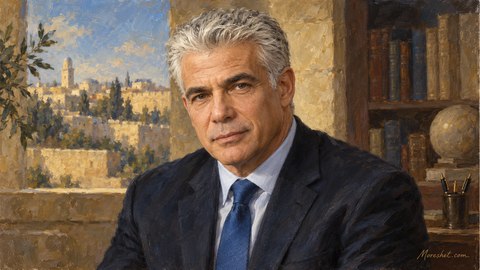
Mark Reed Levin
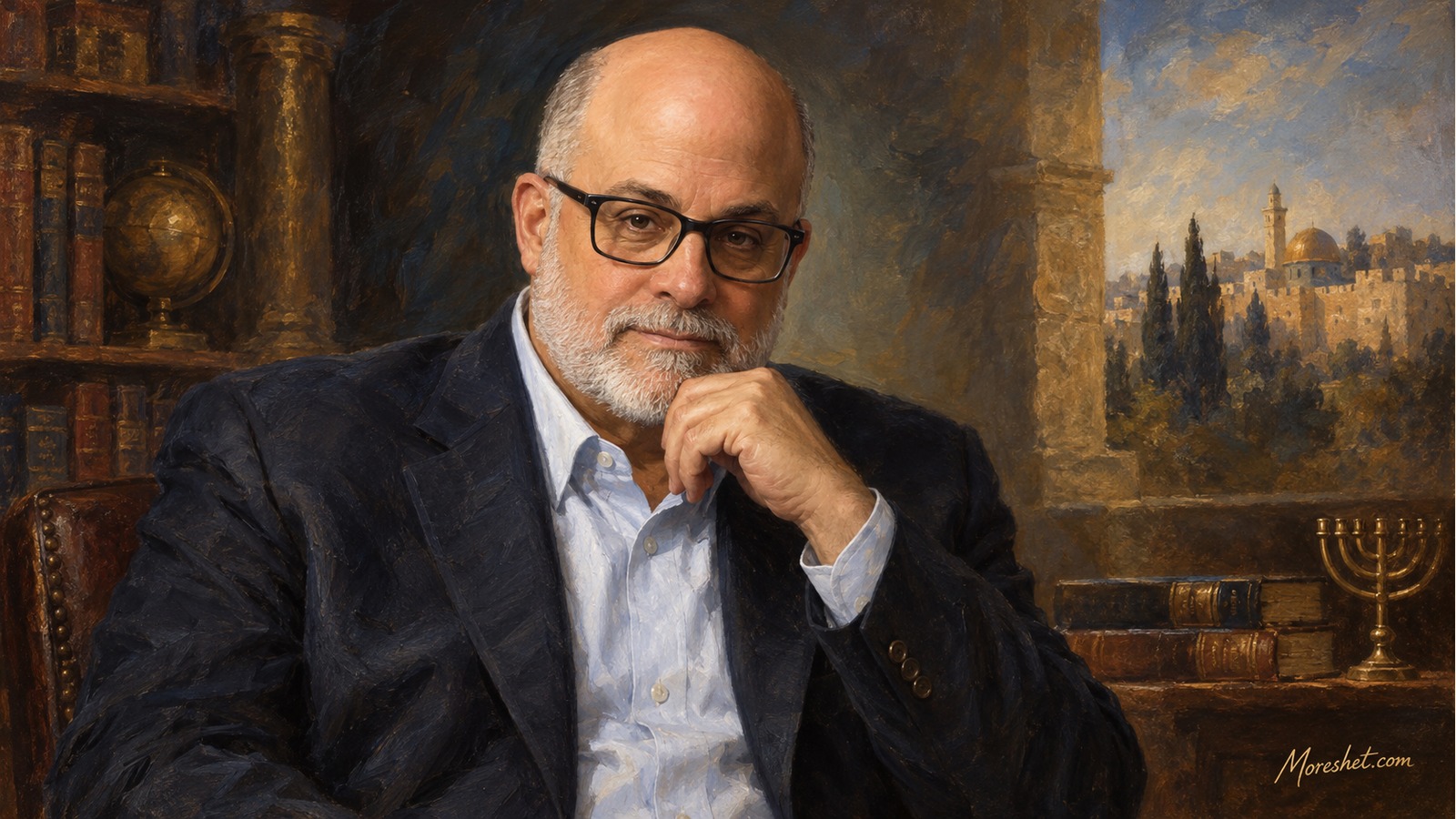
Mark Levin — AI-generated artistic portrait · Moreshet.com 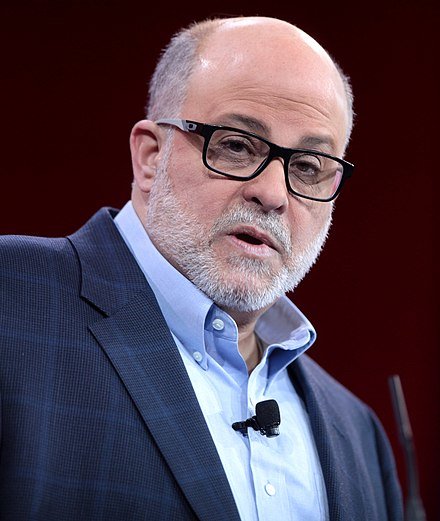
Mark Levin — image from the Moreshet archive
Jewish-American lawyer, author, radio and television broadcaster, and one of the leading conservative voices in American media and public support for Israel
Mark Reed Levin is a Jewish-American lawyer, author, political commentator and radio and television broadcaster, one of the figures most closely identified with conservative media in the United States. He hosts the nationally syndicated radio program The Mark Levin Show, the Fox News television program Life, Liberty & Levin, and is the author of political bestsellers on the Constitution, liberty, limited government, media, political power and the identity of America.
Levin’s importance does not come only from the views he expresses, but from the consistency, scale and influence of his voice over several decades. He moved from law and government to radio, from radio to television, and from daily commentary to broader political writing. As a conservative Jewish American who has been explicit and consistent in supporting Israel, he represents an important current in American Jewish public life: Jews active within American conservatism, speaking in constitutional, security-minded and pro-Israel language, and influencing audiences far beyond the Jewish community itself.
Jewish childhood in Pennsylvania and legal education
Levin was born in Philadelphia, Pennsylvania, on September 21, 1957, to a Jewish family. He grew up in the Erdenheim and Elkins Park area, in a suburban community where education, local politics and American civic identity were part of everyday life. His father, Jack Levin, authored books, and the influence of that household can be seen in Mark Levin’s career as a man of words, arguments, books and public persuasion.
Levin finished Cheltenham High School early, after three years, and went on to Temple University. He graduated magna cum laude with a bachelor’s degree in political science in 1977, and then earned a J.D. from Temple University School of Law in 1980. Already as a young man he combined politics, law and public activity: in 1977 he won election to the local school board in Cheltenham on a platform that included reducing property taxes.
His legal training is essential to understanding his public style. Levin is not merely a radio host with a strong voice; he built his public world around constitutional reading, legal argument, institutional interpretation and a sharp distinction between governmental authority and individual liberty. Even when his words are controversial, they usually rest on a frame he presents as constitutional, legal and historical.
Service in the Reagan administration and public-interest law
After law school, Levin worked at Texas Instruments, but soon entered public service in the administration of President Ronald Reagan. He first worked at ACTION, the federal agency overseeing VISTA and other volunteer programs, and later held legal and administrative roles at the Department of Education and the Department of the Interior. He ultimately became chief of staff to Attorney General Edwin Meese, one of the central figures in Reagan-era legal conservatism.
This chapter shaped his public outlook. For Levin, the Reagan administration was not only a workplace, but an ideological school: limited government, resistance to the expansion of the administrative state, belief in free markets, constitutional conservatism, anti-communism and the view of America as a nation with a mission of liberty. His closeness to Meese connected him to a world in which constitutional interpretation, judicial appointments and the limits of federal power were central questions.
After leaving government, Levin practiced law in the private sector and later joined the Landmark Legal Foundation, a conservative legal organization. He served in senior roles there and later as the foundation’s president. That work connected law, media and public struggle: Freedom of Information Act requests, regulatory complaints, challenges involving teachers’ unions and government agencies, and the advancement of a conservative view of institutional responsibility and transparency.
The move into radio and the creation of a national conservative voice
Levin began in broadcasting as a guest and legal commentator on conservative talk-radio programs. For years he appeared on programs hosted by Rush Limbaugh and Sean Hannity, especially on legal and political issues. Those appearances exposed him to a large conservative audience and demonstrated his strength as a commentator with legal knowledge, political memory and a forceful style of expression.
In 2002 he received his own program on WABC in New York, initially on Sundays. In 2003 he moved into an important daily slot after Hannity’s program, and in 2006 The Mark Levin Show began national syndication. Over time the program became one of the major conservative talk-radio programs in the United States, carried on many stations, satellite radio, streaming services and podcasts.
Radio suited Levin’s personality. He combines extended monologue, emotional tone, political anger, readings from texts, constitutional explanation, loyalty to the audience and direct conversation with listeners. To supporters, he is a voice of clarity and consistency; to critics, he is a fierce and polarizing voice. Either way, his influence comes from the fact that he has maintained a large audience over many years, in an era when media, politics and partisan identity changed rapidly.
The Radio Hall of Fame and digital expansion
In 2018 Levin was inducted into the National Radio Hall of Fame, a major recognition in American broadcasting. The induction marked his status not only as a political commentator, but as one of the influential radio figures of his generation. American conservative radio was for decades a political and cultural force, and Levin became one of the figures who helped preserve and renew it after the Rush Limbaugh era.
Alongside traditional radio, Levin expanded into digital channels. He was connected with Conservative Review and LevinTV, and later with wider conservative platforms and mergers. His programs are available through podcasts, video channels and streaming platforms, so his voice moved from local and national broadcast into a multi-channel media environment.
The digital transition matters because Levin is not only an old-style radio broadcaster. He shows how American political commentary moved from AM radio to cable television, podcasts, social networks, video channels and content ecosystems that build a continuous political community around a host, a style and a set of concepts.
Life, Liberty & Levin and political television
In 2018 Levin began hosting Life, Liberty & Levin on Fox News. The program was designed to combine relatively long-form interviews with discussions of the Constitution, history, politics, society, culture, law and security. Unlike faster cable-news formats, the program allows Levin to develop longer conversations with guests, authors, government figures, security officials, scholars and commentators.
The move into television strengthened his influence by adding a visual dimension to a voice already known through radio. The program made him a regular figure on the leading conservative news channel in the United States and gave him a platform for discussing subjects such as the Supreme Court, free speech, Middle East wars, Iran, China, immigration, homeland security, media and antisemitism.
His television presence also expanded his place in pro-Israel discourse. During security crises in Israel and the Middle East, Levin has used his platform to defend Israel, attack Iran and terrorist organizations, criticize those he sees as hostile to Israel in the West, and present Israel’s security as part of a wider struggle for the free world.
Political writing and bestselling books
Levin is also a prolific author of political books. Men in Black addressed the Supreme Court and criticized judicial activism. Liberty and Tyranny became a major bestseller and presented a conservative manifesto against what Levin describes as statism. Further books, including Ameritopia, The Liberty Amendments, Plunder and Deceit, Rediscovering Americanism, Unfreedom of the Press, American Marxism, The Democrat Party Hates America and On Power, extended his conceptual world to many readers.
His books are not neutral academic works, but combative political writing aimed at a broad conservative audience. They offer an interpretive framework in which America is engaged in a struggle between liberty and concentrated power, constitutionalism and administrative rule, independent citizenship and dependency on the state, and what he sees as hostile media versus a public seeking truth.
The success of the books matters from a heritage perspective because Levin is not only a broadcaster of daily news. He built a popular conservative canon of books, ideas and political phrases. For millions of readers and listeners, his books serve as a guide to the Constitution, the media, the Democratic Party, governmental power and the role of the citizen.
Israel, Jewishness and foreign policy
One of the central elements of Levin’s public profile is his consistent support for Israel. He presents Israel as a moral and strategic ally of the United States, sharply criticizes Iran, supports a tough security posture, and often addresses antisemitism, terrorism, Hamas, Hezbollah and regional threats. His views on Israel fit within a wider hawkish, anti-Iranian and pro-Western foreign-policy outlook.
His Jewishness is not always at the center of his public presentation, but it is an important part of how Jewish and Israeli audiences understand him. Levin does not speak for all American Jewry and does not represent all its diversity; however, he does represent a clear current: conservative Jews who see support for Israel, opposition to antisemitism and the U.S.-Israel alliance as inseparable from their political identity.
Over the years Levin has used his platforms to defend Israel during periods of international criticism, accuse Western actors of misunderstanding the Iranian and jihadist threat, and present Israel as a forward line in a wider struggle over liberty, security and Western civilization. His style is sharp and contested, but his influence over a large conservative audience makes him an important figure in documenting the relationship among American Jewry, Israel and the American right.
Constitutional conservatism, public polemic and controversy
Levin is known as one of the sharpest voices in American conservatism. He attacks the Democratic Party, liberal media, what he describes as the administrative state, and at times Republicans whom he believes are insufficiently committed to conservative principles. His style often includes anger, ridicule, nicknames and forceful monologues. In that sense he belongs to a long American tradition of political radio in which persuasion, camp identity and emotional identification with the audience matter as much as analysis itself.
Supporters, by contrast, see him as a courageous commentator with historical and constitutional memory, unafraid to confront political, legal and media elites. They value his loyalty to the Constitution as he interprets it, his opposition to large centralized government, and his willingness to say things others avoid. The gap between how supporters and critics perceive him is part of his public significance.
Precisely because he is a polarizing figure, his documentary importance is considerable. Levin helps explain how American conservative discourse moved from the Reagan administration into the eras of cable news, syndicated radio, podcasts, Trump, judicial battles and disputes over the future of American democracy.
Advisory roles and homeland security
In 2025 Levin was appointed as a member of the United States Homeland Security Advisory Council. The appointment reflects the place he has gained in conservative discourse on security, borders, terrorism, Iran, China and internal and external threats. He is not a professional security official in the military or intelligence sense, but his public voice affects how part of the public and the conservative movement speak about national security.
The connection between media and security is one of the features of our time. Commentators such as Levin do not merely describe policy; they participate in shaping public support for it, presenting threats, defining enemies and setting the language through which citizens understand the relationship between liberty and security. His place therefore extends beyond broadcasting alone.
Personal life
Levin is married to Julie Strauss Levin. He was previously married to Kendall Levin. In 2000 he suffered a heart attack and underwent open-heart surgery, an experience that has appeared at times in personal and public context. His personal life is not the center of his public identity; his public figure is built mainly around microphone, books, television, law and politics.
Alongside political writing, he also published Rescuing Sprite, a personal book about a dog he adopted and the experience of love, loss and the bond between a human being and an animal. That book revealed a softer and more personal side of Levin, reminding readers that behind the fierce political voice is also someone who writes about family, feeling and loyalty.
Editorial note on inclusion
Mark Levin is included on the site even though this person and their public record are controversial among broad sections of the public. Inclusion does not determine whether the influence is positive or negative; it reflects the significant place this figure holds in shaping the lived experience, culture and way of life of the public. Naturally, some regard this activity as positive and even heroic, while others see it as contrary to their worldview. The very existence of opposing assessments is part of the historical record that justifies including this significant and influential figure in the heritage of the Jewish people.
Why this legacy belongs in Moreshet
Mark Reed Levin merits inclusion in Moreshet because he is one of the most visible Jewish voices in American conservative media in the late 20th and early 21st centuries. His path connects a Jewish family in Pennsylvania, legal education, the Reagan administration, public-interest law, national radio, cable television, bestselling books and consistent support for Israel.
Moreshet.com documents Levin because Jewish and Israeli heritage also includes figures who worked in media and public argument and influenced the way large audiences understand law, liberty, security, Israel and antisemitism. Mark Levin’s place in Moreshet rests on the durable influence of his voice on American conservatism, his Jewish and pro-Israel presence within that camp, and the fact that broadcasting, writing and public commentary became in his hands instruments for shaping political consciousness across several generations of listeners, viewers and readers.