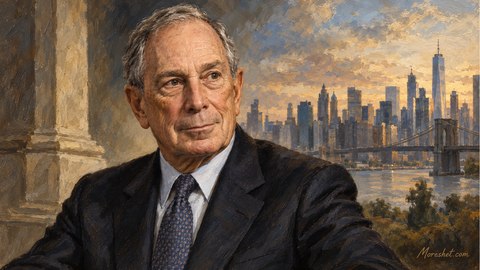
David J. Frum
A Jewish Canadian-American journalist, author, and conservative public intellectual who shaped political debate and Jewish civic engagement
David J. Frum is a Jewish Canadian-American author, journalist, editor, and political commentator. Born in Toronto on June 30, 1960, he built a career across journalism, political writing, government, and public debate. Frum became widely known for combining intellectual analysis with direct participation in policy-making: he served as an economic speechwriter for U.S. President George W. Bush, wrote books examining conservatism and the Bush administration, and became an influential voice in debates over the Republican Party, American institutions, and the place of Jewish citizens in public life.
Family and education
Frum grew up in a prominent Canadian Jewish family. His mother, Barbara Frum, was a well-known journalist and radio broadcaster, while his sister, Linda Frum, later served in the Canadian Senate. Frum describes himself as not particularly observant, yet his Jewish background and connection to Jewish communal and civic life have remained meaningful elements of his public biography.
He studied history at Yale University, where he wrote for the Yale Daily News. He later studied law at Harvard University and, during his time there, was elected president of the university's Federalist Society chapter. His training in history and law helped shape a style of writing attentive to institutions, political ideas, and the historical forces behind contemporary events.
From journalism to national politics
Frum's political engagement began at an early age. He initially identified with the left, but his views gradually moved to the right. In 1980 he volunteered in Ronald Reagan's presidential campaign and later described himself as a conservative Republican. At the same time, he retained an independence that led him to criticize people and ideas on the right when he believed they were mistaken.
From 1989 to 1992, Frum worked as an editorial-page editor at The Wall Street Journal. He subsequently wrote a regular column for Forbes. His national political reputation grew after a 1991 article in The American Spectator criticizing Pat Buchanan, a candidate associated with the nationalist right. From the beginning, Frum's work showed a willingness to engage with the internal arguments of conservatism rather than simply repeat the movement's accepted positions.
In 2001, Frum was appointed an economic speechwriter for President George W. Bush. The appointment was notable in part because Frum held only Canadian citizenship at the time; he became a naturalized U.S. citizen in 2007 while retaining his Canadian citizenship. His White House work illustrated the importance of speechwriting in public leadership: economic and political ideas had to be translated into language that a president could present clearly and persuasively to the nation.
Frum was among the prominent supporters of the Bush administration's response to the September 11, 2001 attacks and supported the 2003 invasion of Iraq. He also served as a senior foreign-policy adviser to Rudolph Giuliani during Giuliani's unsuccessful 2008 campaign for the Republican presidential nomination. During that election cycle, Frum publicly expressed reservations about Sarah Palin's candidacy for vice president, although he ultimately said that he would vote for the Republican ticket of John McCain and Palin.
That independence also appeared in his later positions. Although identified with the conservative right, Frum opposed the Republican Party's aggressive campaign against President Barack Obama's health-care reform. His interventions contributed to a conservative debate that was not limited to party loyalty, but also addressed governmental responsibility, public institutions, and the proper limits of ideology.
Books that shaped conservative discussion
Frum's first book, Dead Right, was published by Basic Books in 1995. It examined the American conservative movement from within, including the tension between its principles and the social and political challenges it faced. The book attracted praise from both the political right and the left. Frank Rich of The New York Times described it as the smartest book written from the inside about the American conservative movement, while William F. Buckley called it an especially refreshing ideological experience.
In 2003, Random House published Frum's The Right Man. The book examined the early part of George W. Bush's presidency and the American response to the September 11 attacks. Frum's proximity to the administration gave the book an insider's perspective on the period. It also documented how a government attempted to explain itself and construct a public narrative after a national crisis.
A Jewish voice in public life
Frum's work also belongs to the history of Jewish civic participation in North America. He served on the board of the Republican Jewish Coalition, a conservative Jewish organization founded in 1985 that operates in American political life. Through this involvement, he represented a form of Jewish public engagement that extends beyond communal or religious affairs into debates about foreign policy, security, economics, and political identity.
This role is significant in the American context, where Jewish citizens participate across a broad political spectrum. Frum helped make the Jewish conservative voice more visible in journalism and politics, while maintaining enough independence to criticize the political camp with which he was associated. Through his writing and public appearances, he participated in debates familiar to many American Jews: how Jewish identity relates to civic responsibility, how foreign policy and Israel should be understood, and what place values, institutions, and tradition should hold in modern politics.
A commentator with an international reach
Frum published articles in major American and European newspapers and magazines, wrote regular columns for Canadian journalism and the American news magazine The Week, and appeared as a radio commentator. This work extended his influence beyond his years in government. He served as an intermediary between policy circles and the wider public, offering historical and political interpretations of developments affecting the United States, Canada, and the world.
Frum's distinctive contribution lies in the combination of practical experience in government, a journalist's command of language, and an ability to explain ideological disputes in accessible terms. He has not merely recorded political change; through articles, books, and public messages, he has taken part in shaping how that change is understood. His readers encounter not only a particular political position, but also the internal arguments that have influenced American conservatism and American society.
Why this legacy belongs in Moreshet
David J. Frum merits inclusion in a heritage archive because he worked at an unusual intersection of journalism, political thought, government, and Jewish civic engagement. He helped formulate the economic messages of a U.S. president, documented from close range a period shaped by the September 11 attacks, and influenced conservative self-understanding through his books and essays.
Moreshet preserves the stories of people whose work helps explain how Jews and Israelis have participated in shaping public life, culture, and institutions around the world. Frum's biography adds the example of a North American Jew who operated on a national and international stage, used journalism and books to advance intellectual debate, and brought a Jewish conservative perspective into the center of public discussion. His place on Moreshet.com rests not only on the offices he held, but on the cumulative effect of his writing, public service, and participation in Jewish and civic life.