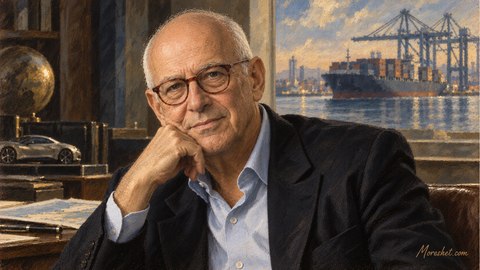
Henry Kravis
KKR co-founder, pioneer of leveraged buyouts and philanthropist supporting education, medicine, science and civic leadership
Henry Roberts Kravis, born January 6, 1944, is an American businessman, investor and philanthropist from a Jewish family. In 1976, he co-founded Kohlberg Kravis Roberts, known as KKR, with his cousin George R. Roberts and Jerome Kohlberg Jr. The firm became one of the defining institutions in private equity and leveraged buyouts, and Kravis remained one of its principal leaders for decades.
Kravis’s importance extends beyond the creation of a global investment firm. Through business leadership, philanthropy and sustained involvement in education, health care, culture and civic organizations, he helped shape major American institutions and supported generations of students, researchers, physicians, nonprofit executives and public-minded leaders.
Early life and the development of a new investment model
Kravis was born in Tulsa, Oklahoma, into a Jewish family. His father, Raymond F. Kravis, was an oil engineer and businessman. Kravis attended Eaglebrook School and Loomis Chaffee School, earned a degree in economics from Claremont McKenna College in 1967, and received an MBA from Columbia Business School in 1969.
In the late 1960s, Kravis joined Bear Stearns, where he worked with his cousin George Roberts under Jerome Kohlberg. The three developed what they called “bootstrap” investments: acquiring companies through a combination of equity and financing, then working with their management teams to expand or reorganize the businesses. Their early transactions included Stern Metals, Incom, Cobblers Industries and Boren Clay. These experiences exposed them not only to successful investments but also to the risks of concentrating substantial capital in a single company.
Founding KKR and expanding private equity
In 1976, Kravis, Roberts and Kohlberg left Bear Stearns and established KKR. The firm began on a modest scale. Kohlberg invested $100,000, while Kravis and Roberts each invested $10,000 of their own money. After regulatory changes allowed pension funds to invest in private-equity firms, KKR raised its first institutional fund in 1978, securing approximately $30 million in commitments.
The model KKR developed made leveraged buyouts a major instrument in modern finance. The firm raised capital from investors, acquired companies, worked with their management teams and sought to increase their value over time. Kravis played a central role in building the firm and guiding its investments. After Kohlberg left KKR in 1987, Kravis and Roberts continued to lead the organization together.
Major transactions and leadership at KKR
Kravis is most closely associated with KKR’s 1988 acquisition of RJR Nabisco. Valued at $31.4 billion, it was then the largest price ever paid for a commercial enterprise. The transaction became a landmark in American financial history and was chronicled in the book and film Barbarians at the Gate. KKR ultimately lost money on its overall investment in RJR Nabisco after selling its remaining holdings in 1995, but the experience provided important lessons about the size, financing and management of major acquisitions.
Over the years, KKR under Kravis and Roberts invested in companies across a wide range of industries, including Hospital Corporation of America, TXU, Playtex, Beatrice Foods, Safeway, Toys “R” Us, Borden, First Data and Regal Entertainment Group. Its acquisition of battery maker Duracell proved especially profitable. In 2013, KKR closed its first dedicated real-estate fund, raising $1.2 billion and providing more than $1.5 billion for investment when combined with additional firm resources.
In 2021, Kravis and Roberts stepped down as co-chief executive officers after a planned succession process. Joseph Y. Bae and Scott C. Nuttall assumed responsibility for daily operations, while Kravis continued as co-executive chairman and remained involved with KKR’s investment committees. The transition demonstrated that the institution they built could renew its leadership while preserving its founders’ experience.
Philanthropy in education, leadership, medicine and science
A defining part of Kravis’s legacy is his investment in institutions that develop human capacity over the long term. Established in 2006, the Henry R. Kravis Prize in Nonprofit Leadership is administered through Claremont McKenna College and honors exceptional nonprofit leaders. The prize is designed not merely to recognize individual achievement but also to share recipients’ methods and lessons with other organizations. Kravis has funded the Kravis Leadership Institute and leadership-studies programs at the college, as well as the Henry Kravis Internships for Teachers of Color.
Kravis has supported the schools he attended through major building and infrastructure projects, including Kravis House at Middlesex School, a dormitory at Eaglebrook School, an arena at Deerfield Academy and Kravis Hall at Loomis Chaffee School. In 2024, he gave $100 million to the Loomis Chaffee endowment, the largest single gift in the school’s history and one of the largest ever made to an independent school.
In health care, Henry and Marie-Josée Kravis donated $15 million to Mount Sinai Medical Center to establish the Center for Cardiovascular Health and support a professorship. They also endowed a chair in human oncology at Memorial Sloan Kettering Cancer Center. In 2022, Kravis gave Memorial Sloan Kettering $100 million to support its Cancer Ecosystems Project, which studies cancer relapse. In 2023, the foundation made an additional $40 million gift to establish the Marie-Josée Kravis Center for Cancer Immunobiology. These gifts strengthen long-term research, medical infrastructure and scientific training, with potential effects reaching patients and families well beyond a single generation.
Civic, cultural and economic engagement
Kravis has served on the boards and governing bodies of numerous civic and cultural institutions. He is a former chairman of New York’s public television station, a trustee of the Metropolitan Museum of Art and vice chairman of Rockefeller University. He has also served as a trustee of the Council on Foreign Relations, chairman of Sponsors for Educational Opportunity and a member of The Business Council.
In New York, Kravis previously co-chaired the Partnership for New York City, an organization founded by David Rockefeller that works to strengthen the city’s economic and civic life. He also created the New York City Investment Fund, a nonprofit organization focused on creating jobs and encouraging new businesses. Through these roles, he acted not only as a private investor but also as a participant in discussions about education, employment, entrepreneurship and urban renewal.
Kravis has played an important role at Columbia Business School, where he co-chairs the Board of Overseers. He pledged $100 million to support the school’s new campus project, and one of its principal buildings is named Henry R. Kravis Hall. His academic philanthropy has therefore taken two complementary forms: financing physical institutions and creating programs, prizes and pathways for training.
Public recognition
Kravis’s honors include the Golden Plate Award of the American Academy of Achievement in 1987, Investment Management’s Lifetime Achievement Award in 2015, Columbia Business School’s Centennial Award and the Atlantic Council’s Distinguished Leadership Award in 2016, and the Carnegie Medal of Philanthropy in 2019.
Why Henry Kravis belongs in Moreshet
Henry Kravis merits inclusion in Moreshet because his life reflects an important combination of Jewish-American entrepreneurship, institution-building and philanthropic responsibility. As a co-founder of KKR, he helped shape a field of investment that transformed corporate ownership and influenced international finance. Alongside that business achievement, he committed substantial resources to education, leadership development, medical research, culture and civic institutions.
His significance lies not only in the scale of his wealth, but in the way he directed business success toward institutions intended to serve the public over time: schools, universities, hospitals, laboratories, nonprofit organizations and urban initiatives. For Moreshet.com, his story preserves an important chapter in the history of American Jews—their participation in the central institutions of economic and public life, and their ability to use that position to strengthen education, health, science and the wider community.