Heinrich Heine
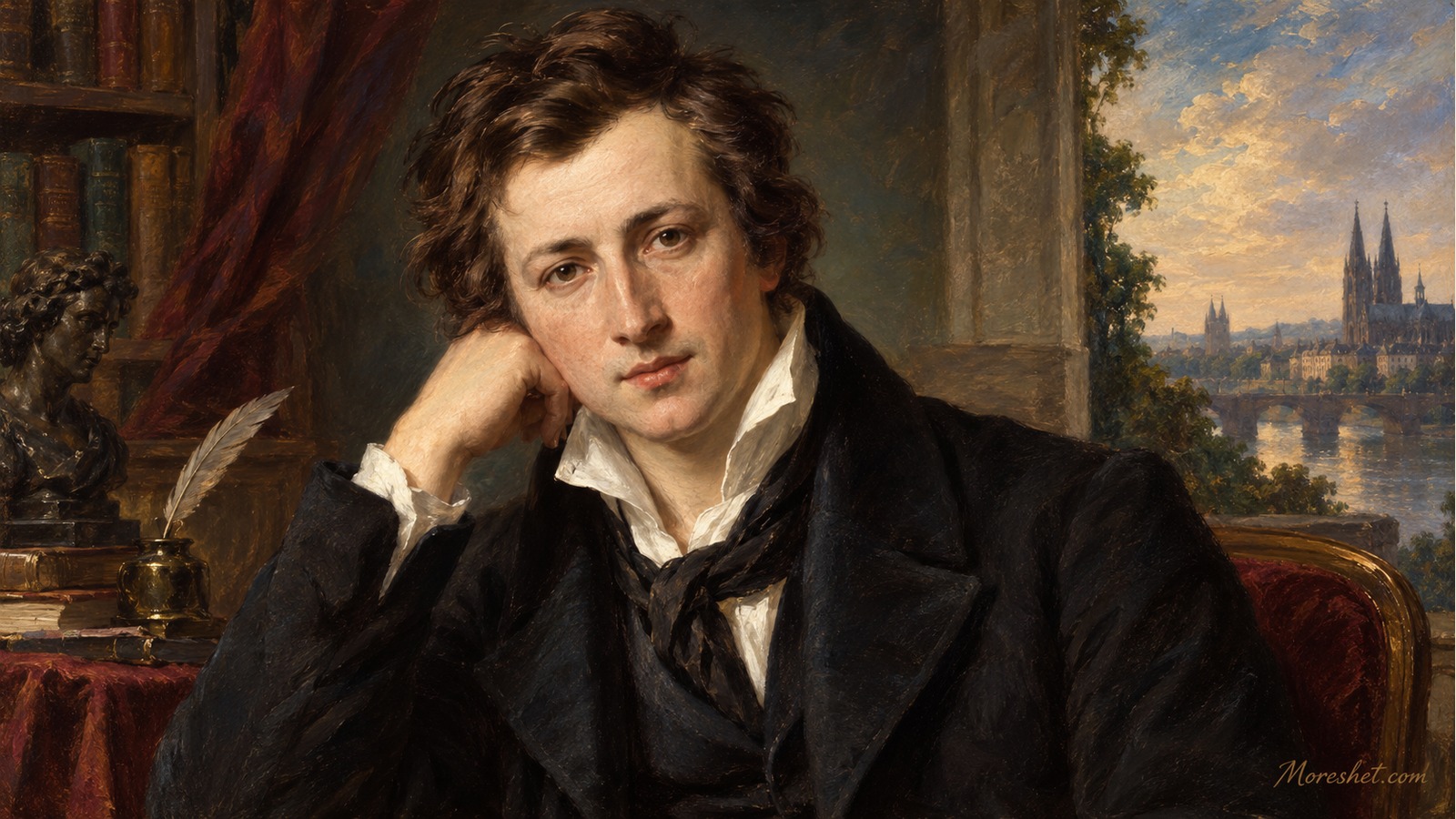
Heinrich Heine — AI-generated artistic portrait · Moreshet.com
Jewish-German poet, writer, essayist and political journalist whose work joined lyric beauty, irony, exile, Jewish memory and modern European criticism
Heinrich Heine, born Harry Heine and baptized in 1825 as Christian Johann Heinrich Heine, was a Jewish-German poet, writer, essayist, journalist and literary critic, one of the greatest and most complex figures in nineteenth-century German literature. Born in Düsseldorf in 1797 into a modern Jewish family, he studied law at German universities, converted to Lutheran Christianity in the hope of opening civic and professional doors, and spent most of his adult life in Paris as an exile, political writer and mediator between German and French culture.
Heine became one of the most translated, set-to-music and widely read German poets in the world. He emerged from German Romanticism but also turned it inside out. He made everyday language worthy of poetry, introduced irony, wit, sting and doubt into the lyric poem, and transformed the feuilleton, travel sketch and political essay into sharp literary forms. His work moves between disappointed love and criticism of nationalism, Jewish memory and the pain of conversion, longing for Germany and suspicion of German culture, the pleasures of life and the realities of illness, loneliness and death.
Jewish childhood in Düsseldorf
Heine was born on December 13, 1797, in Düsseldorf, a city shaped during his youth by French and Napoleonic influence, with its language of emancipation, citizenship and relative equality for Jews. His father, Samson Heine, was a textile merchant; his mother, Betty née van Geldern, came from a Jewish family marked by learning and culture. The family home was Jewish but modern, connected to the spirit of the Haskalah and to the hope of civic integration in European society.
The Düsseldorf of Heine’s childhood remained a place of double memory. It was the city of birth, streets, family, youth and the German language, but also a place where a young Jew learned the limits of liberal promise. The emancipation that seemed possible under French influence was not secure in post-Napoleonic Germany, and Heine grew up in a world where Jewish origin could open a deep cultural inheritance while also closing social and professional doors.
He wrote poetry from an early age. He studied at the Düsseldorf lyceum, but did not complete a smooth educational path. His family, especially his wealthy uncle Salomon Heine in Hamburg, hoped he would enter commerce. But Heine was not made for business. Attempts to train him in banking and textiles failed, not because he lacked talent, but because his real talent lay in language, image, irony, sharpness and wound.
Hamburg, disappointed love and the beginning of writing
During the years he spent in Hamburg under the patronage of his uncle Salomon, Heine encountered the world of wealthy Jewish bourgeois society, international commerce and the distance between financial success and literary vocation. His uncle supported him for years, yet never fully understood his calling as a poet. Heine, in turn, lived with gratitude, dependence and resentment.
His unrequited love for his cousin Amalie, and later complicated feelings toward other women in his family and circle, fed part of his early lyric poetry. In the Book of Songs, suffering in love, rejection, longing and self-irony became a distinctive poetic mechanism. The reader begins inside familiar Romantic feeling, but the poem suddenly turns, puncturing the elevated emotion and revealing the pain, absurdity or theatricality behind it.
Commercial failure became a kind of liberation. It led his family to allow him university study, officially with law in mind, but in reality it opened the path toward literature, philosophy and public controversy.
Bonn, Göttingen and Berlin: learning, philosophy and antisemitism
In 1819 Heine began studying law at the University of Bonn. Among his teachers was August Wilhelm Schlegel, one of the shapers of German Romanticism. He later moved to Göttingen and then to Berlin, where he heard lectures by Georg Wilhelm Friedrich Hegel and connected with literary circles, intellectual salons and Jewish scholarly networks.
In Bonn and Berlin he was also linked to the beginnings of the Association for the Culture and Science of the Jews, in which young Jewish intellectuals sought to study Judaism through scholarly, historical and philological tools. Figures in this environment included Leopold Zunz and others. For Heine this was a period of renewed encounter with Judaism as culture, history and language, not only as religion or social fate.
In Göttingen he encountered open antisemitism. One well-known episode involved a duel challenge after another student insulted him because of his Jewish background, leading to Heine’s temporary exclusion from the university. The episode reveals his situation: even when he sought entry into high German culture, his Jewish origin was placed before him as an obstacle, insult and reminder that education alone did not erase prejudice.
Baptism and the entrance ticket that did not open the door
On June 28, 1825, Heine was baptized into the Lutheran church in Heiligenstadt and took the name Christian Johann Heinrich. That same year he received a doctorate in law. The baptism did not arise from deep Christian religious awakening. Heine himself famously described it as an entrance ticket to European culture. He hoped the step would remove barriers to a legal, academic or public career.
That hope proved largely illusory. German society did not forget his origin, and Heine himself could not and would not cut away the Jew within him. He often regretted the conversion, not because he returned to a religious Jewish life, but because he discovered that after baptism he remained a Jew in the eyes of many, while in his own eyes he had sacrificed part of his inner integrity without receiving the equality he had been promised.
This conversion is one of the keys to understanding his work. It is not a simple story of betrayal or assimilation, but a modern tragedy of a European Jew who wished to become a full citizen of a culture he loved, only to find that the same culture used him, admired him and rejected him at once. From that wound came much of Heine’s great irony.
The Book of Songs and the invention of a new lyric voice
In 1827 Heine published the Book of Songs, the work that placed him at the center of German literature. The collection included early poems, love cycles, ballads and poems that quickly entered German cultural memory. The best known is Lorelei, which became almost a German folk song, even though its author was a baptized Jew whose books would later be burned by German nationalists.
The originality of the Book of Songs lies in its tone. Heine knew how to use Romantic melody, images of nature, love, moonlight, sea and tears, but at the end of the poem insert a sting, reversal or bitter smile. He taught German poetry that one could be lyrical without being naive, tender without being innocent, musical without surrendering criticism.
Thousands of musical settings were written for his poems, by composers including Robert Schumann, Franz Schubert, Felix Mendelssohn, Franz Liszt, Richard Wagner and many others. Schumann’s Dichterliebe, based on poems by Heine, is one of the great examples of his influence on classical music. Heine thus became not only a poet to be read, but a voice to be sung, heard and remembered.
Travel Pictures and the feuilleton as art
In the late 1820s Heine published the works collected as Travel Pictures, including The Harz Journey, The North Sea, Ideas: The Book Le Grand and other pieces. These writings turned the travel sketch and feuilleton into flexible, witty and brilliant literary forms. Instead of merely describing landscape, Heine used travel to speak about society, politics, memory, love, history and freedom.
His prose seemed light, but it was exact. He could move from witty sentence to poetic image, from roadside observation to political analysis, from joke to pain. In this he influenced the modern journalistic essay and the possibility of writing about culture and politics in language that is neither heavy nor shallow.
Heine admired the achievements of the French Revolution and the figure of Napoleon as a symbol of breaking the old order. His relation to Napoleon was Romantic and complex, but it expresses the depth of his longing for civil freedom and liberation from social structures of estate, religion and inherited privilege.
Paris: exile, freedom and mediation between cultures
In 1831, after the July Revolution in France and amid suffocation under censorship and political pressure in Germany, Heine moved to Paris. The city became his home until death. In Paris he found a freer intellectual space, a different public, a lively press, revolutionaries, artists, musicians and thinkers. He met figures such as Hector Berlioz, Frédéric Chopin, George Sand, Alexandre Dumas, Alexander von Humboldt, Karl Marx and Ferdinand Lassalle.
In Paris Heine worked as a correspondent, commentator and cultural mediator. He wrote for Germans about France and for the French about Germany. In books and essays such as French Affairs, On the History of Religion and Philosophy in Germany and The Romantic School, he tried to explain the spiritual, political and literary forces of the new Europe. He understood that literature is not detached from history, and that philosophy can precede politics as lightning precedes thunder.
His Paris exile was freedom and pain at once. He loved Paris, but longed for Germany; wrote in German, but lived in French; criticized Germany, but never ceased belonging to its language. This tension made him a deeply European figure: not only a German poet, but an intellectual of borders, translation, migration and estrangement.
German censorship and Young Germany
In the 1830s Heine’s writings were banned in Prussia and then across the German Confederation together with the writings of Young Germany. The authorities saw him as dangerous because his works attacked religious, social and political institutions, challenged conservative tradition and voiced a desire for democratic freedom and public criticism.
Heine was not a simple propagandist. He disliked crude didactic literature even when he sympathized with progressive political aims. For him, good political writing had to be good literature. That is why his power was so great: he did not reduce poetry to manifesto, but made the manifesto artistic.
In his book on religion and philosophy in Germany, he warned the French about violent and nationalist forces that could one day erupt in Germany. In retrospect those warnings have often been read as almost prophetic, especially after his books were burned by the Nazis. But even in his own time they showed acute perception. Heine understood that German culture could produce music, philosophy and poetry, but also a cult of force, hatred of foreigners and political violence.
Judaism in his work: irony, longing and memory
Judaism in Heine’s work does not appear as simple religion or stable identity. It appears as memory, wound, inheritance, irony, historical story, longing and ineradicable belonging. Although he converted to Christianity, Heine returned again and again to Jewish figures, the Bible, Jewish history, the Sabbath, Moses, Judah Halevi and the experience of exile.
The cycle Hebrew Melodies includes works such as Princess Sabbath and Judah Halevi, where one finds Heine’s characteristic mixture of affection, humor, parody and deep respect. In Judah Halevi, he presented the great Spanish Jewish poet as a figure whose longing for Zion expresses spiritual and historical power. In doing so, Heine connected the heritage of Sephardic Jewry with modern German poetry.
In the fragment The Rabbi of Bacherach, written partly in response to the Damascus blood libel, Heine sought to create a broad Jewish novel. The work remained unfinished, but its existence matters. It shows that Heine regarded Jewish life, fear of blood libel, communal tradition and the memory of persecution as central literary material, not marginal subject matter.
Moses, Judah Halevi and the Sabbath
In his writings Heine returned to the figure of Moses as lawgiver, maker of a people and spiritual leader. In one of his famous formulations, he presented Moses as someone who built not pyramids of stone, but a living people. The image expresses Heine’s deep understanding: Jewish power is not measured only by kingdom or military victory, but by the ability to create memory, law, language and a people that endures in exile.
His relation to Judah Halevi was especially significant. Heine, the Jewish-German poet exiled in Paris, wrote about the Spanish Jewish poet who dreamed of Jerusalem. Through Judah Halevi he could speak about longing for Zion, Sephardic Jewish culture, poetry as historical force and the gap between cultural belonging and an unreachable home.
The Sabbath also appeared in his work as a Jewish poetic and cultural experience. In Princess Sabbath Heine joined parody, warmth, Jewish food, longing and wit. He turned a domestic Jewish experience, simple and sensual in part, into literary material of universal force.
Heine, Marx and The Silesian Weavers
In the 1840s Heine became more political and radical in tone. He knew Karl Marx and Friedrich Engels, published in journals connected to their circle and early understood the distress of the new working class. His poem The Silesian Weavers, written after the weavers’ uprising of 1844, is one of the powerful social poems of the period.
The poem was circulated as a leaflet and enraged the Prussian authorities. It gave voice to class pain, hunger, exploitation and anger against king, fatherland and God as powers perceived to have abandoned the poor. Heine showed that poetry could be a moral weapon, not only the expression of private feeling.
Yet Heine never became a Marxist in the full sense. He feared radical communism and the possibility that it would destroy parts of European culture he loved. This complexity matters. He understood the cry of the poor, but distrusted every ideological system that promised total redemption at the price of liberty, beauty and human plurality.
Germany: A Winter's Tale and national satire
In 1844 Heine published Germany: A Winter's Tale, one of his greatest satirical works. It arose from his last journey to Germany to visit his mother and combines actual travel, dream, politics, longing, insult, love and hatred. Heine returns to his homeland, but he can no longer be at home there.
In this work he attacked German nationalism, censorship, the Romantic worship of an imagined past, the church and the old political order. Yet the attack does not come only from outside. It comes from someone who loved the German language painfully, and therefore refused to allow it to become a language of servility, hypocrisy and violence.
Heine’s satire is not light laughter. It is the laughter of someone who understands that the homeland can be both home and danger. That is why Germany: A Winter's Tale remains central to understanding the German-Jewish relationship: deep attraction to German culture together with the ability to see its cracks earlier than many others.
Illness, the mattress grave and late poetry
In 1848 Heine’s illness worsened dramatically, and he entered the long period he called his mattress grave. For the last eight years of his life he was nearly paralyzed, suffering from pain, visual problems and severe weakness. The diagnosis of his illness remains debated, with hypotheses over the years including syphilis, multiple sclerosis, motor neuron disease and lead poisoning. What is clear is that the suffering was heavy and prolonged.
Despite his condition, his creative power did not disappear. He dictated poetry and prose, published Romanzero in 1851 and Confessions and Lutetia in his final years. His late poetry is deeper, more exposed and often more bitter. It speaks with death, with God, with the treacherous body, with late love and with the memory of life to which the poet still clings.
During these years there was also movement in his relation to religion. He declared belief in a personal God, but did not return to religious Judaism and did not sincerely rejoin any church. He rejected the rumor that he had retreated into the arms of a church, but moved away from absolute atheist pride. Here too Heine remained faithful to complexity: a man unwilling to abandon reason, irony and freedom, yet unwilling to abandon metaphysical longing.
Death in Paris and burial in Montmartre
Heine died in Paris on February 17, 1856, and was buried in Montmartre Cemetery. His wife, Eugénie Crescence Mirat, whom he called Mathilde, was buried beside him years later. Mathilde did not share his German literary world, and Heine loved, among other things, that she did not fully understand the literary status of the man she had married. Their relationship was complicated, human and sometimes comic, like much in his life.
One deathbed line attributed to him — that God will forgive him because that is His profession — captures the Heinean combination of joke, theology, audacity and fear. Even before death he did not surrender wit, but behind it stood real pain and recognition of human limits.
His grave in Paris became a site of memory for German literature, European Jewry, exile and freedom of thought. Symbolically, the poet who had to leave Germany was buried in France, yet remained one of the greatest writers in the German language.
Book burning and posthumous memory
After his death, the argument over Heine continued and even intensified. In the nationalist and antisemitic Germany of the late nineteenth and early twentieth centuries, many found it difficult to accept a writer of Jewish origin, a convert, satirist, liberal and enemy of nationalism as a central voice of German literature. Struggles over memorials to him, especially in his birthplace Düsseldorf, revealed the depth of resistance to him.
In 1933 the Nazis burned Heine’s books together with those of Jewish, liberal, socialist and other writers. The act gave chilling meaning to his famous line from the play Almansor: where they burn books, they will in the end burn human beings. The line was written in a different historical context, but after the Holocaust it became one of the great warnings of European literature.
The Nazis tried to erase his name and to hide the Jewish contribution to German culture, but they could not erase his place in the language, in music and in literary memory. That fact reveals the historical irony: a culture that sought to expel the Jew from itself could not part from the melody he had given it.
Commemoration in Israel and the Jewish world
In Israel, Heine was received with admiration, unease and argument. On the one hand, poets, translators and scholars saw him as one of the great Jewish voices of Europe. Hayim Nahman Bialik referred to him as one of the poets of Israel in connection with Sabbath poetry. On the other hand, his conversion made official commemoration difficult in some cities for many years.
In Tel Aviv, a street was first named not directly for him but for The Rabbi of Bacherach, the Jewish novel fragment he had planned. Only later was a street named for Heinrich Heine himself. In Jerusalem, a small street in Mishkenot Sha'ananim bears his name. In Haifa, the twin city of Düsseldorf, the Heinrich Heine House has operated as a cultural center, and Israel issued a postage stamp in his honor. These forms of remembrance show that even within Jewish memory Heine remains complex: not a simple saint, but a lost son, critic, poet and participant in fate.
The difficulty of commemorating him is part of his importance. Heine forces Jewish memory to face questions of conversion, assimilation, rejection, exile, foreign language and cultural contribution that does not always come from visible religious loyalty. Precisely because he is not simple, he matters.
Literary and musical influence
Heine’s influence on European literature is vast. He was a lyric poet, satirist, essayist, journalist, cultural critic and politician of language. He influenced German, French, Russian, Hebrew and wider European writing, and helped shape the modern understanding of the poet as someone who lives inside history rather than outside it.
In music his influence was enormous. Thousands of settings were written for his poems, and they entered the repertoire of the German Lied and Romantic music. The musicality of his poetry, together with its irony, posed a special challenge to composers: how to set a poem that sounds like innocent love but ends in a bitter smile.
In journalism and the essay he showed that one could write lightly about serious matters, and also expose through a light sentence the depth of political absurdity. In this he anticipated many forms of modern writing: the personal column, cultural criticism, political essay and intellectual satire.
A Jewish-European legacy of non-belonging
Heine is one of the essential figures for understanding the modern Jewish-European condition. He did not live as a religious Jew, did not remain inside a Jewish community, and did not always speak of Judaism with solemn loyalty. Yet his Jewishness never left him. It was a source of injury, humor, memory, pride and pain.
In this he represents many Jews of the modern age: people drawn to European culture, making decisive contributions to it, seeking entry into it, and repeatedly encountering the boundaries of acceptance. Heine knew how to write that pain without reducing it to a slogan. He turned it into art.
His legacy cannot be reduced to love or criticism, Judaism or conversion, Germany or France. It lives in the tension between them. That is why Heine remains so modern: he lived inside unresolved contradictions and wrote them in language that is beautiful, dangerous, funny and painful.
Why this legacy belongs in Moreshet
Heinrich Heine merits inclusion in Moreshet because he is one of the most influential Jewish-European writers of the nineteenth century. He transformed German poetry, gave it a new self-aware lyric voice, turned journalistic and essayistic prose into art, fought censorship and nationalism, wrote about Judaism, exile, the Sabbath, Judah Halevi and Moses, and influenced literature, music, political thought and Jewish memory.
Moreshet.com documents Heine because Jewish and Israeli heritage includes the stories of Jews who lived at the borders of identities, languages and cultures. Heinrich Heine’s place in Moreshet rests on the rare combination of literary genius, Jewish pain, freedom of thought, moral criticism and historical warning against book burning, xenophobia and destructive nationalism. He reminds us that even a poet who distanced himself from religious community can remain deeply part of Jewish memory, and that sometimes the voice of exile is the voice that reveals a culture’s truth to itself.