Hazi Carmel
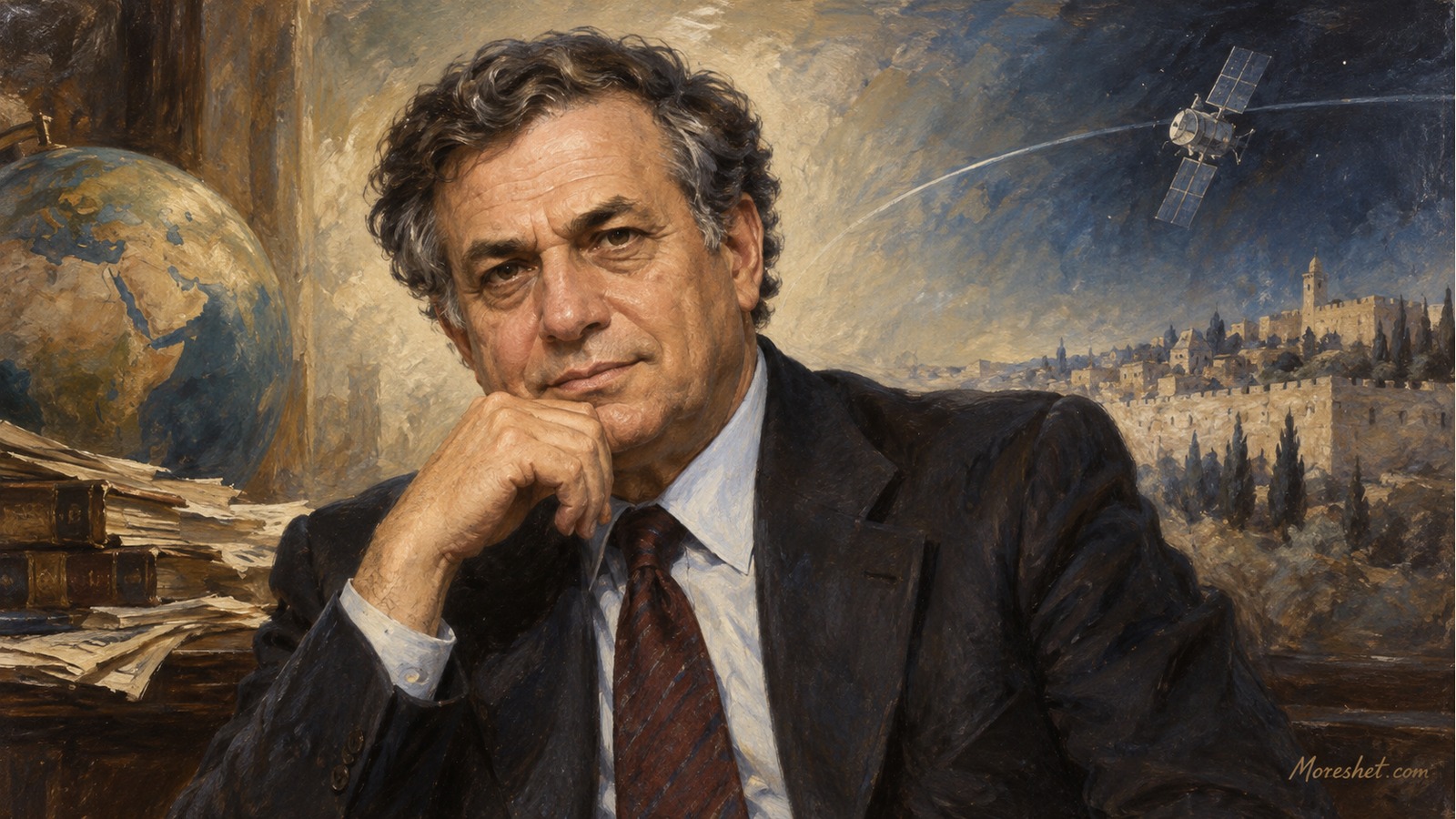
Hazi Carmel — AI-generated artistic portrait · Moreshet.com
Intelligence officer, diplomat, defense journalist, and entrepreneur who helped establish the commercial foundations of Israel’s AMOS communications-satellite venture
Hazi Carmel (March 24, 1937–April 22, 2007) worked for decades at the intersection of intelligence, diplomacy, journalism, and communications technology. He served in the Mossad and Israel’s foreign service, reported on military and regional affairs for Israeli and French publications, edited a book examining how intelligence could support peacemaking, and became one of the early initiators of the business venture from which Israel’s AMOS communications-satellite enterprise developed.
Carmel’s distinctive contribution lay in connecting fields that usually operated separately. His intelligence and diplomatic experience informed his journalism; his understanding of security and communications needs led him toward satellite entrepreneurship; and his study of the Middle East joined firsthand reporting with sustained attention to the diplomatic possibilities created by discreet channels of contact.
From military liaison work to intelligence and diplomacy
Carmel was born in Tel Aviv during the British Mandate. He served in the Israel Defense Forces as a liaison officer and sat on the Israel–Syria Mixed Armistice Commission, one of the bodies responsible for addressing border incidents and implementing the armistice arrangements that followed Israel’s War of Independence. The assignment placed him early in his career in the sensitive territory where military security, negotiation, and communication between adversaries met.
In the early 1960s, he completed his studies at the Paris Institute of Political Studies. He also held several positions in the Mossad. Among them, he served as bureau chief to Meir Amit, one of the central figures in the history of Israeli intelligence, and later headed a branch of the Mossad’s Tevel division in Southeast Asia. Tevel is responsible for the organization’s foreign relations and operational liaison, making such work dependent on regional knowledge, discretion, relationship-building, and diplomatic judgment.
Carmel also served in Israel’s diplomatic missions in Paris, Abidjan, Kinshasa, Bangkok, Tokyo, and Singapore. In September 1970, he became Israel’s consul in Los Angeles, remaining in that position until 1972. His assignments across Europe, Africa, Asia, and the United States gave him an unusually broad view of Israel’s international position at a time when the young state was expanding its diplomatic and economic relationships.
Defense journalism grounded in firsthand experience
In 1968, Carmel was appointed military and defense correspondent for the Israeli newspaper Maariv. His reporting extended beyond battlefield affairs to Palestinian society, the broader Arab world, the Kurds in Iraq, and the meeting points of law, military government, and regional politics. His familiarity with government and diplomatic institutions gave his journalism the perspective of someone who understood official systems from within but was now writing for the public.
For approximately thirty years, he also served as a commentator on Israel and the Middle East for the French weekly L’Express. In that role, he helped European readers understand Israeli society, the country’s security considerations, and the region’s political transformations. This long-running work for an international publication mattered particularly during decades when perceptions of Israel abroad were shaped by a relatively small group of correspondents and specialists with direct knowledge of the region.
The Yom Kippur War and Hamikhdal
During the 1973 Yom Kippur War, Carmel accompanied a paratrooper force that crossed the Suez Canal. His frontline experience contributed to Hamikhdal—a Hebrew title meaning “The Failure” or “The Blunder”—a book written collectively by Carmel and fellow journalists Uri Dan, Eitan Haber, Eli Tavor, Yeshayahu Ben-Porat, Yehonatan Geffen, and Eli Landau.
Published immediately after the war, the book presented vivid accounts of the battlefields, casualties, and loss of equipment while raising searching questions about Israel’s preparation for the conflict. Its rapid appearance made it an important document in the first wave of public debate that followed the war. Carmel’s participation formed part of the larger role played by military correspondents at the time: documenting the human and material cost of the fighting and giving Israelis information with which to reassess assumptions about leadership, warning, and military readiness.
Intelligence as an instrument of diplomacy
Carmel viewed intelligence as more than a mechanism for warning governments and managing wars. That idea found its clearest expression in the volume Modi’in Le-Shalom: On the Role of Intelligence in Times of Peace, which he edited. According to the edition documented in the archive’s source material, the 317-page book was published by Yedioth Ahronoth in 1998 and brought together essays by experienced practitioners and academic specialists.
The volume’s central argument was that intelligence services can play an important part during negotiations as well as crises. Their relationships and discreet channels may allow governments to exchange messages, assess intentions, reduce uncertainty, and prepare for formal talks before public communication becomes politically possible. Its contributors examined Middle Eastern cases and experiences, some of which had not previously been presented to a broad readership.
The book’s significance lies in this change of perspective. Rather than treating intelligence solely as a way to gain an advantage over an adversary, it explored how information, relationships, and confidentiality might also help societies move from confrontation toward dialogue. For Israel—a country required since its founding to combine self-defense with the continuing search for regional agreements—the subject has both historical and practical importance.
Carmel also examined relations between Israel and its neighbors in Kesher K: The Secret Diary of the Israeli-Egyptian Interim Agreement, written with Judy Kipper and published in 1975. The book addressed contacts surrounding the interim agreement with Egypt during the years before the countries signed their peace treaty. In 1980, he and Rani Carmel published Embassy, another work informed by familiarity with diplomatic life.
From intelligence to space: the beginnings of AMOS
During the early 1980s, Carmel turned part of his attention to business. In 1981, he and Meir Amit initiated an Israeli communications-satellite project that became associated with the AMOS program. Together with French businessman Jean Frydman, they established the General Satellite Services Company and recruited additional investors in Israel and the United States. The company later held approximately a quarter of Spacecom, the operator of the AMOS satellites.
Carmel was not the engineer who designed the spacecraft or its systems. His contribution was entrepreneurial and organizational: identifying the need, assembling partners, creating a business framework, and helping to secure investment for the idea of an Israeli communications-satellite enterprise. That distinction is important, but it does not lessen the value of his work. Space industries require more than engineering; they also depend on people who can connect technology, capital, policy, and markets.
The initiative in which Carmel participated helped lay the commercial groundwork for the AMOS name, which became a prominent part of Israel’s space and communications activity. Pursuing the idea in the early 1980s also demonstrated foresight. Communications satellites would become vital to television broadcasting, data transmission, and connections among countries and communities separated by great distances.
Further communications ventures
Carmel’s interest in the relationship between content and emerging distribution technology appeared in several other projects. In 1980, he led an investor group that sought to produce a television series about the Bible and create a biblical-style filming site that could later serve as a tourist attraction. In 1990, he competed for a regional cable-television franchise. In 1999, he participated in establishing InterTV, a company that sought to develop digital television services delivered through the internet. Not all these plans matured into lasting enterprises, but together they show his sustained attention to the possibilities opened by changes in broadcasting technology.
Political thought and the future of the region
After the Six-Day War, Carmel joined the Committee for an Israel–Palestine Federation alongside Uri Avnery, Shalom Cohen, Boaz Evron, Nathan Yellin-Mor, and Amnon Zichroni. The committee was among the early Israeli groups to advocate dividing the land into an Israeli state and a Palestinian state, rather than returning all the territories captured in the war to Jordan, Egypt, and Syria. His participation reflected his continuing interest in how regional knowledge, contact, and communication might be translated into a more stable political framework.
Carmel died on April 22, 2007, at the age of seventy, and was buried in the cemetery of Kibbutz Ein Carmel. He left a body of work that cannot be confined to a single profession: state service, public-interest reporting, writing and editing about intelligence and diplomacy, and entrepreneurship directed toward the future of Israeli communications.
Why Hazi Carmel’s legacy belongs in Moreshet
Hazi Carmel merits inclusion in Moreshet because his career illuminates several important chapters in the development of modern Israel: the growth of the young state’s intelligence and foreign services, the press’s role in shaping public reflection after the Yom Kippur War, the use of discreet channels to support diplomacy, and Israel’s emergence into the age of satellite communications.
His impact is clearest in the connections he created. He brought intelligence experience to public reporting, encouraged readers to consider intelligence as a possible instrument for reducing conflict, and helped turn an ambitious proposal for an Israeli communications satellite into an organized venture with partners and investors. These were tangible contributions to Israel’s security, its public conversation, and the technological and commercial capabilities that strengthened its connections with the wider world.
Preserving his story on Moreshet.com gives deserved attention to a figure who often worked behind the scenes but participated in institutions and initiatives that shaped Israeli life. His legacy is a reminder that national achievements are created not only by the most visible leaders, but also by people able to bring together knowledge, institutions, investors, and ideas—and convert them into foundations for sustained action.