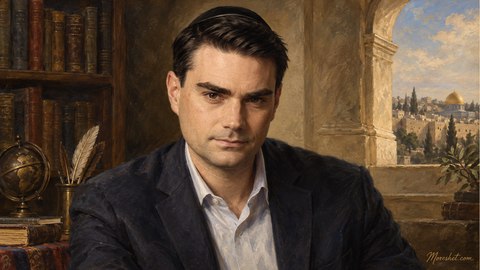
Groucho Marx
The Jewish American comedian who transformed wit, improvisation, and satire across film, radio, and television
Julius Henry “Groucho” Marx (October 2, 1890 – August 19, 1977) was a Jewish American comedian, actor, singer, host, and writer whose career helped define modern popular comedy. Active for more than seven decades, he moved from vaudeville and Broadway to motion pictures, radio, and television, carrying with him a distinctive style of rapid speech, verbal invention, self-mockery, improvisation, and irreverence toward authority.
Marx first became famous as part of the Marx Brothers, one of the most influential comedy teams in American theater and cinema. He then built an important solo career, most notably as the host of You Bet Your Life, a radio and television quiz-and-interview program that became one of the leading entertainment shows of the mid-twentieth century. His legacy lies not only in the films and programs he made, but also in the comic language he shaped, the image of the Jewish American entertainer he embodied, and the generations of performers and writers who absorbed his timing, irony, and creative freedom.
A Jewish New York childhood and the beginning of a career
Marx was born in Manhattan to a Jewish family of German and French background that had immigrated to the United States. His father, Sam “Frenchie” Marx, came from an Alsatian family, while his mother, Minnie Schönberg, had immigrated from northern Germany. The family lived among New York’s immigrant communities, in a multilingual urban environment shaped by Irish, German, Italian, and Jewish life.
His parents encouraged their children to enter show business, and his maternal uncle Al Shean was a successful vaudeville performer. Groucho played guitar, sang, and read avidly, but the family’s financial difficulties forced him to leave school at an early age. In 1905 he began performing as a young singer, and he later joined his brothers on the vaudeville circuit.
The family act went through several names and configurations. When the brothers began adding jokes and dialogue to their performances, they discovered that audiences responded more enthusiastically to them as comedians than as singers. That change—from a musical act to a comic one—was decisive. It led to the characters and rhythm that would make the Marx Brothers an international phenomenon.
The Marx Brothers: from stage to screen
Groucho appeared with his brothers in three Broadway shows and thirteen feature films. Alongside Chico and Harpo, he developed the persona of a fast-talking, charmingly dishonest outsider who refused to respect social rules and dismantled them through jokes. His painted mustache, glasses, cigar, and bent walk became instantly recognizable, but his greatest strength was the ability to invent a sharp response at precisely the right moment.
Among the major films in which he appeared were The Cocoanuts, Animal Crackers, Monkey Business, Horse Feathers, Duck Soup, A Night at the Opera, A Day at the Races, Go West, and A Night in Casablanca. These films combined music, staged chaos, social satire, and rapid dialogue, expanding the possibilities of screen comedy. Groucho did not merely deliver written lines; he was known for improvisation, disrupting the rhythm of a scene and turning encounters with authority figures into comic confrontations.
The Marx Brothers therefore made a major contribution to American popular culture. They showed that comedy could be unruly, intellectual, musical, and critical at the same time. For many Jewish American artists, their success also demonstrated that immigrant accents, urban experience, and humor rooted in cultural survival could become artistic strengths that reached a mass audience.
A solo career and You Bet Your Life
In 1947 the brothers began developing separate careers. Groucho found a medium especially suited to his abilities in radio, where he could improvise in conversation and respond instantly to guests. After appearing on a program with Bob Hope, he became the host of You Bet Your Life.
The program began on radio in 1947, moved to television in 1950, and continued on television until 1961. Groucho was joined by announcer George Fenneman, who served as both comic partner and straight man. The premise was simple: contestants played a quiz game, but the most memorable part was often Groucho’s unpredictable conversation with them beforehand. He asked questions, listened to details about their lives, improvised jokes, and turned an incidental answer into the center of the program.
The format mattered because it made the host’s personality central to the entertainment. Rather than relying solely on scripted sketches, the show combined game, conversation, and improvisation, demonstrating how a television program could be built around a performer’s ability to read a room and react to it. Its success made Groucho one of the most recognizable figures in 1950s American television and helped shape the modern entertainment host.
Writing, books, and a personal comic style
Alongside his work as a performer and host, Groucho considered himself a writer. In 1959 he published the memoir Groucho and Me, followed in 1963 by Memoirs of a Mangy Lover. He also published letters, essays, and other books, and co-wrote the screenplay for the 1937 film The King and the Chorus Girl with Norman Krasna.
Writing allowed him to extend his comic persona beyond stage and screen. His sentences often operate as verbal traps: they begin with a familiar line of reasoning and end in reversal, exaggeration, or an observation that unsettles the reader’s assumptions. His books and correspondence preserved his individual voice and documented the cultural world in which he worked, making him more than a screen character. They gave audiences access to his memories, ideas, and literary craft.
His stage appearance was equally deliberate: painted mustache, darkened eyebrows, glasses, cigar, and a stylized walk. When he moved into television, he replaced the painted mustache with a real one, but the persona remained immediately recognizable. The look became a cultural symbol; Groucho-style glasses and costume accessories are still sold around the world.
A Jewish American voice of irony and independence
Groucho’s comedy was not a formal statement of Jewish identity, but it grew from the experience of a Jewish immigrant family, a multilingual city, and a performer’s need to advance through talent, resourcefulness, and resilience. He used irony to reverse relations of power: the figure who appeared to be a shabby schemer was often the only person in the room unafraid to say aloud what others were thinking.
This approach helped make comedy a form of intellectual freedom. Groucho mocked status, money, institutions, and social etiquette, but did so through wordplay and wit rather than direct declamation. His famous line, “I don’t want to belong to any club that would accept me as a member,” became an emblem of his suspicion toward institutions that define who is worthy of belonging.
An enduring influence on culture
Groucho Marx influenced comedians, actors, writers, and television hosts for generations. His persona and recognizable gestures appeared in advertising, television series, comic books, music, and film. Performers and fictional characters adopted elements of his mustache, cigar, posture, rhythm, and upside-down logic.
Queen albums titled A Night at the Opera and A Day at the Races drew their names from Marx Brothers films, while filmmakers such as Woody Allen incorporated Groucho’s songs and image into later works. Other actors continued to portray him in stage productions, television programs, and one-person shows, turning his legacy into a living performance tradition rather than a closed chapter of film history.
In 1974 Groucho received an honorary Academy Award on behalf of the Marx Brothers, recognizing his brilliant creativity and their achievements in motion-picture comedy. He continued to appear and give interviews into his later years before dying in Los Angeles in 1977 at the age of 86.
Why this legacy belongs in Moreshet
Groucho Marx merits inclusion in Moreshet because his career stands at an important intersection of Jewish life, immigration, American culture, and mass media. He did not establish an institution or lead a political movement, but through films, radio and television programs, books, and live performance, he reached millions of people and expanded the boundaries of popular comedy.
His legacy also matters in a Jewish and Israeli context. He represents a generation of Jewish American creators who transformed immigrant family experience, linguistic difference, and urban resourcefulness into art with worldwide influence. His wit showed how humor could challenge authority, defend independent thought, and create a shared cultural language. At Moreshet.com, Groucho Marx belongs not only as a film star, but as an artist who left behind a comic vocabulary, a cultural persona, and a Jewish American memory that continue well beyond the years in which he performed.