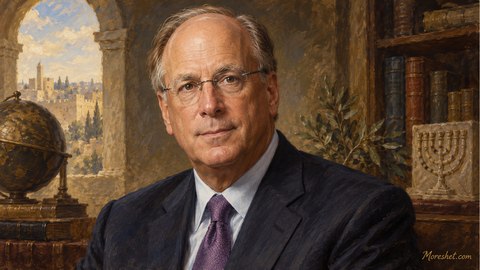
Gad Machnes
Zionist land developer and institution builder who helped lay the foundations of Netanya and Even Yehuda
Gad Machnes (August 1893–March 7, 1954) was a Zionist activist, land developer, agricultural entrepreneur, and public official who helped establish Netanya and Even Yehuda. Through the Hanotea company, the Bnei Binyamin movement, citrus growers’ organizations, and related financial and marketing institutions, he helped turn large tracts of land into orchards, neighborhoods, and communities. He later served as director-general of Israel’s short-lived Ministry of Minority Affairs during the state’s formative years.
Raised among the founders of Petah Tikva
Machnes was born in Petah Tikva to Aharon Leib Machnes, a First Aliyah pioneer and one of the founders of the agricultural colony, and Chaya Sarah, the daughter of fellow Petah Tikva founder Asher Zelig Blum. Settlement was therefore not an abstract ideal in his childhood. It was the practical work of his family and community: cultivating land, organizing local institutions, and creating a durable civic life.
He attended the school maintained by the Palestine Jewish Colonization Association, commonly known by its French initials, PICA. In 1921 he married Efrat, the daughter of Aryeh Leib Gisin and Leah Ostashinsky, members of another Petah Tikva settler family. Machnes belonged to a rising second generation of the moshavot—children of the early pioneers who sought to extend the settlement enterprise beyond the boundaries of the first agricultural colonies.
Hanotea and the development of new communities
Linking land acquisition to urban growth
In 1924, Machnes founded the Hanotea company with his brother Moshe Machnes, Oved Ben-Ami, and other partners. The company acquired tens of thousands of dunams for agriculture and urban construction. Its work joined several stages of development that were often inseparable in Mandatory Palestine: acquiring land, making it usable, planting productive orchards, and creating the corporate structures needed to build new communities.
Among Hanotea’s major undertakings was the acquisition of thousands of dunams near the Mediterranean coast in the Sharon region, on land where Netanya developed. At the company’s initiative, the British Mandatory authorities drained swamps in the area, helping make extensive additional tracts suitable for settlement and cultivation. In 1930, Hanotea formed the Netanya Coast Development Company Ltd. to advance the city’s development. Machnes was thus involved not only in obtaining land but also in the practical mechanisms through which a new urban center could take shape.
Even Yehuda and other land projects
Hanotea’s activity extended beyond Netanya. It acquired extensive areas in Yehudiya, now Yehud; approximately 2,000 dunams near Tzafriya, where citrus orchards were planted; and some 7,000 dunams in the Sharon on which Even Yehuda was founded. The company also acquired roughly 5,000 dunams near Shfaram for urban construction.
These projects reflected a broad conception of settlement. The land was intended to support homes, agriculture, employment, and commercial activity rather than remain a passive holding. Netanya and Even Yehuda, which grew into established Israeli communities, are among the clearest surviving expressions of the work in which Machnes participated.
Strengthening the citrus economy
Citrus growing was a central pillar of the Jewish economy in Mandatory Palestine. Successful orchards required more than suitable soil and agricultural skill: growers needed credit, packing and transport arrangements, coordinated marketing, and access to overseas buyers. Machnes worked across several parts of this economic chain.
In 1932, he and Peretz Pascal founded Bustan, an association of citrus growers. He took part in establishing the Pardes Syndicate in 1939 and served on its executive committee until 1946. That year, he and his brother Moshe acquired Hadarei Jaffa, a citrus marketing company. Machnes also sat on the leadership of the Farmers’ Federation.
These roles made him an economic organizer as well as a land entrepreneur. Growers’ associations and marketing companies enabled orchard owners to pool resources, coordinate their work, and sell produce on a larger scale. His efforts helped sustain an industry that provided livelihoods in numerous Jewish communities and connected the developing economy of the Yishuv with international trade.
Bnei Binyamin, banking, and public service
Machnes was active in Bnei Binyamin, an organization associated with the native-born children of the early agricultural settlers. The movement promoted settlement and economic initiatives, and Machnes chaired the council of its bank. This financial leadership complemented his other work: purchasing and preparing land, planting orchards, and creating new communities all required access to capital, long-term planning, and institutions capable of turning proposals into lasting projects.
Following the establishment of Israel, Machnes served as director-general of the Ministry of Minority Affairs, which operated for a brief period in 1948 and 1949. The ministry addressed civil and administrative matters during the state’s exceptionally complex first years. His service added a governmental dimension to a career previously centered on settlement, agriculture, finance, and organizational development.
Death and commemoration
Machnes died in Tel Aviv on March 7, 1954, and was buried in Segula Cemetery in Petah Tikva, the city of his birth and of his family’s pioneering work. Streets in both Netanya and Petah Tikva were subsequently named in his honor. The two locations capture the arc of his life: from the first generation of Jewish agricultural colonies to the creation of new urban and rural communities in the Sharon.
Israeli footballer Gad Machnes, a grandson of his brother Yitzhak, was named for him. Yet Machnes’s most substantial memorial remains embedded in the landscape itself—in communities, orchards, and economic institutions whose development he helped advance.
Why Gad Machnes belongs in Moreshet
Gad Machnes merits inclusion in Moreshet because his career shows how Zionist settlement was built through sustained institutional work as well as political vision. He helped acquire and prepare land, establish development companies, organize citrus growers, support financial frameworks, and translate plans into functioning communities. His part in the growth of Netanya and the founding of Even Yehuda produced a lasting effect on Israel’s physical and civic landscape.
His story also illuminates an important generational bridge in modern Jewish history. Born into families that helped found Petah Tikva, Machnes carried the practical experience of the early moshavot into a wider era of urban development, commercial agriculture, and state institutions. By preserving his record, Moreshet and Moreshet.com document a legacy of Jewish and Israeli community building whose results remain visible in the country’s towns, economy, and everyday life.