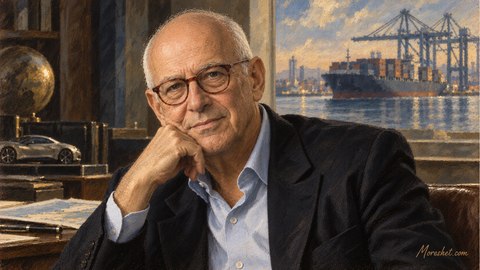
Eli Broad
The Jewish American entrepreneur who turned business success into enduring institutions for art, education, and scientific research
Eli Broad (June 6, 1933–April 30, 2021) was a Jewish American businessman and philanthropist who built his fortune through two major business ventures: homebuilding and insurance. His lasting public legacy, however, extends well beyond commerce. Together with his wife, Edythe, he invested billions of dollars in contemporary art, public education, genomic and medical research, and cultural institutions. Through gifts, institution-building, and sustained personal involvement, Broad helped make Los Angeles a major cultural and research center with global reach.
From a Jewish immigrant family to business leadership
Broad was born in the Bronx, New York, the only child of Rebecca and Leo Broad, Jewish immigrants from Lithuania. His father worked as a house painter and union organizer, while his mother was a dressmaker. When Broad was six, the family moved to Detroit, where he attended public schools and graduated from Detroit Central High School in 1951.
He studied accounting and economics at Michigan State University, graduating cum laude in 1954. That same year he married Edythe, later known as Edye Broad. During college he held a series of jobs, including selling shoes and garbage disposals. After graduation he worked as an accountant, taught evening classes, and established his own accounting practice.
His professional relationship with Donald Kaufman, who operated a small homebuilding and subcontracting business, led Broad into construction. In 1956 the two founded Kaufman and Broad. They set out to make first homes affordable to young families by streamlining construction: instead of basements, they offered carports, allowing them to price homes so that the monthly mortgage could cost less than rent for a two-bedroom apartment. Their first model, called the “Award Winner,” sold for $13,700; seventeen were sold during its first weekend.
Within two years the company had built 600 homes in the Detroit suburbs. In 1960 the partners moved to Phoenix, seeking to reduce their dependence on Detroit’s auto-centered economy, and in 1961 Kaufman and Broad Home Corporation went public on the American Stock Exchange. Broad moved the company to Los Angeles in 1963. The company, later known as KB Home, became the first homebuilder listed on the New York Stock Exchange in 1969. Broad stepped down as chief executive in 1974.
SunAmerica and the turn toward philanthropy
In 1971 Broad acquired Sun Life Insurance Company of America, a small family-owned insurer founded in Baltimore in 1890. He transformed it into SunAmerica, a major retirement-savings company. SunAmerica went public in 1989 and was sold to AIG in 1998 for $17.8 billion. Broad remained its chief executive until 2000, when he left day-to-day corporate leadership to devote himself primarily to civic work and philanthropy.
Broad and Edythe established the Eli and Edythe Broad Foundation and the Broad Art Foundation. In 2010 they joined the Giving Pledge, committing to give away 75 percent of their wealth. By October 2017, their giving had exceeded $4 billion, supporting education, scientific and medical research, and the arts. Their philanthropy was not limited to one-time donations: it created institutions, professional-development programs, research infrastructure, and new ways for the public to encounter art and knowledge.
Art and the cultural life of Los Angeles
Broad was the founding chairman of the Museum of Contemporary Art, Los Angeles, established in 1979, and chaired its board until 1984. He recruited the museum’s founding director and helped negotiate the acquisition of the Panza Collection, one of the institution’s important foundational collections. In 2008 the Broad Foundation gave the museum $30 million, with the condition that it remain independent.
He was a life trustee of the Los Angeles County Museum of Art. In 2003 the Broad Foundation gave the museum $60 million for a renovation campaign, the creation of the Broad Contemporary Art Museum, and an art-acquisition fund. The Broads also donated $6 million to the Los Angeles Opera to support its 2009–10 presentation of Richard Wagner’s Der Ring des Nibelungen, followed by a further $7 million to support the Eli and Edythe Broad general-director position.
They contributed $10 million to establish a programming endowment for Santa Monica College’s music and performing-arts center, the Eli and Edythe Broad Stage, as well as the adjacent black-box venue known as the Edye. In total, the Broads pledged roughly $1 billion to Los Angeles art institutions. Broad also founded the Grand Avenue Committee, which helped coordinate development along the avenue. He participated in fundraising for Walt Disney Concert Hall, which opened in 2003, and helped secure support for Grand Park.
Broad’s art collecting began in 1973 with the purchase of a Vincent van Gogh drawing. He and Edythe later acquired works by Miró, Picasso, Matisse, Andy Warhol, David Smith, Damien Hirst, Cindy Sherman, Edward Ruscha, Jeff Koons, Roy Lichtenstein, Robert Rauschenberg, Jasper Johns, and John Baldessari. In 1984 they established the Broad Art Foundation to make their collection more accessible to the public. Their personal collection eventually included nearly 600 works, while the foundation’s collection held approximately 1,500 works, concentrating on postwar and contemporary art.
In 2010 Broad announced plans for an independent contemporary-art museum in Los Angeles. Designed by Diller Scofidio + Renfro, the museum opened in 2015 as The Broad. It was conceived as a public institution that would present contemporary art to a broad audience, and it received more than 2.5 million visitors in its early years. The museum transformed a private collection into an active public resource, giving large audiences access to major works of modern and contemporary art.
Education and opportunity
The education work of the Eli and Edythe Broad Foundation focused on expanding learning opportunities for students from underserved communities. Since the education program began in 1999, the foundation has awarded $650 million in grants. From 2002 through 2014, it awarded the annual $1 million Broad Prize for Urban Education to urban school districts that improved student achievement while narrowing gaps. In 2012 it launched the Broad Prize for Public Charter Schools. Over 17 years, nearly $18 million in prize money supported scholarships and college-readiness programs.
In 2001 Broad founded the Broad Center, an organization devoted to developing leadership in public education. Its Broad Academy and Broad Residency in Urban Education trained superintendents, school-system leaders, and managers in urban education. The programs connected professional development and organizational leadership with the goal of improving outcomes for students who often lacked equal access to resources.
Broad also supported higher education. In 1970 he committed $10 million to Pitzer College, and in 1973 became chair of its board. At Michigan State University, he gave $20 million to establish the Eli Broad College of Business and the Eli Broad Graduate School of Management, and later supported the Eli and Edythe Broad Art Museum, which opened in 2012 in a building designed by Zaha Hadid. By 2014 the Broads’ giving to Michigan State had approached $100 million. At UCLA, Broad supported the Broad Art Center, while at other universities he helped create lasting infrastructure for the study of art, business, and culture.
Genomics, medicine, and scientific infrastructure
One of Broad’s most significant scientific initiatives was the Broad Institute of MIT and Harvard. In 2003 the Broads made a $100 million founding gift, followed by an additional $100 million in 2004, $400 million in 2009, and $100 million in 2013. The institute was created to use genomics to understand the biology of human disease and lay the groundwork for new therapies. By connecting scientists across institutions, it helped build large-scale research capacity in biology and medicine.
In 2001 the Broads created the Broad Medical Research Program to fund innovative research into inflammatory bowel disease. The program merged with the Crohn’s and Colitis Foundation of America in 2013. They also supported stem-cell and regenerative-medicine research, giving $30 million to a center at the University of Southern California, $20 million to a center at UCLA, and supporting the regenerative-medicine center at the University of California, San Francisco.
At Caltech, Broad supported the Broad Center for the Biological Sciences and the Joint Center for Translational Medicine, a partnership with UCLA. This philanthropy connected basic research, applied medicine, and the training of scientists, giving research institutions resources designed to produce results over many years.
Writing, public recognition, and later years
In 2012 Broad published The Art of Being Unreasonable: Lessons in Unconventional Thinking. The book became a bestseller on the lists of the New York Times, Wall Street Journal, USA Today, and Washington Post. It presented the unconventional business and management thinking that guided his approach to building companies and addressing difficult problems.
Broad was a Fellow of the American Academy of Arts and Sciences, received France’s rank of Chevalier in the Legion of Honor in 1994, and was awarded the Carnegie Medal of Philanthropy in 2007. He served on the Smithsonian Institution’s Board of Regents from 2004 to 2009, received the David Rockefeller Award from the Museum of Modern Art in 2009, and was named by Time among the world’s 100 most influential people in 2016. In 2018 he and Edythe were named Distinguished Philanthropists by the Kennedy Center, and in 2019 they received honorary degrees from the University of Southern California.
Eli Broad died in Los Angeles on April 30, 2021, at the age of 87. He was survived by his wife, Edythe, their two children, and a wide network of institutions, collections, research programs, and educational initiatives.
Why this legacy belongs in Moreshet
Eli Broad merits inclusion in Moreshet because his life demonstrates how entrepreneurial success can be converted into durable public infrastructure. The son of Jewish immigrants who grew up in Detroit’s public-school system, he built companies that influenced housing and insurance, then directed his resources toward institutions serving millions through art, education, and science.
His contribution to Jewish and American life is measured not only by the size of his gifts but by the institutions that continue to operate: The Broad, the Broad Art Foundation, the Broad Institute, medical-research centers, education-leadership programs, museums, and performance venues. These institutions shape how the public encounters art, knowledge, and educational opportunity. For that reason, Moreshet.com presents Broad not simply as a wealthy businessman, but as a builder whose decisions had lasting effects on culture, research, education, and the public role of philanthropy.