Dush
Kariel Gardosh, creator of Srulik and one of Israel’s defining newspaper cartoonists
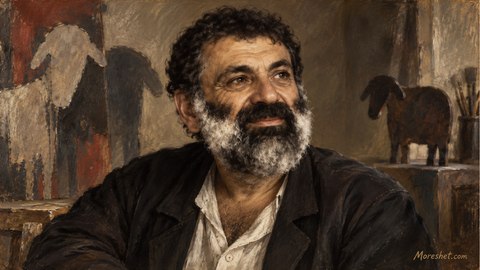
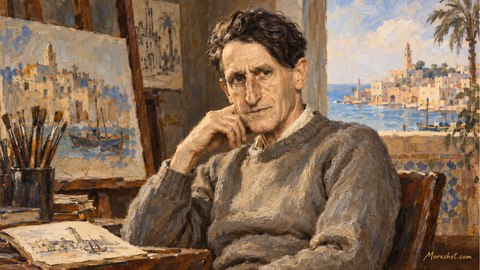
Kariel Gardosh (April 15, 1921–February 28, 2000), known by his professional name Dush, was an Israeli cartoonist, illustrator, journalist, and writer born in Hungary. He is best remembered as the creator of Srulik, the young Israeli figure who became a popular personification of the State of Israel. Through Srulik and through his daily political cartoons, Dush did more than comment on current events: he helped Israelis recognize themselves, their young country, and their public life in images that were immediate, humorous, and unforgettable.
From Budapest, through the Holocaust and the Lehi underground, to Israel
Dush was born in Budapest as Károly, or Karl, Goldberger, to Alexander Goldberger and Margaret née Schneermacher. He grew up in an assimilated Jewish family; his mother died when he was born, and the family name was later changed to the Hungarian name Gardosh. After completing secondary school, he began studying at the University of Szeged. The Second World War interrupted his education. He was sent to forced labor and, in 1944, was transferred to the copper mine at Bor, in territory then occupied by Germany in Serbia.
When he returned to Budapest at the beginning of 1945, he learned that his parents and most of his family had been killed in the Holocaust. He went back to Szeged, studied French and comparative literature, and worked as a journalist. During this period he met Susan, known later as Shoshana, Roman, who was born in Transylvania. They married, and in early 1946 they left Hungary. After passing through a displaced-persons camp in Germany, they reached Paris, where Karl studied literature and philosophy at the Sorbonne.
In Paris, the couple joined the Lehi underground, which maintained a major center of activity there. They received training in weapons and sabotage and took part in advocacy, fundraising, and political-operational work. At the request of Lehi’s central leadership, Dush sent cartoons to its publication HaMa’as, signing them with the pen name “Shir.” Shoshana, whose underground name was “Lilian,” also served as a liaison to Dr. Yaakov Yardaor, a representative of Lehi’s political branch.
In March 1948, the couple immigrated to Palestine using transit visas for Argentina via Palestine. Karl Hebraized his first name to Kariel. At first they lived with Lehi activist Yaakov Meridor; later, Lehi arranged a two-room apartment for them, which they shared with another family. Because he did not yet command Hebrew well, Dush entered the Hebrew press through his art. The cartoon allowed him to communicate quickly and powerfully even while he was still mastering the language.
Cartooning as journalism and historical testimony
After the assassination of Count Folke Bernadotte in September 1948, Dush was arrested and detained, although he had not been part of the team that carried out the killing. While in detention, he drew the Lehi emblem on the walls of the Jaffa detention facility, near the clock that later became one of the site’s familiar landmarks.
After his release, he served as graphic editor of the weekly HaOlam HaZeh, where he published cartoons and a weekly comic strip called Ruti. In 1953 he was injured when a bomb was thrown at the magazine’s offices. That same year he joined the staff of Maariv, where for many years he published a daily political cartoon. His work made the cartoon a regular part of the newspaper and a way for readers to confront wars, elections, social changes, and public disputes through a combination of humor, criticism, and interpretation.
Dush did not limit himself to drawing. He gradually began writing articles, stories, and sketches as well. He also published in the Israeli Hungarian-language newspaper Új Kelet, maintaining a connection with Hungarian-speaking Jewish and Israeli readers. At Maariv, he worked alongside Yosef Lapid, Ephraim Kishon, and Yaakov Farkash, known as “Zeev.” The four were affectionately nicknamed the “Hungarian mafia,” reflecting the strong presence of Hungarian-born creators in Israeli journalism and satire.
Srulik and the face of a young country
In 1956, Dush first drew the character initially called “Israelik,” whose name later settled as “Srulik.” The boy with the hat, sandals, and pioneering clothes quickly became familiar and widely loved. He represented Israel not through an official emblem or a political speech, but through a young, human, slightly mischievous figure who could appear as a soldier, farmer, citizen, or alert observer of the world around him.
Srulik’s importance went beyond humor. The character gave the young state a recognizable visual portrait at a time when Israeli society was still forming its language, symbols, and shared memory. Srulik allowed readers to see the country as living, vulnerable, and determined, and to connect everyday experience with the national story. For decades, Dush used the character to help shape some of the central images through which Israelis imagined themselves.
Illustration, writing, and cultural service
Dush’s work extended beyond the daily press. In 1969 he illustrated Micha Shagrir’s film The War After the War. From 1981 to 1983, he served as Israel’s cultural attaché at the embassy in London, representing Israeli cultural life abroad.
In 1983–1984, he illustrated the children’s books 100 First Stories and 100 First Songs, published by Kinneret. His drawings made the books inviting and accessible to children and helped shape the reading experience of Israeli families. Alongside his work for children and adults, he received the Herzl Prize and the Jabotinsky Prize for Literature and Research.
Dush was first married to Shoshana, and they had a son and a daughter. Their daughter, Daniela Gardosh-Santo, later served as director of the Children and Youth Department of Israel’s Channel One. After their divorce, Dush married the actress Tova Pardo in 1964; she remained his partner until his death. Dush died on February 28, 2000, at the age of 79, and was buried at Yarkon Cemetery.
Commemoration and continuing influence
Dush’s archive is preserved at the National Library of Israel, safeguarding not only his individual work but also a broad visual record of Israeli society and its press. In 2003, a street in Tel Aviv was named after him. Since 2002, the Dush Prize for Cartooning has been awarded every two years by the Tel Aviv-Yafo municipality alongside the Sokolov Prize for Written Journalism.
As a political cartoonist in a daily newspaper, Dush necessarily expressed a point of view in his work. His cartoons addressed Israeli identity, security, settlement, relations between social groups, and arguments about the country’s direction. Even when they reflected political positions, they demonstrated the power of the cartoon to turn a complex public idea into an image that could be remembered and debated. In this way, Dush became part of Israel’s tradition of illustrated journalism, satire, and direct public conversation.
Why Dush’s legacy belongs in Moreshet
Dush merits inclusion in Moreshet because his life and work brought together Jewish memory, Israeli renewal, journalism, and visual culture. He survived forced labor and the destruction of his family in the Holocaust, took part in underground Zionist activity in Europe, immigrated to Palestine, and made the cartoon a central instrument for describing the life of the emerging state.
Srulik gave generations of Israelis a shared figure that remained present in public consciousness, while Dush’s work at HaOlam HaZeh, Maariv, and Új Kelet recorded the language, conflicts, and visual imagination of Israeli society. His children’s illustrations, cultural service in London, and preserved archive broaden his influence beyond the daily cartoon. Moreshet.com presents his story as part of Jewish and Israeli heritage because that heritage was built not only through institutions and political events, but also through lines, characters, humor, and the visual memories people hold in common.