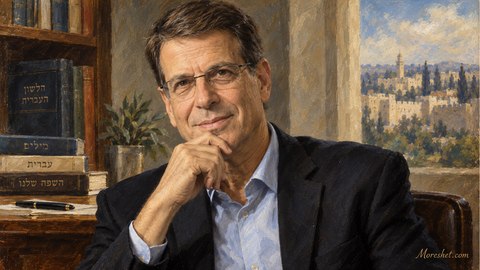
Natan Zehavi
An Israeli journalist, publicist, radio host and filmmaker whose direct voice became part of the country’s public conversation
Natan Zehavi, born on October 27, 1946, is an Israeli journalist, publicist, radio host, actor and film producer. Across several decades he worked in the press, radio, television and cinema, bringing to each medium a distinct, direct and often confrontational style. His work focused on Israeli society as he encountered it in neighborhoods, streets, demonstrations, newsrooms and conversations with ordinary citizens. He received the Sokolow Prize for journalism in 2000.
Zehavi is best known for the daily radio program Zehavi Atzני, in which conversations with listeners became a long-running forum for discussing inequality, corruption, social hardship and the conduct of government. Alongside broadcasting and newspaper writing, he created documentary films and television programs, including a series devoted to Judaism and Jewish identity. His career therefore forms part of the cultural and public record of Israel in the late twentieth and early twenty-first centuries.
Entering journalism at an early age
Zehavi was born and raised in Tel Aviv, the son of Yaakov and Sarah Zehavi and the younger brother of literary editor and critic Alex Zehavi and scientist Avinoam Zehavi. The family Hebraized its name from Goldovitz after immigrating to Israel. His father, Yaakov Zehavi, arrived in Mandatory Palestine in 1926; the rest of his father’s family was murdered in the Holocaust. Zehavi attended the Har Nevo elementary school and completed only eight years of formal education. He later described himself, with characteristic humor, as having a “Mediterranean education.”
He began his journalistic career at fifteen as a press photographer and soccer reporter. At seventeen he started photographing and writing for the weekly HaOlam HaZeh. Even as a young reporter, he insisted on reaching events directly and documenting them himself. During a demonstration near the Knesset he confronted parliamentary guards who tried to stop him from taking photographs. On another occasion he stood his ground when bodyguards attempted to prevent him from photographing Miriam Eshkol in a Tel Aviv clothing store.
As a teenager, Zehavi took part in May Day demonstrations and in protests promoting Jewish-Arab fellowship, and he cooperated with the Israeli Black Panthers movement. These experiences reinforced his interest in social inequality, civil rights and groups that felt excluded from the public center. From 1977 to 1982, while living in Ofira, he was a southern correspondent for Israel’s Army Radio and also worked in fishing. He was among the residents evacuated from Ofira following the peace agreement between Israel and Egypt.
Journalism, public criticism and a phrase that entered the political vocabulary
From 1982 to 1984, Zehavi wrote a column for Yedioth Ahronoth, but his public profile grew especially during his years at Hadashot. He was mentioned in Dan Ben-Amotz’s column, became the newspaper’s correspondent coordinator and later edited the monthly Monitin Penthouse. In 1990, according to the biographical source, he coined the slogan “We’ve had enough of the corrupt,” against the background of the political affair known as the “dirty trick.” The slogan first appeared as a paid advertisement on the front page of Hadashot, was later displayed on banners throughout the country and was subsequently used in the Alignment’s 1992 election campaign.
The episode illustrates Zehavi’s influence as a journalist and publicist. He did not merely describe public discourse; he also produced concise expressions that entered it and shaped the way many Israelis spoke about politics and governmental responsibility. From 1992, apart from a break between 2012 and 2014, he wrote the column Zehavi Ba-Shetach in Ma’ariv. The column continued his emphasis on meeting people directly and reporting on problems as they were lived rather than merely discussed in official settings.
Zehavi Atzני: radio as a public arena
In September 1997, Zehavi began hosting the daily radio program Zehavi Atzני on Radio Without a Break, now 103FM. The program, broadcast continuously except for most of 2001, is built largely around conversations with listeners. This format gave ordinary people more than the role of subjects in news reports: it gave them an opportunity to speak, argue and bring their own experiences before a broad audience.
Zehavi’s positions on social and economic issues have generally been social-democratic. On the program he attacked corruption, raised the hardships of citizens and conducted conversations that moved between heated argument and an effort to uncover the personal story behind a headline. His direct, loud and sometimes abrasive manner became his trademark, turning the program into one of the most recognizable platforms for activist journalism on Israeli radio.
In 2018 he reduced his broadcasts and later took an indefinite leave, citing his health and exhaustion among other reasons. After approximately two months he returned to the air twice a week. From late July 2021 he also took over the Thursday slot following the death of journalist Roni Daniel. Over the years the program included his personal political reflections as well, but its broader significance lay in making poverty, inequality, public health and the conduct of state institutions recurring subjects of radio conversation.
Advocacy for cancer patients and public health
On May 21, 2006, Zehavi joined a hunger strike by colorectal cancer patients in Jerusalem who were protesting the exclusion of important medicines from the national drug basket. He organized a demonstration and took part in the hunger strike for more than a week. At the end of the struggle, several of the medicines were added to the health basket. Although he was arrested during the demonstration on suspicion of firing a flare, the episode reflected the way he used his public profile to bring a patients’ campaign to wider attention.
About six months later, in December 2006, Zehavi revealed that he himself had been diagnosed with bladder cancer, after having overcome skin cancer twelve years earlier. His decision to speak publicly about his illness connected his media persona with the experience of patients and families, adding a personal dimension to his public engagement with health and welfare.
Literature and society at the margins
In 1995, Zehavi published On the Banks of the Sewer, a collection of 29 short stories about Tel Aviv’s criminal underworld. The stories are written in a bleak, almost hopeless atmosphere and are marked by sarcasm, wordplay and distinctive slang. In 2016 he published a sequel, Black Hopes. Both books give literary space to figures and settings usually pushed to the margins of respectable Israeli narratives: criminals, socially marginal people, those struggling to survive and an urban world that does not present itself attractively.
Zehavi’s fiction is closely connected to his journalism. In both, he is drawn to living language, to people who rarely receive a public platform and to the gap between a society’s official image and everyday life. His books thus add a literary record of voices and places outside Israel’s cultural center.
Film, television and the documentation of Jewish identity
Alongside journalism, Zehavi acted in Israeli films and television series. His film appearances include Peeping Toms, Shuro, Afula Express, Tonight We’re Going to the Movies, The Other Half, Derrick’s Brother, Shabazi, Mr. Baum and On the Line. On television he appeared, among other programs, in Stories for Late at Night, Deep Blue and Asfur. He also voiced Mustafa in the adult animated series Celebs, played Shlomo, a garage owner, in Asfur and took part in the Hebrew dubbing of The Incredibles.
Zehavi wrote the screenplay for the 1984 film Pressure and produced several films, including Koko Ben 19 in 1985, about a young man who slides into crime. He was also one of the creators of the 1996 film The Chain, in which he appeared.
His most direct contribution to documentary television came with Zehavi Searches for an Answer, broadcast by Telfed in 2000. Created with screenwriter and director Dror Sabo and editor Miki Mandel Moses, the series ran for 14 episodes and explored Judaism. A second season was broadcast in 2002. The choice of a secular, non-establishment media figure with a distinctly personal style to undertake a television journey through Judaism created a meeting point between Jewish identity, questions of faith, Israeli culture and public curiosity. The series brought discussion of Judaism to a broad audience, including viewers who were not religious, and presented Jewish identity as a living subject open to personal questioning.
In 2004, Zehavi created the documentary An Indictment about the assassination of Yitzhak Rabin, broadcast on Channel 10. In 2007, he also took part in the documentary series On Life and Death, which examined people whose lives had been transformed by an intense awareness of mortality.
Personal life and public identity
Zehavi lives in Tel Aviv. He has never married and has no children; he has described himself as childfree. He identifies as an atheist. He was a close friend of Dan Ben-Amotz, who stipulated in his will that Zehavi should receive a bottle of fine whisky every month. These personal details are part of the public image he built: a person unwilling to conform easily to conventional expectations and prepared to present his views and way of life openly.
Why Natan Zehavi merits inclusion in Moreshet
Natan Zehavi merits inclusion in the archive because for decades he worked in several of the arenas that shaped Israeli society: the press, radio, television, cinema and literature. He gave space to social voices that were often heard only faintly at the center of the media, turned citizens’ hardships into public issues and developed a critical language that became part of Israeli discourse.
His importance to Jewish and Israeli heritage is also evident in Zehavi Searches for an Answer, which brought questions of Judaism and Jewish identity to mainstream television from a personal, secular and questioning perspective. His books, his advocacy for cancer patients and his sustained attention to social inequality further document real aspects of Israeli life and the struggles of its people. Moreshet and Moreshet.com preserve the stories of people who shaped society not only through official positions, but also through public voice, creative work and lasting presence in Israeli life; Zehavi’s career is a clear example of that kind of influence.