David Wdowinski
Political leader of the Jewish Military Organization, concentration-camp survivor, and Eichmann trial witness
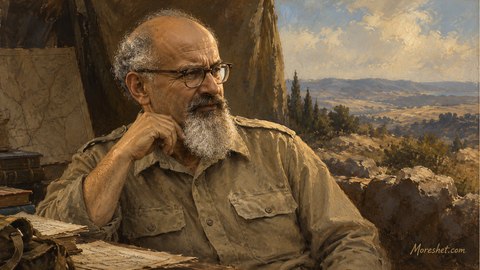
David Wdowinski (Polish: Dawid Wdowiński; 1895–1970) was a psychiatrist, Revisionist Zionist leader, and one of the founders of the Jewish Military Organization (ŻZW), known in Hebrew as the Irgun Tzvai Leumi, in the Warsaw Ghetto. He was not a military commander; his role was political. As head of the organization’s political representation, he helped connect armed Jewish resistance with leadership, public advocacy, and communal responsibility under Nazi rule.
From Jewish Self-Defense to Zionist Leadership
Wdowinski was born in 1895 in Będzin, Poland. As a young man, he joined other Jews in efforts to defend Jewish communities against anti-Semitic violence. He later studied psychiatry at academic institutions in Europe, including universities in Vienna, Brno, and Warsaw, and became a physician specializing in psychiatry.
Under the influence of Ze’ev Jabotinsky, Wdowinski devoted himself increasingly to public and political work in the Revisionist Zionist movement. He was active in the Hatzohar movement and became one of the leaders of Revisionist Zionism in Poland. His decision to place public service ahead of a full medical career reflected his conviction that Jewish survival required not only individual care, but also national, political, and defensive institutions.
Work in the Warsaw Ghetto and the Founding of the ŻZW
After Nazi Germany invaded Poland and the Jewish population was forced into the Warsaw Ghetto, Wdowinski helped organize mutual aid for the ghetto’s residents through an organization known as ZTOS. At a time when hunger, disease, terror, and deportation were dismantling Jewish communal life, such networks provided practical assistance and preserved a measure of collective responsibility.
In the summer of 1942, Wdowinski helped found the Jewish Military Organization, or ŻZW, an underground Jewish resistance group in the Warsaw Ghetto. The organization brought together political activists and Jews with military experience, including veterans of the Polish Army. Wdowinski served as its political head and led the political representation working alongside the organization’s headquarters, while others held military command. His contribution lay in linking armed resistance with political organization, public representation, and the effort to sustain Jewish leadership in the ghetto.
During the ghetto’s existence, Wdowinski also worked at a hospital on Chisza Street. His work placed him at the center of efforts to save lives and provide medical care under conditions in which the Nazi regime had turned Jewish existence into a daily struggle. When the Warsaw Ghetto Uprising began, he was at the hospital. Nazi forces captured him and sent him through the Umschlagplatz, the ghetto’s deportation square, to Majdanek. He was subsequently transferred through twelve concentration camps and survived them all.
After the War: Leadership, Testimony, and Memory
After the defeat of Nazi Germany, Wdowinski moved to Italy and became politically active among Jewish survivors and displaced persons. He later traveled to the United States on behalf of the Irgun and the National Committee for the Resurrection of the Nation, together with Arieh Jabotinsky, Hillel Kook, and others. This work continued the public mission he had undertaken in the underground: bringing the Jewish resistance into international political discussion and advocating for the Jewish people’s future.
In 1961, Wdowinski testified at the trial of Adolf Eichmann in Jerusalem. His testimony formed part of the legal and public record of Jewish life, persecution, and resistance during the Holocaust. In 1963, he published his memoir, And We Are Not Saved, describing his involvement with the ŻZW and the Warsaw Ghetto Uprising. The book preserved the perspective of a Revisionist Zionist participant and helped keep the Jewish Military Organization’s role within the broader historical record of resistance in the ghetto.
In anticipation of Holocaust Remembrance Day in 1970, Wdowinski was invited to speak at a memorial gathering organized by the Museum of Fighters and Partisans at the Jabotinsky Institute in Tel Aviv. After completing his speech, he became ill and died. He was buried in the Jewish cemetery on the Mount of Olives in Jerusalem.
Why this legacy belongs in Moreshet
David Wdowinski’s life connects several important chapters in the history of European Jewry and the Jewish state: Jewish self-defense, Revisionist Zionism, underground organization in the Warsaw Ghetto, survival in the concentration-camp system, postwar public leadership, and testimony at the Eichmann trial. His contribution was more than personal survival. He helped establish a Jewish resistance framework and worked to preserve leadership, mutual responsibility, and a political voice amid destruction.
His testimony, memoir, and public appearances helped preserve the memory of the ŻZW and the participation of Revisionist activists in the Warsaw Ghetto resistance. For that reason, Wdowinski merits inclusion in Moreshet: not simply as a historical figure, but as someone whose actions continue to shape how Jewish and Israeli communities understand resistance, communal responsibility, and the struggle against annihilation. At Moreshet.com, his story gives readers access to the actions, testimony, and enduring memory of a survivor who carried the history of Jewish resistance into the postwar world.