Yaakov Heruti
Lehi fighter, founder of the Tzrifin Underground, and lawyer active in Israel’s national and settlement history
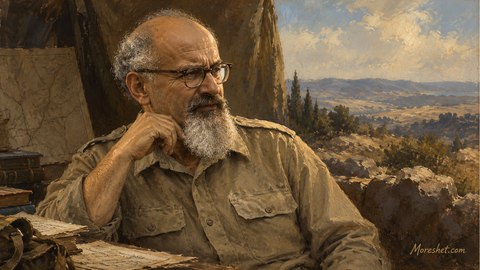
Yaakov Heruti (15 January 1927 – 28 July 2022) was an Israeli lawyer, a fighter in the pre-state Lehi underground, and a founder of the group known as the Kingdom of Israel or the Tzrifin Underground. His life intersected with several defining chapters in the history of the Jewish settlement and the State of Israel: the struggle against British rule, the transition from underground resistance to statehood, the ideological conflicts of Israel’s early decades, and the legal and practical efforts to establish Jewish communities in Judea and Samaria.
Family, education, and entry into Lehi
Heruti was born in Tel Aviv to a Zionist family. His mother, Yehudit, immigrated from Poland with her parents in 1923. His father, Mordechai Walker, had been among the founders of the Hashomer Hatzair movement in Poland. He immigrated to Mandatory Palestine in 1920, Hebraized his surname to Heruti—derived from “Herut Yisrael,” or “freedom of Israel”—and was part of the first group sent to Beitanya Illit. Mordechai Heruti later joined Mapai and eventually served as deputy president of the Israel Defense Forces Court of Appeals.
Yaakov studied at the Herzliya Hebrew Gymnasium and joined the Jewish Settlement Police. After a year of service, he entered Lehi, influenced in part by the writings of Lehi founder Avraham Stern and the nationalist poetry of Uri Zvi Greenberg. Within Lehi, he joined the technical department, which produced weapons under clandestine conditions. He developed a method for manufacturing explosives that, according to the supplied sources, enabled the organization to produce as much as half a ton of explosives in a working day. In practical terms, this gave a small underground organization an important independent capacity at a time of severe scarcity, secrecy, and pursuit.
Underground operations and the British mission
One of the explosives produced by Lehi’s technical department was placed in a British police building at the Sarona compound in Tel Aviv in April 1947. The blast destroyed the building and killed a police officer and three other policemen. Later that year, Lehi sent Heruti to Britain to establish a cell, recruit operatives, and carry out the organization’s assignments. He simultaneously studied law at the University of London, laying the foundation for the legal career he would pursue after independence.
The British cell was given missions involving senior British figures, including Foreign Secretary Ernest Bevin, General Evelyn Hugh Barker, and Roy Farran, a former Palestine police officer. The order to attack Bevin was later canceled. A letter bomb sent to Barker’s home aroused his wife’s suspicions and was defused; a bomb sent to Farran was opened by his brother Rex, who was killed in the explosion. This episode shows how Lehi operated beyond Palestine and also the grave human cost of clandestine violence.
After the outbreak of Israel’s War of Independence, Heruti returned through France on an immigrant ship. He heard the news of the establishment of the state on the radio while still at sea. After reaching Israel, he joined Lehi fighters. In Jerusalem he commanded the organization’s religious company and took part in Operation Kedem, a joint attempt by the Haganah, Irgun, and Lehi to break through to the Old City. The operation failed, but during the fighting Heruti helped evacuate a wounded Haganah man under fire, an act later mentioned in the legal proceedings brought against him.
The Tzrifin Underground, trial, and imprisonment
After the assassination of Count Folke Bernadotte and the state’s dismantling of Lehi, many former members were detained. Heruti was transferred from detention directly to a military recruitment office, and in the following years he remained active in the ideological circle surrounding Israel Eldad and his journal Sulam. In the winter of 1952, Heruti and fellow former Lehi member Shimon Bachar established the group known as the Kingdom of Israel, or the Tzrifin Underground.
The group sought to attack Soviet and Czechoslovak representations in protest against antisemitic persecution and to respond with gunfire whenever Arab Legion troops fired at Jews in divided Jerusalem. Heruti and Bachar recruited several dozen former Lehi members and also created a younger framework resembling a youth movement. In February 1953, a bomb was placed at the Soviet Embassy in Tel Aviv. The explosion severely damaged the building and wounded three people, including the ambassador’s wife. The Soviet Union subsequently severed diplomatic relations with Israel. The supplied sources also attribute to the group actions directed at the Czechoslovak representation and an attempt to target West German Chancellor Konrad Adenauer.
Heruti was arrested in May 1953 after the group’s network was exposed. The government declared the Tzrifin Underground a terrorist organization, and Heruti and his associates were tried before a special military court headed by Judge Benjamin Halevy. Heruti received a ten-year sentence. On appeal, Supreme Court Justice Shimon Agranat recommended reducing the sentence, partly in recognition of Heruti’s rescue of a Haganah fighter in Jerusalem. After approximately two years, Heruti and the other convicted members received pardons from Prime Minister and Defense Minister David Ben-Gurion, following recommendations from Religious Affairs Minister Yehuda Leib Fishman Maimon and Chief Rabbis Yitzhak Isaac Halevi Herzog and Yitzhak Nissim. During his imprisonment, Heruti completed his law studies, turning a period of confinement into professional preparation for the next stage of his life.
Years later, Heruti said that he had supplied explosives to Amos Kenan and Shealtiel Ben Yair, who, he alleged, threw them at the home of Transport Minister David-Zvi Pinkas. Heruti said that he understood the intended target to be a shop selling goods of German origin, rather than the minister’s home itself.
The Kasztner affair and the legal profession
Following the 1957 murder of Israel Kasztner, Heruti and several associates were arrested on suspicion of belonging to a terrorist organization. He was acquitted of that charge but convicted of distributing leaflets condemning Magistrate’s Court Judge M. Peretz, after the judge had been prepared to acquit Kasztner in a case involving a claim of false testimony brought by Malkiel Gruenwald. Heruti was sentenced to a year and a half in prison. Because he had already spent about a year in detention, he was released after sentencing, with the applicable reduction for time served.
After the years of underground activity, war, trial, and imprisonment, Heruti turned to law and family life. For him, law was not only a profession but also a means of public and national action. His expertise in land law—drawing on Ottoman, Mandate, and Jordanian legal frameworks that applied in the West Bank—made him a significant participant in efforts to purchase land and assist in the establishment of Jewish communities in the area.
Law, land, and settlement
After the 1967 Six-Day War, Heruti advised the legal adviser to the Civil Administration on land matters. According to the supplied sources, the first transaction in which he was involved was the purchase of land in Gush Etzion, undertaken at the request of Himnuta, a subsidiary of the Jewish National Fund that handled such matters with considerable secrecy. He later represented prominent merchants and activists involved in land purchases in Judea and Samaria, particularly after the political change of 1977. Communities including Elkana, Givat Ze’ev, and Sha’arei Tikva were subsequently established on land acquired through such efforts.
His legal work was closely connected to a firm national-Zionist outlook and to his relationships with the leadership of Gush Emunim and other circles opposed to the evacuation of settlements. He appeared on the Moledet party list in the elections for the Twelfth Knesset. The sources identify him as one of the founders of the Tehiya and Tzomet parties and credit him with coining the name Moledet for Rehavam Ze’evi’s party. In 1997 he completed a doctoral dissertation in law. During the 1990s and 2000s he was active at the College of Judea and Samaria in Ariel; in 2005 he participated in public activity opposing the evacuation of settlements. He also served on the public council of the Honenu organization.
Writing, family, and historical memory
Heruti recorded his worldview and experiences in the book One Truth, Not Two, published in 2008 by Yair Press. In it, he described the struggle for Israel’s freedom and his own role in it. He also remained involved in preserving the memory of the underground generation through interviews, recorded conversations, and documentation about his life and Lehi’s history.
Heruti was married twice. His first marriage, to Ilana, produced one son, Dr. Amir Yehezkel Heruti. His second marriage, to Shani, née Levinson, produced Adi Harel, Asaf Heruti, attorney Edna Heruti, Professor Rafi Heruti, Raya Heruti, and attorney Naomi Heruti-Periel. He lived in Tel Aviv and practiced law into his later years. Yaakov Heruti died on 28 July 2022.
Why Yaakov Heruti belongs in Moreshet
Yaakov Heruti merits inclusion because he acted directly at several decisive points in Israel’s history: in the technical development of Lehi’s underground capacity, in the organization’s British mission, in the fighting of the War of Independence, in the creation of the Tzrifin Underground, in the legal proceedings surrounding it, and in the legal efforts to acquire land and establish communities after 1967. His biography helps readers understand not only his individual actions but also the movement of ideas, organizations, and people from underground resistance into the institutions of the state, the legal system, and politics.
For Moreshet, his story links the history of Zionist struggle with the development of Israeli society, law, settlement, and political memory. On Moreshet.com, his life can be preserved as part of the complex record of Israel’s underground generation and of the people whose choices shaped national debate and the Israeli landscape for decades. The value of documenting him does not depend on agreement with every part of his path; it lies in the concrete historical influence of his work and in what his life reveals about a formative period in Jewish and Israeli history.