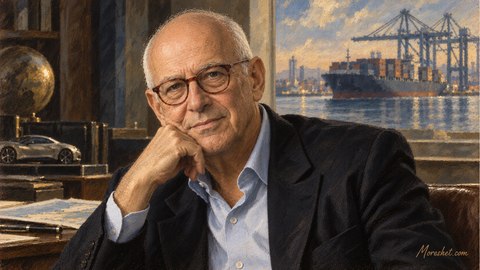
David Lawrence Geffen
The Jewish-American entrepreneur, producer and philanthropist who reshaped popular music and film while building lasting institutions in medicine, education and the arts
David Lawrence Geffen, born on February 21, 1943, in Brooklyn, is one of the most influential figures in modern American culture. As the founder of Asylum Records, Geffen Records and DGC Records, and a co-founder of DreamWorks, he helped give major artists, producers and filmmakers the platforms through which they transformed popular music and cinema. He later directed a substantial share of his fortune toward public institutions, including UCLA, Yale University, Lincoln Center, the Los Angeles County Museum of Art and the National Library of Israel.
From a Jewish Brooklyn family to entertainment leadership
Geffen was raised in a Jewish family. His parents, Abraham Geffen and Batya Volovskaya, were Jewish immigrants who met in Mandatory Palestine before moving to the United States. His mother operated a clothing store in Brooklyn. That family background connected Geffen early on to both immigrant experience and entrepreneurship.
After brief periods at the University of Texas at Austin, Brooklyn College and Santa Monica College, Geffen moved to Los Angeles to pursue a career in entertainment. In 1964 he began in the mailroom of the William Morris Agency. He quickly learned how the industry worked, how agents identified talent and how opportunities were created before they became obvious to the wider market. Within a few years he had become a talent agent and later managed artists including Laura Nyro and Crosby, Stills & Nash.
Asylum Records: a home for difficult-to-place artists
In 1971, Geffen and Elliot Roberts founded Asylum Records. The label's name expressed their willingness to sign artists whom established companies had struggled to understand or market. Asylum became a central force in the Southern California folk-rock scene, signing the Eagles, Joni Mitchell, Bob Dylan, Tom Waits, Linda Ronstadt, Warren Zevon, Judee Sill and J. D. Souther.
Geffen's achievement was not simply the creation of a profitable company. He built an environment in which artists with distinctive voices could develop and reach large audiences. Asylum linked personal songwriting and artistic freedom with professional production and broad distribution. In doing so, it helped shape the sound and identity of American popular music in the 1970s. The label was later acquired by Warner Communications and merged with Elektra, but its name and artistic legacy remain part of recording history.
Geffen Records and DGC: backing artists and ambitious work
After serving as a senior executive at Warner Bros. film studios and taking a temporary retirement, Geffen returned to the industry and founded Geffen Records in 1980. The company soon demonstrated that it could work with both established stars and ambitious new projects. Its artists included Donna Summer, John Lennon, Olivia Newton-John, Elton John, Cher, Peter Gabriel, Aerosmith, Neil Young, Sonic Youth, Guns N' Roses, Nirvana, Weezer, Blink-182 and many others.
One of his most consequential decisions was signing John Lennon and Yoko Ono for Double Fantasy. Lennon said that Geffen was the only executive confident enough to make a deal without hearing the recording first; Ono recalled that Geffen was the only label head who paid serious attention to her. Lennon's murder shortly after the album's release turned it into a worldwide cultural event, but Geffen's decision preceded that tragedy and demonstrated his willingness to trust an artist and a work under conditions of uncertainty.
In 1990, Geffen Records was sold to MCA in a transaction that gave Geffen shares worth hundreds of millions of dollars. He continued to run the label until 1995. The company later became part of the structure of Universal Music Group, while DGC, founded by Geffen in 1990, became an important home for alternative and rock music. His influence therefore lies not only in individual records, but also in the way major and independent labels identified, developed and marketed artists with strong creative identities.
From music to film and Broadway
Geffen expanded into film through the Geffen Film Company, producing movies including Risky Business, Little Shop of Horrors and Beetlejuice. These films combined commercial reach with distinctive artistic styles and became enduring parts of American popular culture. He also backed Broadway productions including the musicals Dreamgirls and Cats.
In 1994, Geffen co-founded DreamWorks SKG with Steven Spielberg and Jeffrey Katzenberg. The studio sought to create a more creative and entrepreneurial alternative to Hollywood's traditional structure, bringing together film, television, music and animation. Geffen remained involved in the venture until 2008. DreamWorks reflected his ability to recognize structural change in the entertainment business and connect visionary creators with substantial organizational and financial resources.
Philanthropy: investing in medicine, education and culture
Geffen's public giving is notable for both its scale and its range. In 1995, he donated $5 million to UCLA's Westwood Playhouse, which was subsequently renamed the Geffen Playhouse. In 2002, he gave $200 million to UCLA's medical school, which became the David Geffen School of Medicine at UCLA. In 2012, the university announced an additional $100 million gift intended to cover the full cost of attendance for up to 30 medical students each year, beginning with the class of 2017. In 2020, he pledged a further $46 million to the medical school.
The significance of these gifts goes beyond institutional naming. Full scholarships remove an economic barrier for talented students and allow them to choose medicine on the basis of vocation rather than family resources. Support for theater and the arts likewise strengthens the cultural infrastructure of Los Angeles, the city where Geffen built his career.
In 2015, Geffen pledged $100 million toward the renovation of Avery Fisher Hall at New York's Lincoln Center for the Performing Arts. After the renovation, the hall was named David Geffen Hall. In 2021, he gave $150 million to Yale School of Drama, enabling the school to eliminate tuition for students in its master's, doctoral and certificate programs; it was renamed the David Geffen School of Drama at Yale University. That same year, Columbia Business School announced a $75 million gift toward its new Manhattanville facilities. The East Building was named David Geffen Hall when it opened in 2022.
In 2017, Geffen pledged $150 million to the Los Angeles County Museum of Art, the largest gift in the museum's history at the time of the announcement. The contribution was intended to support a new building and expand the museum's ability to present art to a broad public. It placed Geffen within the American tradition of private support for public cultural institutions, creating infrastructure intended to serve visitors, artists, scholars and communities for decades.
Israel, Jewish identity and cultural life
Geffen's family roots in Mandatory Palestine and his parents' Jewish identity are important parts of his story. In 2021, it was reported that he had announced plans to contribute to the National Library of Israel toward the construction of an auditorium in the library's new building. The auditorium, intended for lectures, concerts and other cultural events, represents a connection between Jewish heritage, knowledge, music and public life in Israel. The available material describes an announced contribution, so the pledge should be distinguished from completion of the project itself.
Geffen also represents a visible and influential Jewish-American presence in American culture. He came out as gay in 1992 and became one of the most prominent Jewish-American business figures to live publicly with that identity. His influence is evident not only in personal visibility, but also in the institutions and creative opportunities he helped make available to diverse voices.
Art, public recognition and cultural influence
Geffen collected major works by American artists including Jackson Pollock, Mark Rothko and Willem de Kooning. His collection has been regarded as one of the strongest representations of postwar American art. Sales from the collection, including Pollock's No. 5, 1948, drew worldwide attention to the art market and to the value of postwar American painting.
Geffen's influence also entered popular culture. Joni Mitchell wrote Free Man in Paris about him, and he appeared alongside other entertainment executives on Barbra Streisand's The Broadway Album. His life and career have been examined in books, biographies and the PBS documentary Inventing David Geffen, broadcast as part of the American Masters series in 2012.
For his contribution to music, Geffen received the Ahmet Ertegun Award from the Rock and Roll Hall of Fame in 2010 and the President's Merit Award from the National Academy of Recording Arts and Sciences at the 2011 Grammy Awards. These honors recognize more than commercial success: they acknowledge his role in bringing innovative music and influential artists to international audiences.
Why David Lawrence Geffen belongs in Moreshet
David Geffen merits inclusion in the archive because his legacy operates in three lasting spheres: cultural creation, institution-building and public philanthropy. He founded labels that helped artists such as Joni Mitchell, John Lennon, Nirvana and Neil Young reach broad audiences; co-founded DreamWorks; and supported cultural venues and educational institutions that have affected the lives of students, artists, physicians and audiences.
His story connects the experience of a Jewish immigrant family in America with the ability of a Jewish-American entrepreneur to shape wider culture and support institutions in Israel. For that reason, a profile in Moreshet and Moreshet.com records more than wealth or celebrity. It explains how business vision, confidence in creative talent and large-scale giving can leave a durable mark on Jewish and Israeli life, American culture and the wider world.