Daniel Kahneman
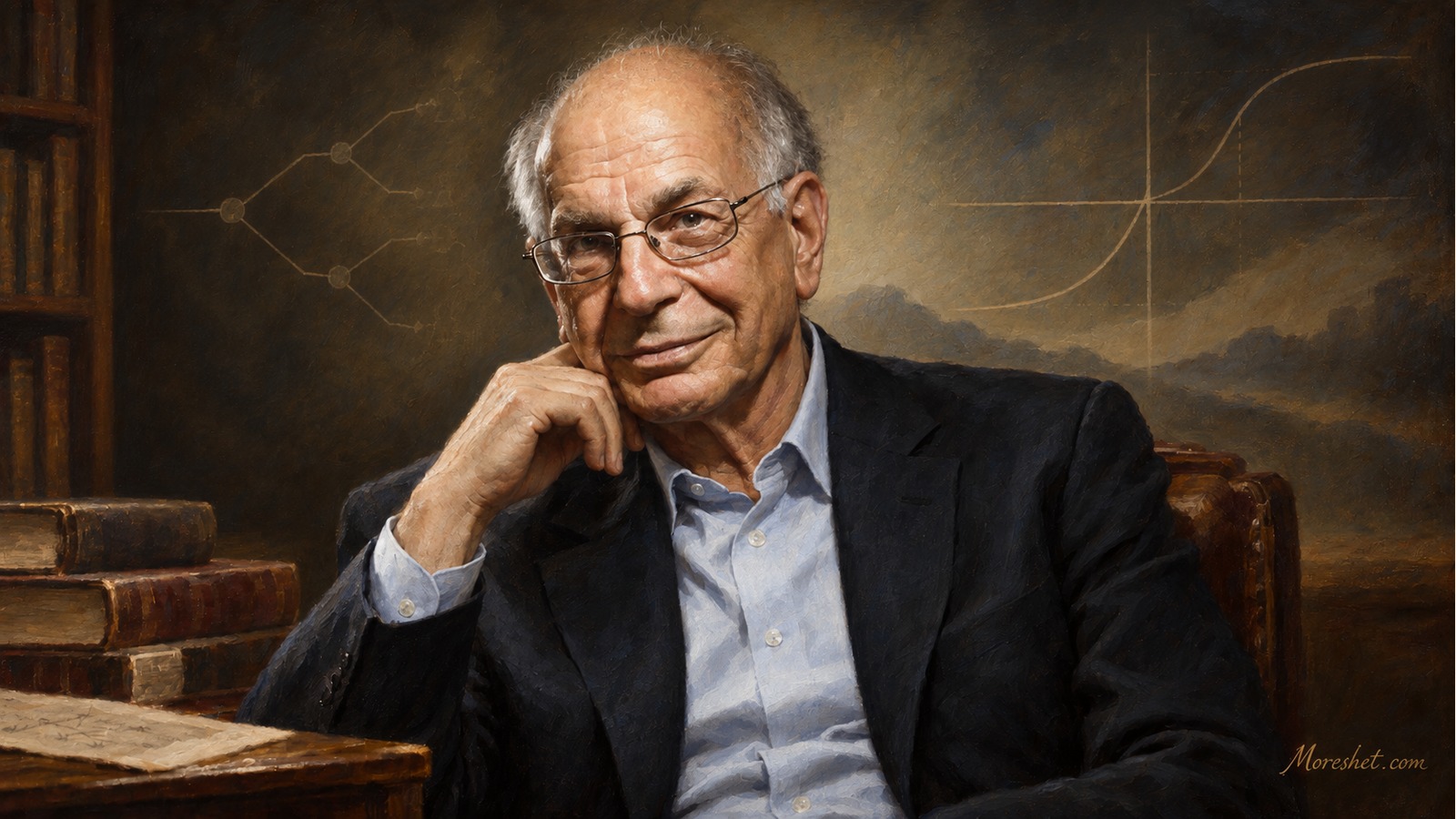
Daniel Kahneman — AI-generated artistic portrait · Moreshet.com
The psychologist who transformed the study of judgment and decision-making
Daniel Kahneman (1934–2024) transformed how researchers and the wider public understand decisions. He showed that useful mental shortcuts can also produce predictable mistakes. Work developed with Amos Tversky moved economic discussion beyond an abstract, consistently rational decision-maker toward actual people, whose choices respond to context, wording and the experience of loss.
From Jerusalem to fundamental questions
Born in Tel Aviv while his mother was visiting relatives, Kahneman grew up in France. His family hid during the Nazi occupation and later settled in Mandatory Palestine. He studied psychology and mathematics at the Hebrew University, worked on assessment in the Israeli military and completed his doctorate at Berkeley. He returned to research and teaching in Jerusalem before later appointments in Canada, Berkeley and Princeton, maintaining connections with Israeli scholarship.
A partnership that changed the field
Kahneman and Tversky investigated how people judge probabilities and choose under uncertainty. Their research explained how an easily recalled example can distort an estimate and how an arbitrary starting point can anchor a judgment. Prospect theory, published in 1979, showed that people assess gains and losses relative to a reference point and often give losses disproportionate weight. Presenting equivalent choices as gains or losses can change the decisions people make.
These findings did not mean that sound reasoning was impossible. They gave economists, physicians and other decision-makers better tools for recognizing circumstances in which judgment becomes unreliable.
Bringing research into public life
Kahneman received the 2002 Nobel Memorial Prize in Economic Sciences. Tversky, who died in 1996, could not receive a posthumous award. In Thinking, Fast and Slow, Kahneman made the distinction between intuitive and effortful thinking accessible to a broad readership. His research on well-being and remembered experience, and later work on unwanted variation in judgments, extended the discussion beyond markets and financial choices.
Why this legacy belongs in Moreshet
Moreshet includes Kahneman because a research partnership rooted in Israel changed entire disciplines and offered practical insights to people everywhere. His story at Moreshet.com links intellectual rigor with an unusually useful form of humility: understanding the limits of judgment can become the beginning of improving it. That contribution enriches both the record of Jewish scholarship and the everyday language of responsible decision-making.