Bette Midler
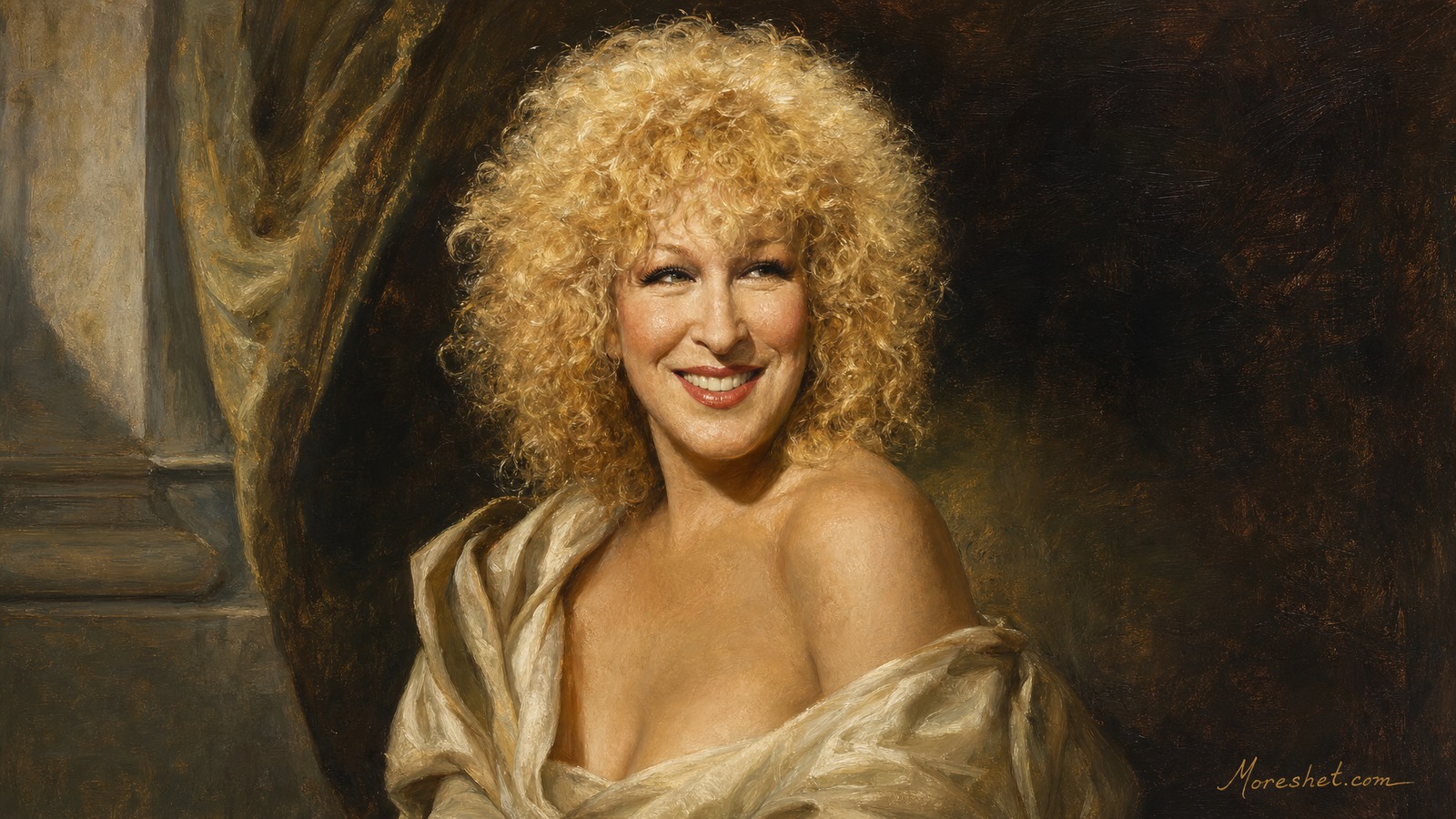
Bette Midler — AI-generated artistic portrait · Moreshet.com
The Jewish American singer, actor, comedian, and civic benefactor who carried theatrical showmanship from Broadway and pop music into film, television, and New York’s neighborhoods
Bette Midler (born December 1, 1945) is a Jewish American singer, actor, comedian, producer, and author whose career has moved with unusual fluency among popular music, Broadway, film, television, and live spectacle. Known as “The Divine Miss M,” she developed a performance style built on a powerful voice, sharp comedy, emotional directness, and exuberant theatricality. Her honors include four Golden Globe Awards, three Grammy Awards, three Primetime Emmy Awards, and two Tony Awards, as well as two Academy Award nominations and a Kennedy Center Honor for lifetime achievement in the performing arts.
The scale of her contribution is clearer in the work than in the trophy count. Midler made songs such as Wind Beneath My Wings, The Rose, and From a Distance enduring parts of American popular culture. She created comic and dramatic screen characters that remained recognizable across generations, returned to Broadway in a demanding starring role late in her career, and founded an organization that restored neglected green spaces for New York communities. As an openly Jewish woman in mainstream American entertainment—from her early work in Fiddler on the Roof to her portrayal of Jewish public figures such as Bella Abzug—she has also contributed to the visibility and range of Jewish cultural life.
A Jewish childhood in Hawaii and a route to New York
Midler was born in Honolulu, the third of four children of Ruth Schindel Midler and Fred Midler, both New Jersey natives. Her mother was a seamstress and homemaker; her father worked as a painter at a United States Navy base and also painted houses. The Midlers were among the few Jewish families in their predominantly Asian neighborhood. Bette was named after film star Bette Davis, although Midler pronounces the name as one syllable rather than Davis’s two.
Raised in Aiea, Midler attended Radford High School and studied drama at the University of Hawaii at Manoa before leaving after three semesters. She appeared as an uncredited extra in the 1966 film Hawaii, and money from that work helped her relocate to New York. There she studied at HB Studio with the influential acting teacher Uta Hagen and began performing in small off-off-Broadway productions.
From Fiddler on the Roof to an unconventional first audience
In 1966 Midler joined the Broadway company of Fiddler on the Roof. She initially appeared in the ensemble as Rivka and understudied Tzeitel, Tevye’s eldest daughter; in February 1967 she assumed the role of Tzeitel and continued in it until 1970. For a young Jewish performer, working in one of the most influential theatrical representations of Eastern European Jewish life provided both rigorous professional training and an early connection between Jewish memory and the American commercial stage.
In the summer of 1970, Midler began singing at the Continental Baths, a gay bathhouse in New York’s Ansonia Hotel. Far outside the conventional entertainment circuit, she shaped the persona that would make her famous: powerhouse singing, outrageous costumes, quick humor, and an immediate rapport with the room. Gay audiences formed her first devoted following. She continued to acknowledge that community’s importance to her career and became a longstanding public supporter of LGBTQ+ people and causes.
At the Continental Baths she worked with pianist and arranger Barry Manilow, who helped shape her early sound and co-produced her first album. In 1971 she also appeared in the first professional production of the Who’s rock opera Tommy, staged by the Seattle Opera.
The arrival of “The Divine Miss M”
Released in December 1972, Midler’s debut album, The Divine Miss M, transformed her from a New York club attraction into a nationally known recording artist. It reached the Billboard Top 10, earned platinum certification, and produced the singles Do You Want to Dance?, Friends, and Boogie Woogie Bugle Boy. The last of these revived a song made famous by the Andrews Sisters and demonstrated one of Midler’s enduring strengths: her ability to carry older American entertainment traditions into a contemporary setting. The album brought her the Grammy Award for Best New Artist.
Over the course of her recording career, Midler released 14 solo studio albums and sold tens of millions of records. Her repertoire crossed traditional pop, ballads, standards, comedy, and cabaret rather than remaining within one genre. She also used her stature to reintroduce earlier singers and vocal traditions. Bette Midler Sings the Rosemary Clooney Songbook in 2003 and Bette Midler Sings the Peggy Lee Songbook in 2005 honored two major interpreters of American song. The 2014 album It’s the Girls! ranged across generations of women’s vocal groups, from the Boswell Sisters and the Andrews Sisters to TLC.
Live performance remained the foundation of her artistic identity. Clams on the Half Shell Revue helped earn her a Special Tony Award in 1974 for adding distinction to the Broadway season. Later tours included the large-scale Kiss My Brass production of 2003–2005 and the 2015 Divine Intervention tour. From 2008 to 2010 she headlined The Showgirl Must Go On at Caesars Palace in Las Vegas, supported by a large band, dancers, elaborate staging, and the comic-musical personality she had spent decades refining.
Songs that outlived their original moment
Midler made her first major starring film appearance in The Rose in 1979, playing Mary Rose Foster, a fictional rock singer whose story drew on the destructive pressures of the 1960s music world and was especially associated with Janis Joplin. The film was not a direct Joplin biography, but it gave Midler a role that fused dramatic acting with ferocious musical performance. She won a Golden Globe and received her first Academy Award nomination for Best Actress. Her recording of the title song became a major hit and won the Grammy Award for Best Female Pop Vocal Performance.
Another defining musical success arrived with Beaches in 1988. Midler co-starred with Barbara Hershey and also served as a producer on the film, a drama about a friendship sustained through ambition, separation, illness, and loss. Its soundtrack sold millions of copies, while Wind Beneath My Wings reached number one on the Billboard Hot 100 and earned Midler the Grammy for Record of the Year. Her 1990 recording of Julie Gold’s From a Distance became another prominent hit. Both songs moved well beyond their original commercial setting and became familiar choices for memorials, tributes, ceremonies, and expressions of gratitude.
Drama, screen comedy, and lasting characters
Midler’s screen career demonstrated that her live-performance energy could support both drama and comedy. After The Rose, she established a successful comic run in the 1980s with Down and Out in Beverly Hills, Ruthless People, Outrageous Fortune, and Big Business. Her characters were frequently brash and larger than life, but she gave them vulnerability as well as verbal force.
In the 1991 musical drama For the Boys, she played Dixie Leonard, an entertainer whose partnership with another performer unfolds against decades of shows for American service members. The role brought her another Golden Globe and a second Academy Award nomination. In the 1993 television adaptation of Gypsy, she took on the formidable role of Mama Rose and won a Golden Globe for the performance.
That same year she first played Winifred Sanderson in Disney’s Hocus Pocus. Although the film was not an immediate hit, television broadcasts and home viewing gradually turned it into a multigenerational Halloween favorite. Midler returned as Winifred in Hocus Pocus 2 in 2022. The First Wives Club, released in 1996, further established her as a major comic star and became another film with a durable audience.
Her later work included The Stepford Wives, Then She Found Me, and Parental Guidance, as well as voice performances in Cats & Dogs: The Revenge of Kitty Galore and the animated Addams Family films. In Julie Taymor’s 2020 film The Glorias, Midler portrayed Bella Abzug, the Jewish congresswoman, lawyer, and feminist leader. The role connected Midler’s screen presence to an important figure in Jewish American political and social history.
Television, comedy, and a recognizable public persona
Midler built a varied television record through specials, dramatic roles, comedy, and guest appearances. Her special Ol’ Red Hair Is Back won an Emmy, and her HBO concert special Diva Las Vegas earned her another. One of her most remembered television appearances came on the penultimate episode of The Tonight Show Starring Johnny Carson in 1992. Singing One for My Baby directly to Carson, she created an intimate farewell that earned an Emmy for individual performance in a variety or music program.
She played versions of herself on programs including Seinfeld and The Nanny, and starred in the CBS sitcom Bette in 2000–2001. In 2019 and 2020 she appeared as Hadassah Gold in the Netflix series The Politician. The repeated use of her public image—glamorous, candid, comic, and self-aware—reflects how thoroughly Midler became not merely an actor in individual roles but an instantly recognizable cultural personality.
A triumphant return to Broadway
In 2013 Midler returned to Broadway to portray Hollywood agent Sue Mengers in John Logan’s one-person play I’ll Eat You Last: A Chat with Sue Mengers. The production recouped its investment and later transferred to Los Angeles. A still larger return came in 2017, when Midler took her first leading role in a Broadway musical as Dolly Gallagher Levi in the revival of Hello, Dolly!. Her performance became a major theatrical event and earned her the Tony Award for Best Actress in a Musical.
The achievement mattered beyond a successful revival. It demonstrated that a veteran female performer could command a physically and vocally demanding commercial production, draw large audiences, and make a familiar role feel like a contemporary star vehicle. In 2021 Midler received a Kennedy Center Honor for lifetime achievement, recognizing the combined influence of her work in music, theater, film, and television.
Restoring land and building neighborhood institutions
Midler’s public legacy also includes a practical and enduring environmental undertaking. In 1995 she founded the New York Restoration Project, a nonprofit devoted to parks, community gardens, and open spaces, particularly in New York neighborhoods that had received too little public and private investment. The organization helped protect community gardens from development, took responsibility for numerous plots, and worked with residents to turn neglected land into safe places for recreation, education, and neighborhood life.
One of its landmark projects is Swindler Cove Park, a five-acre park on the Harlem River that opened in 2003. The site includes environmental education facilities and the Peter Jay Sharp Boathouse, described as the first community rowing facility built on the Harlem River in more than a century. The organization has also provided environmental programming for students in high-poverty schools. These projects converted celebrity advocacy into lasting public infrastructure: trees, gardens, learning spaces, and community facilities used in everyday life.
Midler’s annual Hulaween costume benefit, which draws on the theatrical sensibility associated with her career and Hocus Pocus, raises funds for the organization. She has also participated in large humanitarian music efforts, including the 1985 recording of We Are the World and the Live Aid concert in Philadelphia.
Jewish identity, representation, and community connection
Midler is a mainstream entertainer rather than a religious artist, but her Jewish background forms a meaningful thread through her life and work. She emerged from a small Jewish family in Hawaii, reached Broadway through Fiddler on the Roof, portrayed Jewish characters and historical figures, and participated in communal projects such as the online Saturday Night Seder in 2020. Her success expanded the visible range of Jewish women in American entertainment without confining Jewish identity to a single appearance, accent, or dramatic type.
Her longstanding bond with LGBTQ+ audiences is also central to her cultural influence. At a time when relatively few mainstream entertainers openly cultivated gay audiences, Midler built her early art in a gay social space and continued to credit that community. Her combination of Jewish American humor, cabaret tradition, theatrical camp, and solidarity with audiences at the margins helped define a distinctive public voice.
Why Bette Midler’s legacy belongs in Moreshet
Bette Midler merits inclusion in Moreshet because her career illuminates a significant Jewish American story: a daughter of one of Hawaii’s relatively few Jewish families who reached Broadway, concert halls, film screens, and mass television while retaining an unmistakably independent public identity. Her formative work in Fiddler on the Roof, her portrayal of Bella Abzug, and her participation in Jewish cultural events provide concrete links between her artistic achievement and Jewish memory and representation.
Her place on Moreshet.com also rests on a broader record of lasting influence: songs that have remained culturally useful for decades; two Academy Award-nominated dramatic performances; comic characters shared across generations; a Tony-winning return to Broadway; and tangible improvements to New York neighborhoods through gardens, parks, and environmental education. Midler’s life demonstrates how popular culture, civic responsibility, and institution-building can reinforce one another. Her story therefore belongs both to Jewish heritage and to the wider human history of performance, community, and public service.