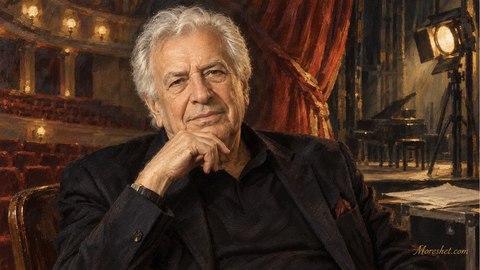
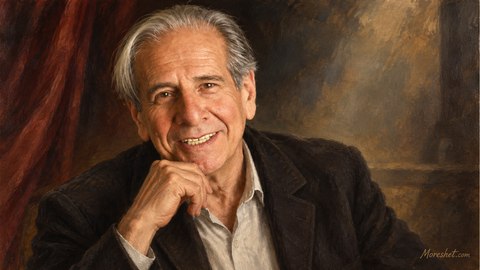
Stephen Fry
A British-Jewish actor, writer, comedian and broadcaster who turned language, personal candour and cultural knowledge into public influence
Stephen John Fry, born on 24 August 1957 in Hampstead, London, is one of Britain’s most versatile cultural figures: an actor, comedian, writer, playwright, director, broadcaster and narrator. Across more than four decades in theatre, television, film, literature, radio and digital media, he has combined verbal brilliance with intellectual curiosity and an unusual willingness to speak openly about identity, Jewish heritage and mental health.
Fry’s Jewish connection comes through his mother, Marianne, née Neumann. His maternal grandparents were Hungarian Jews who emigrated to Britain from Šurany in 1927. Relatives on that side of the family were murdered during the Holocaust; members of his grandmother’s family were deported to ghettos and camps, including Auschwitz and Stutthof. Fry was raised in a non-religious home, but this family history became central to his understanding of identity, loss, belonging and public responsibility.
From Cambridge to the stage and screen
Fry’s early years were troubled, and in his autobiographical writing he described difficulties at school, a short period in custody after a theft, and his return to education. He eventually won admission to Queens’ College, Cambridge, where he studied English literature, joined the Footlights and met Hugh Laurie and Emma Thompson. His Cambridge experience laid the foundation for one of British television comedy’s most influential partnerships.
His play Latin! or Tobacco and Boys won the Fringe First prize at the 1980 Edinburgh Festival. In 1981 he wrote and performed in The Cellar Tapes, the Footlights revue that won the Perrier Comedy Award. He later worked with Laurie and Thompson on programmes that led to Alfresco, and then created A Bit of Fry & Laurie with Laurie. Broadcast in four series between 1989 and 1995, the programme made elaborate wordplay, parody and intellectual absurdity central to a popular comedy style.
During the same period, Fry played Lord Melchett and the Duke of Wellington in Blackadder. From 1990 to 1993 he appeared as Jeeves opposite Hugh Laurie’s Bertie Wooster in Jeeves and Wooster, the television adaptation of P. G. Wodehouse’s stories. These roles established him as a performer with exceptional command of language, comic timing and the literary traditions of Britain.
Writing, theatre and film
Fry adapted the musical Me and My Girl, which ran in London’s West End for eight years before transferring to Broadway. His work on the adaptation earned major recognition and a Tony Award nomination. He has written four novels, works of nonfiction and three autobiographical volumes. His first novel, The Liar, appeared in 1991 and follows a gay schoolboy at a private school and Cambridge. The Stars’ Tennis Balls is a modern reworking of The Count of Monte Cristo, while Making History uses alternate history to examine the conditions that allow tyranny to emerge.
In his memoirs, Fry wrote candidly about childhood, sexuality, addiction and bipolar disorder. His personal disclosures were not simply confessional. Through humour, self-criticism and literary craft, he made experiences often surrounded by shame and silence available for public discussion, helping readers recognise the human complexity behind them.
On screen, Fry portrayed Oscar Wilde in the 1997 film Wilde, earning a Golden Globe nomination. He also appeared in Peter’s Friends, Robert Altman’s Gosford Park, The Life and Death of Peter Sellers, V for Vendetta, Sherlock Holmes: A Game of Shadows, Peter Jackson’s Hobbit films and Love & Friendship. In 2003 he made his directorial debut with Bright Young Things, his adaptation of Evelyn Waugh’s Vile Bodies.
He has also maintained a significant theatre career. In 2012 he played Malvolio in Shakespeare’s Twelfth Night at Shakespeare’s Globe. The production transferred to the West End and Broadway, where Fry received a Tony Award nomination for Best Featured Actor in a Play.
Voice, knowledge and cultural access
One of Fry’s most far-reaching contributions has been his voice work. He narrated the British audiobook editions of all seven Harry Potter novels, as well as works by Douglas Adams, A. A. Milne, Roald Dahl, George Orwell and Alexander Pushkin, and the Paddington stories. For many listeners, particularly children and people who cannot easily read print, his voice has made literature accessible, vivid and memorable.
In 2003 Fry began hosting QI, the comedy panel quiz devoted to interesting facts and unexpected questions. The programme turned scientific knowledge, historical misconceptions and intellectual curiosity into popular entertainment. Fry’s contribution was not merely to supply answers, but to show that knowledge begins with asking better questions. He won the Rose d’Or award for Best Game Show Host in 2006. He also presented documentary series about the English language, the United States, endangered species and the history of light entertainment.
His books Mythos, Heroes, Troy and Odyssey retold Greek mythology in an accessible, contemporary and humorous style. By recording the audiobooks himself, Fry connected the ancient tradition of storytelling with modern popular literature and brought classical narratives to new audiences.
Mental health, human rights and public life
Fry has spoken publicly about living with cyclothymia, a form of bipolar disorder. In 2006 he made the Emmy Award-winning documentary Stephen Fry: The Secret Life of the Manic Depressive. He interviewed people including Carrie Fisher and Richard Dreyfuss, presenting mood disorders not as moral failures but as medical and human experiences that can be understood, treated and discussed. Since 2011 he has served as president of the British mental-health charity Mind, and in 2009 he became an Honorary Fellow of the Royal College of Psychiatrists.
His openness about mental health, homosexuality and identity helped broaden public discussion in Britain and beyond. Fry has also supported humanism, freedom of expression, freedom of information, LGBT rights and campaigns against racism and antisemitism. He has supported conservation and served as president of the Great Fen Project and vice-president of Fauna & Flora International. He has also been patron of Listening Books, a charity that provides audiobooks for people with print disabilities.
Through his website, podcasts and social-media presence, Fry has directed public attention towards writers, musicians, charities and causes that might otherwise have received less exposure. His digital influence demonstrated how a cultural figure can turn a large audience into a resource for knowledge, solidarity and charitable action.
Jewish identity and the relationship with Israel
Fry was not raised religiously and has generally described himself as a humanist and atheist. Yet his maternal Jewish heritage and the persecution suffered by his relatives have remained an important part of his life story. In Channel 4’s alternative Christmas message in 2023, he declared proudly: “I am Stephen Fry, and I am a Jew.” The statement asserted that Jewish identity should not be defined or controlled by antisemites.
Fry has been critical of Israeli policy towards Palestinians and has supported British initiatives advocating Palestinian rights. At the same time, he has not supported boycotts of Israel and has visited the country. This complexity is relevant to understanding his place in contemporary Jewish heritage. He brings to British public life a non-religious Jewish identity, a commitment to Holocaust memory, opposition to antisemitism and a human-rights perspective, even when his political views do not coincide with those of every Jewish community.
Why this legacy belongs in Moreshet
Stephen Fry merits inclusion in Moreshet because his cultural achievements and human influence reinforce one another. He helped shape British comedy through A Bit of Fry & Laurie, Blackadder and Jeeves and Wooster; contributed to theatre through Me and My Girl and Twelfth Night; enriched literature through novels, memoirs and mythological retellings; and brought knowledge to broad audiences through QI, documentaries and audiobooks.
His Jewish significance also lies in the way he connects a family history marked by persecution and the Holocaust with a modern, open and humanist Jewish identity. By speaking about mental health, sexuality, antisemitism and human dignity, he has helped turn subjects once surrounded by silence into subjects of public conversation. He is therefore not only a successful entertainer, but also a cultural mediator who has shaped how millions of people encounter literature, history, science and identity.
For Moreshet and Moreshet.com, Fry represents several forms of heritage at once: a Jewish family legacy carrying the scars of Europe, a British literary and theatrical tradition, and a civic legacy of empathy, free expression and access to knowledge. His influence survives in the works he created, the audiences he reached and the language he gave people for understanding themselves and their world.