Bernard Kouchner
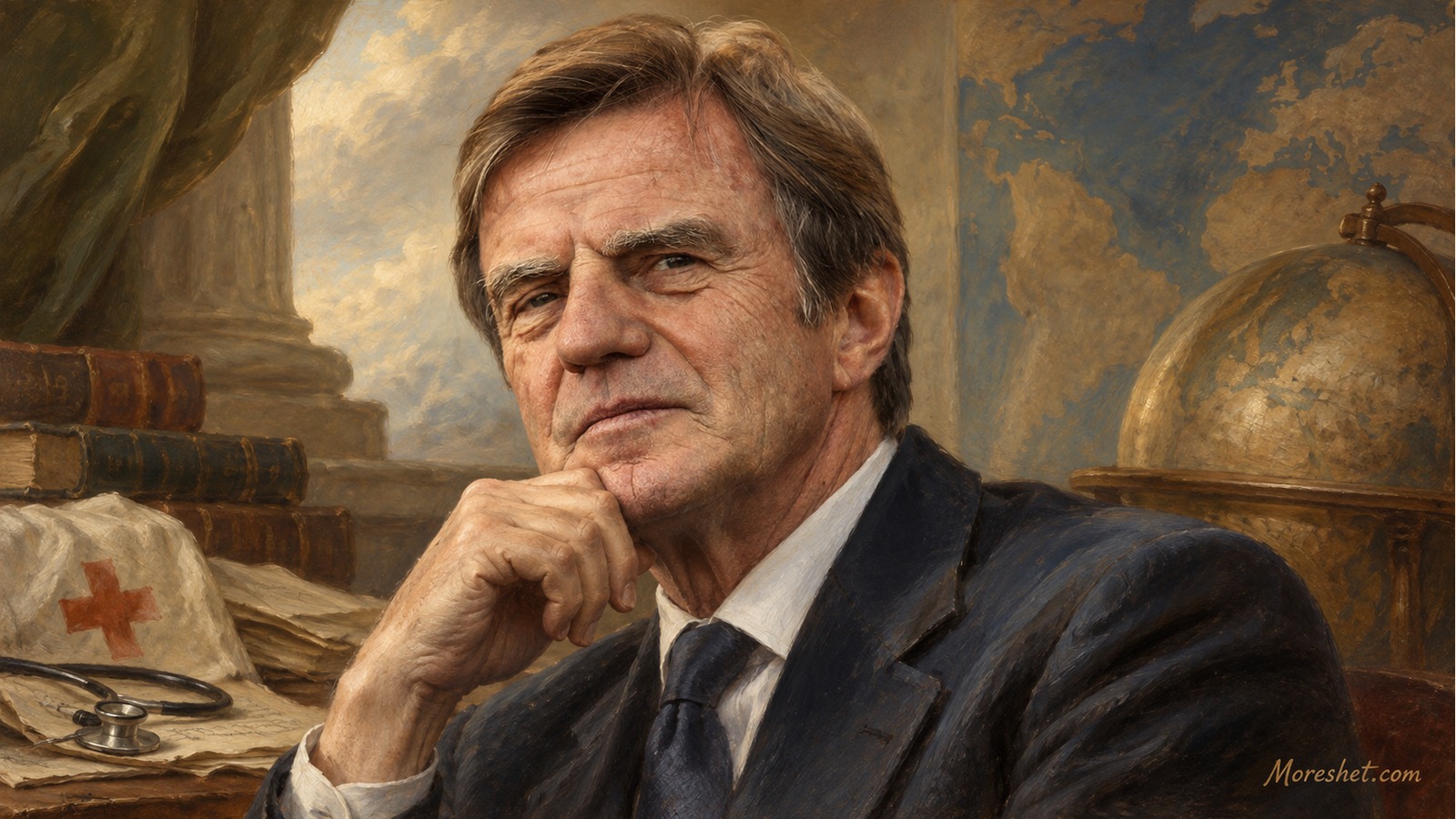
Bernard Kouchner — AI-generated artistic portrait · Moreshet.com
Physician, co-founder of Doctors Without Borders, and French statesman who brought humanitarian medicine into international public life
Bernard Kouchner is a French physician, diplomat, and politician who helped create Doctors Without Borders and later founded Doctors of the World. Across a career that joined medical work, humanitarian action, public administration, and international diplomacy, he helped establish the idea that medical professionals have both the right and the responsibility to reach people trapped in war, famine, displacement, and political violence. His work gave humanitarian medicine a stronger public voice and made the protection of civilians a central concern of international policy.
Jewish roots and the beginning of a medical vocation
Kouchner was born on November 1, 1939, in Avignon, southern France, to a Jewish Ashkenazi father and a French Protestant mother. His paternal grandparents were Russian-born Jews who had immigrated to France after fleeing pogroms; during the German occupation of France, they were deported to Auschwitz and murdered. This family history, together with his medical training, formed an important background to his lifelong concern with persecution, human responsibility, and the protection of vulnerable people.
Kouchner specialized in gastroenterology, but his broadest public influence came through humanitarian medicine. In 1968, during the Nigerian Civil War, he worked as a physician with the Red Cross in Biafra. The experience of treating people affected by war, hunger, and disease convinced him that emergency medicine could not be separated from public testimony. Medical teams, he came to believe, should not only treat victims but also draw attention to the conditions that produced their suffering.
Doctors Without Borders and Doctors of the World
In 1971, Kouchner was among the founders of Médecins Sans Frontières, Doctors Without Borders. The organization developed a distinctive model: professional medical teams provide care in war zones and disaster areas while reporting publicly on the conditions they encounter. Kouchner helped shape the principle that medical neutrality does not require silence in the face of mass suffering, starvation, or crimes against civilians.
In 1980, following disagreements with the leadership of Doctors Without Borders, he founded Doctors of the World, Médecins du Monde. The new organization continued the effort to bring medical care into areas affected by conflict and humanitarian crisis. Both organizations eventually became internationally recognized institutions. Their lasting significance lies not only in the patients treated by their teams, but also in the professional culture they helped create: doctors, nurses, and volunteers are expected to combine clinical competence with solidarity, independence, and public witness.
From humanitarian action to public service
Kouchner began his political life in the French Communist Party and took part in the political and student activism of the 1960s. During the May 1968 protests, he chaired the strike committee of the Sorbonne medical faculty. He later entered public service through France's Socialist governments, although his political affiliations and alliances changed over time.
In 1988, Kouchner became Secretary of State for Humanitarian Action in the government of Michel Rocard. He served as France's Minister of Health in 1992–1993, returned to the post in 1997 under Prime Minister Lionel Jospin, and held it until 1999. He served again as health minister from 2001 to 2002. These positions allowed him to connect his experience as a physician with national health policy and to argue that access to care and social protection are matters of public responsibility.
From 1994 to 1997, Kouchner was a Member of the European Parliament. He chaired its Committee on Development and Cooperation, served on the Subcommittee on Human Rights, and participated in the Parliament's delegation for relations with the People's Republic of China. In 1994, together with Judge Andrée Ruffo, he helped establish the International Bureau for Children's Rights, a Montreal-based nongovernmental organization devoted to protecting children.
The Kosovo mission
In 1999, United Nations Secretary-General Kofi Annan appointed Kouchner the second UN Special Representative and head of the United Nations Interim Administration Mission in Kosovo, under Security Council Resolution 1244. For approximately eighteen months, he led an exceptionally difficult effort to establish a civil administration, create political institutions, and begin rebuilding an economy devastated by war.
Under the administration he headed, local councils were elected by the end of 2000. The mission required more than emergency relief: it involved restoring public institutions, supporting local governance, and helping a postwar society resume civic life. Kouchner's service in Kosovo expanded his humanitarian model into the work of institution-building. He later received an honorary doctorate from the University of Pristina in recognition of his contribution.
France's foreign minister
In 2007, after Nicolas Sarkozy was elected president of France, Kouchner was appointed Minister of Foreign and European Affairs in the government of Prime Minister François Fillon. The appointment was unusual because Kouchner had supported Sarkozy's Socialist rival, Ségolène Royal, during the presidential campaign. Despite their political differences, the two men found common ground on several issues, including a pro-American foreign policy and closer ties between France and the United States. Kouchner remained foreign minister until a cabinet reshuffle in November 2010.
In this role, he continued to emphasize human rights, humanitarian engagement, and international responsibility. He was a committed supporter of European integration and backed ratification of the Lisbon Treaty. He also argued that the international community should prevent Iran from obtaining a nuclear weapon, while stressing negotiation, European coordination, and a diplomatic solution as the preferred means of addressing the issue.
Medicine, human rights, and Jewish heritage
Kouchner occupies a distinctive place in the public life of French Jewry: he is a Jewish-French physician whose family history is directly linked to the Holocaust, yet whose humanitarian work was directed toward people of every religion and nationality. That combination gives his career a wider significance. He transformed the memory of vulnerability and persecution into practical commitments to treat the sick, assist refugees, defend children, and help rebuild civic institutions.
In 2005, the Hebrew University of Jerusalem awarded Kouchner an honorary doctorate. The honor reflected recognition of his work in medicine, humanitarian action, and human rights, as well as the connection between Jewish public life in France and major institutions and values in Israel. His later work included participation in international bodies concerned with health, peace, human rights, and refugee assistance.
Why this legacy belongs in Moreshet
Bernard Kouchner merits inclusion in Moreshet because his influence can be seen in institutions and methods that changed modern humanitarian practice. He did not merely express concern for victims of war: he treated them as a physician, helped establish organizations that became international networks, led an effort to build civilian institutions after conflict, and brought human rights concerns into the center of statecraft.
His life connects Jewish historical memory, including the experience of the Holocaust, with a universal responsibility for human life. His contributions to medicine, children's rights, United Nations administration, and French foreign policy affected professionals, volunteers, and communities across the world. Moreshet.com therefore records him not only as a French minister or a public figure of Jewish background, but as a person who helped turn medical compassion into a durable public and institutional principle.