Theodor Herzl
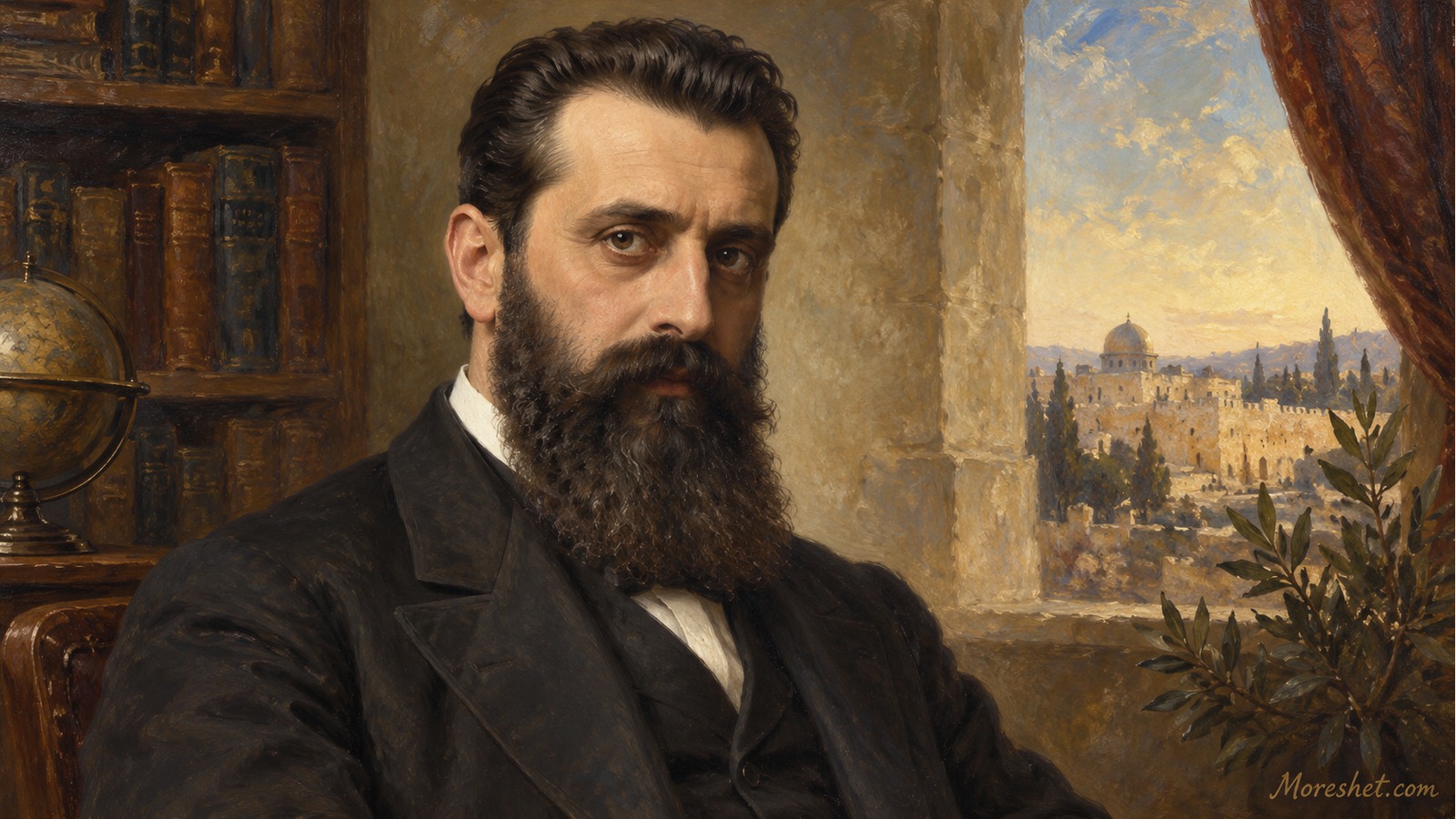
Benjamin Ze'ev Herzl — AI-generated artistic portrait · Moreshet.com
Journalist, lawyer, writer, playwright, diplomat and founder of modern political Zionism, who transformed an ancient Jewish longing into an organized international movement and a political vision that led toward the State of Israel
Theodor Herzl, also known in Hebrew as Benjamin Ze’ev Herzl, was a Hungarian Jewish journalist, lawyer, writer, playwright and political activist, remembered as the father of modern political Zionism and the visionary of the State of Israel. In less than a decade of intensive Zionist activity, from 1895 until his death in 1904, he transformed the distress of European Jews from a recurring historical grievance into an international political question, and turned the idea of Jewish sovereignty into an organized movement with congresses, institutions, a newspaper, a bank, diplomacy and a new political language.
Herzl’s uniqueness was not that he was the first Jew to dream of a return to Zion. Long before him there were religious forerunners, proto-Zionist thinkers, Hovevei Zion activists and early settlers. Herzl’s achievement was to give that ancient dream a modern political architecture. He understood that the Jewish problem in Europe was not only religious or social, but national, and that a national problem required a national solution secured by international law. For that reason, Jewish and Israeli memory gave him the title Visionary of the State.
Pest, Vienna and assimilated Jewish Europe
Herzl was born on May 2, 1860, in Pest, today part of Budapest, into a prosperous, educated Neolog Jewish family. His father, Jakob Herzl, was a businessman, and his mother, Jeanette, née Diamant, came from a cultured Jewish family steeped in German literature. The home in which he grew up was not Zionist in the later sense of the word. It belonged to the world of Central European Jewry, moving between family tradition, education, cultural integration and loyalty to German-speaking European civilization.
His childhood unfolded near the great Dohány Street Synagogue, but his imagination was shaped largely by literature, languages, theater, German history and the European culture of the 19th century. The death of his sister Pauline from typhus in 1878 shook the family, and his parents moved to Vienna. That move brought Herzl into one of Europe’s great capitals, but also into a city where Jewish emancipation stood beside modern, populist and political antisemitism.
At the University of Vienna he studied law and received a doctorate. As a student he joined a German nationalist student fraternity, but left after antisemitic displays. That experience was one of his early encounters with the fact that even an educated, German-speaking Jew with European taste and full civic ambitions was not necessarily accepted as a natural member of the society in which he lived.
Lawyer, journalist and playwright
Herzl practiced law only briefly. After legal work in Vienna and Salzburg, he understood that the glass ceiling facing Jews in state and legal careers limited his future, and he turned almost entirely to journalism, literature and theater. He wrote feuilletons, travel pieces, short stories and plays, gradually becoming one of the notable writers in the German-speaking press.
The central newspaper of his career was Neue Freie Presse, one of the major papers of Vienna and the German-speaking world. Herzl first became a popular contributor and later its Paris correspondent. His journalistic skill is essential to understanding his Zionist achievement. He knew how to formulate an idea sharply, create public drama, write for an educated audience, use symbols and headlines, and understand how public opinion is created and spread.
His theatrical writing also helped prepare the ground for political Zionism. His play The New Ghetto expressed the suffocation of the educated Jew in Europe: a person who has left the physical ghetto, yet discovers that society has built around him a social and cultural ghetto. From that place emerged Herzl’s movement from the dream of integration toward the conclusion that the Jewish condition required a political exit.
Paris, Dreyfus and the maturing of the Jewish question
During his years as Paris correspondent, Herzl encountered French antisemitism around the Panama scandal and the Dreyfus affair. He covered the trial of the Jewish officer Alfred Dreyfus, falsely convicted of treason, and witnessed Dreyfus’s public degradation in January 1895. The crowd that shouted against Dreyfus and against Jews showed Herzl that even republican France, homeland of human rights, did not truly protect Jews from political hatred.
Historians have debated how far the Dreyfus affair alone turned Herzl into a Zionist. The evidence points to a more complex process. Dreyfus was a powerful event, but so were the rise of the antisemitic Karl Lueger in Vienna, anti-Jewish agitation in parliaments and mass meetings, the failure of assimilation and Herzl’s gradual recognition that legal emancipation did not erase social rejection. Herzl did not move in a single step from Jewish indifference to Zionism. He first struggled with ideas of assimilation, mass conversion and Jewish disappearance within Europe, before reaching the opposite conclusion: the Jews were a people, and a people needed a state.
In 1895 he began keeping his political diary and drafting a plan of action. He first approached Baron Maurice de Hirsch and members of the Rothschild family, hoping to enlist great Jewish wealth for a national project. These approaches failed, but they sharpened his understanding that philanthropy or isolated settlement would not be enough. What was needed was a broad, public, organized and political movement.
The Jewish State and the birth of political Zionism
In February 1896 Herzl published Der Judenstaat, The Jewish State: Proposal of a Modern Solution for the Jewish Question. The short pamphlet made a direct argument: the Jews were one people, their distress could not be solved fully through emancipation or assimilation, and the solution was a Jewish state recognized in international law. Herzl saw the Jewish question as an international political problem to be discussed and settled by the nations.
The book provoked enthusiasm, ridicule, anxiety and opposition. Many assimilated Jews saw it as a threat to their status as loyal citizens of their countries; rabbis and communal leaders feared the transformation of Judaism into political nationalism; Hovevei Zion activists saw in Herzl a man insufficiently aware of the work already being done in the Land of Israel. Yet many Eastern European Jews and Jewish students received him with extraordinary excitement. For them, Herzl gave a new, clear and elevated voice to a distress they already knew intimately.
The power of The Jewish State lay in the fact that it did not ask merely for pity. Herzl spoke in the language of organization, migration, finance, law, diplomacy, society and statehood. He proposed institutions that would handle the political and economic aspects of the national project. Even when many details changed, the daring act of speaking about a Jewish state as a practical political instrument changed Jewish history.
The First Zionist Congress and Basel
In 1897 Herzl convened the First Zionist Congress in Basel, Switzerland. The event was both a symbolic and practical revolution. For the first time, Jewish representatives from different countries gathered publicly to discuss a shared political goal: the establishment of a homeland for the Jewish people in the Land of Israel, secured by public law. Herzl was elected president of the Zionist Organization, a position he held until his death.
The congress created institutions, language, a flag, an agenda and a movement center. Herzl understood that the Jewish people were scattered among states, languages, religious currents and social classes, and therefore needed a common public stage. Basel was not only a conference; it was a rehearsal for sovereignty. The congress functioned as a kind of world Jewish parliament before there was a state, government or territory.
After the congress, Herzl wrote in his diary that in Basel he had founded the Jewish state, and that if he said this publicly people would laugh, but perhaps in five years and certainly in fifty everyone would recognize it. The statement became one of the most famous prophecies in Zionist history because about fifty years later, in 1948, David Ben-Gurion declared the establishment of the State of Israel.
Institutions: from vision to national infrastructure
One of the most important aspects of Herzl’s work was institution-building. He did not settle for speeches or books. During his leadership the Zionist Organization, the Zionist Congress, the newspaper Die Welt, the Jewish Colonial Trust and the Jewish National Fund emerged or took shape. These institutions created the first tools through which the Jewish people could act as a modern political body.
Die Welt, the newspaper founded by Herzl, served as a central platform for spreading Zionist ideas, reporting on the movement and creating an international Jewish discourse. The Jewish Colonial Trust was intended as a financial instrument for the national project. The Zionist Congress created a mechanism of representation, discussion and decision. The Jewish National Fund later became one of the central tools for land purchase and the creation of infrastructure for Jewish settlement in the Land of Israel.
In retrospect, the institutions Herzl initiated or advanced were state-like foundations before the state. They trained Jews to think in terms of budgets, representation, diplomacy, land, infrastructure and public authority. This is one of the great differences between a literary vision and a historical movement: Herzl did not only see; he built instruments of action.
Diplomacy among emperors, sultans and powers
Herzl understood that without international political recognition, Zionism could not advance toward its goal. He therefore launched an energetic diplomatic campaign. He tried to reach Ottoman Sultan Abdul Hamid II, German Emperor Wilhelm II, British statesmen, Pope Pius X, Russian ministers and wealthy Jewish leaders. Many of these meetings ended in disappointment, but their very existence gave Zionism a new status.
In 1898 Herzl met Wilhelm II first at Mikveh Israel and later in Jerusalem. He visited the Land of Israel and saw Jaffa, Jerusalem, Jewish colonies and the condition of the Ottoman land. The visit was not only romantic. Herzl came as the statesman of a young movement seeking recognition. His efforts with the Sultan aimed at securing a charter, a legal framework that would allow wide Jewish settlement in the Land of Israel under Ottoman sovereignty or by recognized arrangement.
In 1902 and 1903 he also approached the British government, and plans were discussed for Jewish settlement in El-Arish and in British East Africa, known as the Uganda Scheme. Herzl saw the East Africa proposal, especially after the Kishinev pogrom, as a possible temporary refuge for Jews in danger. The fierce opposition from Zionist delegates, especially from Russia, showed how deeply the Land of Israel had already become the heart of the movement. The proposal was examined and ultimately rejected after Herzl’s death, but the debate exposed the tension between immediate rescue and unwavering loyalty to Zion.
Altneuland: the Jewish state as modern society
In 1902 Herzl published the novel Altneuland, translated into Hebrew by Nahum Sokolow as Tel Aviv. The book presented a literary vision of a modern Jewish society in the Land of Israel in 1923: developed, open, technological, egalitarian, rich in infrastructure, science, culture, cooperation among peoples and full civil rights for non-Jews.
The novel is not only a work of literature; it is a document of political imagination. Herzl tried to show what the future Jewish society could look like: not a new ghetto and not a narrow religious kingdom, but a modern civic society using science, economics, cooperation and welfare to build new life. He imagined equal voting rights for women, religious tolerance, freedom from religious coercion, a multilingual public sphere and a land in which Jews and non-Jews participated in development.
The famous phrase from the book, If you will it, it is no dream, became one of the central slogans of Zionism. Its strength lay in its simplicity. National will is not passive dreaming; it is a force of action. If the people will, organize, build institutions and act politically, even what looks like a dream can become historical reality.
Judaism, religion, nation and language
Herzl was not religious in the traditional sense. He grew up in an assimilated environment, lived in the world of German culture, and at times struggled to understand the depth of religious, linguistic and cultural currents within the Jewish people. At the beginning he did not even see Hebrew as a practical language for the future state. Over time, through encounters with Eastern European Jews, Hovevei Zion activists and the reality of a living national movement, his understanding changed.
Yet precisely his initial distance from traditional Jewish life allowed him to see the Jewish question in modern political terms. He did not seek to replace religion, but to create a national framework in which Jews could live as free people. Religion, for him, was a unifying force in historical and identity terms, but the future state was not meant to be a theocracy. In his vision, national freedom and civil freedom were linked.
This tension made Herzl a broad figure: a secular man who returned to the Jewish people, a European who became a Jewish national leader, a man who first thought in German but became one of the central symbols of Hebrew revival and Zionism. His personal complexity is not a weakness of the story; it helps explain why he could speak to so many different kinds of Jews.
Effort, illness and early death
Herzl’s Zionist activity was short but intensely demanding. He wrote, traveled, spoke, corresponded, met statesmen, confronted opponents, created institutions, edited a newspaper and managed internal movement struggles. The enormous effort took a heavy toll on his health. In his final years he suffered from heart disease, exhaustion and psychological pressure.
Herzl died on July 3, 1904, in Edlach in Austria-Hungary, at the age of 44. He was first buried in the Döbling cemetery in Vienna, as he had requested, beside his father until the Jewish people would carry his remains to the Land of Israel. In 1949, after the establishment of the State of Israel, his remains were brought to Jerusalem and reburied on the mountain named after him, Mount Herzl.
The fact that Herzl did not live to see the state he called for does not diminish his achievement; it intensifies his symbolic power. In only a few years he created a language, institutions, diplomacy and political myth that continued to work after his death. A movement that began as the almost impossible project of a Jewish journalist in Vienna became the historical force that helped lead to the establishment of the State of Israel.
Family, tragedy and memory
Herzl’s family life was difficult. His marriage to Julie Naschauer was unhappy, and his three children — Paulina, Hans and Margarethe, known as Trude — had tragic lives. They did not continue a stable family line, and his only grandchild, Stephen Theodore Norman, served in the British Army, visited Mandatory Palestine, identified with Zionism, and died by suicide in 1946 after learning the fate of his family in the Holocaust.
The tragedy of Herzl’s family stands in sharp contrast to the national success of his vision. The man who tried to secure a future for the Jewish people could not secure a future for his own household. This made his memory more complex: not only a face on a stamp, street or mountain, but a lonely, tense, ambitious and wounded human being who gave much of his life to an idea he did not live to see fulfilled.
Yet his public memory became one of the pillars of the State of Israel. Herzl Day is marked in Israel; Mount Herzl is a central national site; Herzliya is named for him; and Tel Aviv took its name from the Hebrew translation of Altneuland. The Israeli Declaration of Independence explicitly mentions him as the spiritual father of the Jewish State.
Why this legacy belongs in Moreshet
Theodor Herzl merits inclusion in Moreshet because few individuals changed the course of Jewish history as he did. He took the Jewish question from the antisemitic street, the European press and internal communal debate, and made it a world political question. He gave a scattered people a language of sovereignty, congress, institutions, diplomacy and a clear historical objective.
Moreshet.com documents Herzl because modern Jewish and Israeli heritage cannot be understood without him. The State of Israel, the Zionist movement, the institutions of the Jewish people, aliyah to the Land of Israel, the political imagination of Jews in the 20th century and the connection between ancient memory and modern politics all bear his imprint. Theodor Herzl’s place in Moreshet is not only as a political founder, but as a man who proved that an idea, when clearly formulated, organized in institutions and driven by historical will, can alter the fate of a people.