Benjamin Aaron Shapiro
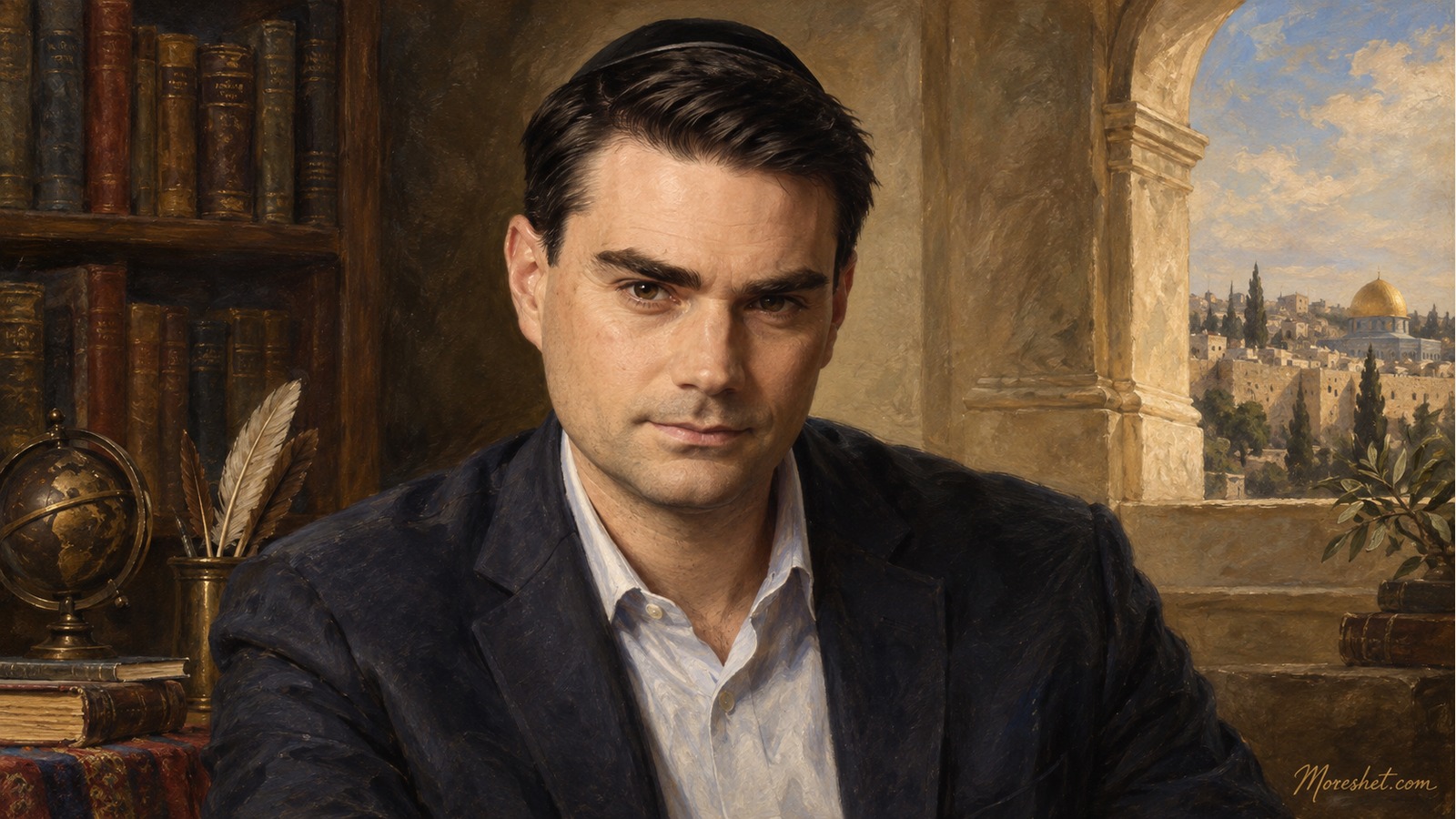
Ben Shapiro — AI-generated artistic portrait · Moreshet.com
Orthodox Jewish-American lawyer, author, columnist, host and media entrepreneur, co-founder of The Daily Wire and one of the most prominent conservative voices in American media and public support for Israel
Benjamin Aaron Shapiro, widely known as Ben Shapiro, is an Orthodox Jewish-American lawyer, author, columnist, podcast and radio host, media entrepreneur and political commentator. He is a co-founder of The Daily Wire, editor emeritus of the site, and host of The Ben Shapiro Show, one of the best-known conservative commentary programs in the United States. Through columns, books, a daily podcast, radio syndication, online video, campus speaking and a strong social-media presence, Shapiro became one of the most visible Jewish voices in 21st-century American political media.
Shapiro’s importance does not come only from the size of his audience or from his polemical style. He created a media model in which open Orthodox Jewish identity, American conservatism, support for Israel, opposition to antisemitism, fast-moving debate culture and digital media business all operate together. For Jewish and Israeli audiences, he represents a significant phenomenon: an observant Jew, visibly marked by his yarmulke and public Jewish identity, who became a central figure not only inside Jewish discourse, but within mainstream and new-media American conservatism.
Jewish childhood in Los Angeles and Orthodox education
Shapiro was born on January 15, 1984, in Burbank, California, to an Ashkenazi Jewish family. His parents worked in the entertainment and cultural world of Hollywood: his father, David Shapiro, was a composer, and his mother worked as an executive in a television company. As a child he began playing violin and, at a young age, performed at community events including an Israel Bonds banquet. The home in which he grew up connected American culture, Hollywood, music, words and Jewish identity.
His family began observing Orthodox Judaism when he was a child. That transition shaped a major part of his public identity. Shapiro studied in Jewish frameworks, including Yeshiva University High School of Los Angeles, and graduated high school at 16. Jewish education, textual learning, intellectual discipline and Orthodox communal life became inseparable from the way he presents himself and his arguments.
From a heritage perspective, this background matters because Shapiro does not hide his Jewishness or treat it as a marginal biographical detail. It appears at the center of his public life: yarmulke, Shabbat, family, halakhah, support for Israel, internal debates about American Jewry and the belief that Jewish tradition can participate in broad political, moral and media language.
UCLA, Harvard and early entry into public writing
Shapiro studied political science at the University of California, Los Angeles, UCLA, graduating summa cum laude in 2004. He then attended Harvard Law School and earned his J.D. in 2007, graduating cum laude. His legal and academic training gave him one of the qualities most associated with him: a tendency to build arguments quickly, systematically and almost legally, distinguishing principle, precedent, data and conclusion.
At 17 he began writing a nationally syndicated column and became known as one of the youngest syndicated columnists in the United States. At an age when many people are still learning the boundaries of public language, Shapiro was already writing about universities, culture, politics, values and media. His first book, Brainwashed: How Universities Indoctrinate America’s Youth, was published in 2004, while he was still a young student, and presented an argument that would become one of his recurring themes: criticism of what he saw as the cultural dominance of the left in academia, media and entertainment.
This early chapter matters because Shapiro was not first built as a television host or internet celebrity, but as a political writer. He came to video and podcasting from the world of columns and books, so even when speaking at high speed, he acts within a framework of public argument: position, reasoning, ideological opponent, audience and persuasion.
Books, columns and conservative public argument
Over the years Shapiro published a long series of political and cultural nonfiction books. His works include Porn Generation, Primetime Propaganda, Bullies, The People vs. Barack Obama, The Right Side of History, How to Destroy America in Three Easy Steps, The Authoritarian Moment and Lions and Scavengers. Several of his books reached bestseller lists and became part of the popular conservative bookshelf in the United States.
His writing repeatedly returns to several central themes: the role of religion and tradition in the West, free speech, criticism of political correctness, opposition to progressive policy, free markets, family, personal responsibility, American identity, and the relationship between Judeo-Christian values and Western culture. Even those who disagree with him recognize that he helped turn conservative argument books into tools of political education for a broad audience.
In The Right Side of History, Shapiro emphasized the connection, in his view, between Greek reason and biblical morality as the foundation of the West. That point is especially important from a Jewish angle: Shapiro does not speak about Judaism only as an ethnic community or private identity, but as an intellectual source he sees as part of the moral architecture of Western civilization.
Breitbart, resignation and the founding of The Daily Wire
In 2012 Shapiro joined Breitbart News as editor-at-large. This period connected him with the world of conservative digital media, which was moving away from older partisan journalism and becoming an ecosystem of websites, video, podcasts, social media and live events. In 2016 he resigned from Breitbart after internal disputes, especially around the site’s relationship to the Trump campaign and the Michelle Fields affair.
Earlier, in 2015, he co-founded The Daily Wire with Jeremy Boreing. The site began as a conservative news and opinion platform but later developed into a wider media company: podcasts, video, subscriptions, films, entertainment, children’s content, commercial products and a loyal audience. Shapiro served as editor-in-chief from its founding and later became editor emeritus, while remaining one of the company’s central public faces.
The Daily Wire is important to understanding his influence because it is not only a personal platform. It is a relatively new media institution built around a direct-to-audience model: subscriptions, podcasts, short clips, social distribution, long-form content and the ability to bypass some of the filters of traditional media. Shapiro was one of the people who showed that a political commentator could also become a media entrepreneur and build a company with economic and cultural influence.
The Ben Shapiro Show and the daily political podcast
The Ben Shapiro Show became the central instrument of his public influence. The program combines news commentary, monologues, interviews, video clips, dry humor, legal-style argument and rapid responses to political developments. It is distributed as a daily podcast and as a radio program, and is regarded as one of the most successful conservative commentary shows in the United States.
The program’s distinctiveness lies in its combination of pace, format and position. Shapiro speaks quickly, breaks down claims, cites sources, moves among domestic news, foreign affairs, culture, religion and law, and gives his audience a feeling of continuous monitoring of the world. In an era when many people consume politics through headphones, short video clips and social platforms, his program became one of the clearest models of daily digital commentary.
For Jewish-American heritage, the very existence of such a program led by a visibly Orthodox Jew is significant. Jews have long influenced American journalism, radio and television, but often their religious identity was muted or merely cultural. With Shapiro, Jewish identity is not hidden: it appears in his schedule, language, discussions of Israel, defense of the Jewish people and confrontation with antisemitic currents on both the right and the left.
Campuses, debate and free speech
Shapiro became strongly associated with speeches on American college campuses, especially during years of intensified debate over free speech, safe spaces, identity, political correctness and the position of conservatives in universities. He appeared on dozens of campuses, often amid large protests, heavy security and attempts to prevent events from taking place.
These appearances built around him the image of a fast, sharp and unapologetic debater. Clips of his question-and-answer exchanges became viral, sometimes reaching tens of millions of views. The format was simple but effective: a student offers a claim, Shapiro responds quickly and confidently, and the moment is distributed as a short confrontation that is easy to watch and share.
More broadly, Shapiro contributed to a new political culture in which campus, video, podcast and social media become one arena. A lecture no longer ends in the hall; it continues on YouTube, TikTok, X, Facebook and podcast feeds. In this way public debate became not only a tool of persuasion, but also a media product.
Orthodox Jewish identity at the center of American media
One of Shapiro’s most notable features is that he is an openly Orthodox Jew inside a largely secular American media environment. He speaks publicly about Shabbat observance, Jewish family life, halakhah, Jewish education and belief in God. He wears a yarmulke and presents his Jewishness as an inseparable part of his public identity, not merely as a private detail.
This gives his public profile special meaning for young Jews, especially those living between a religious world and a competitive academic, media and political world. Shapiro demonstrates that it is possible to appear in the large American public arena without erasing visible Jewish markers. For supporters, this is evidence of Jewish confidence; for critics, it is also a point of dispute in debates over who speaks for Jews or Israel.
Shapiro also sometimes clashes with liberal and Reform Jews, arguing that Judaism detached from tradition, halakhah and Israel loses its foundations. These views have drawn sharp criticism within American Jewry, but they are part of his influence: he does not only represent conservative Jews to the non-Jewish world; he also participates in the internal debate over the future of Jewish identity in America.
Israel, Zionism and opposition to antisemitism
Shapiro’s support for Israel is one of the central axes of his public activity. He presents Israel as the nation-state of the Jewish people, as a central ally of the United States, and as a moral and security front against antisemitism, terrorism and regional threats. Since Hamas’s October 7, 2023 attack, Shapiro has been among the most prominent American voices describing the massacre as antisemitic and genocidal, and consistently defending Israel’s right and duty to destroy Hamas as a military and governing force.
His influence on Israel-related issues matters because his audience is not only Jewish. He speaks to millions of American conservatives, Christians and secular listeners, Republicans, young people and podcast consumers, explaining the Israeli-Palestinian conflict in the language of security, Western morality, counterterrorism and Jewish survival. In doing so, he acts as a mediator between Jewish-Israeli pain and a large American audience that does not live the Israeli reality directly.
In 2025 Shapiro was selected to light a torch at Israel’s 77th Independence Day ceremony. The choice generated public debate, as often happens around figures with a clear political profile, but it also marked Israeli recognition of his influence as a pro-Israel Jewish-American voice during a difficult period of war, global antisemitism and struggle over public opinion.
Opposition to the alt-right and antisemitism from the right
Although Shapiro is identified with the American right, he was one of the conservative voices who spoke out against the alt-right, white nationalism and antisemitism from the far right. After leaving Breitbart and during the rise of the alt-right, he himself became a major target of online antisemitic attacks. Organizations monitoring online antisemitism noted that he was among the Jewish journalists who received an unusually high volume of such attacks.
This chapter matters because it separates constitutional or religious conservatism from nationalist and racist currents that operated on the edges of the American right and at times tried to penetrate its mainstream. Shapiro repeatedly argued that the alt-right was not conservatism, but a movement of corrupt ideas, and that antisemitism could not be part of a moral political camp.
In this respect he played a distinctive role: a conservative Jew attacked by the left for his views and by the far right for his Jewishness, while continuing to argue that American conservatism should rest on the Constitution, religion, family, free markets and Western values — not on hatred of Jews or racial politics.
We Will Rise, Holocaust memory and Jewish culture
In 2024 Shapiro, together with his father David Shapiro, helped create We Will Rise, a musical about the Warsaw Ghetto Uprising and the connection between Jewish heroism in the Holocaust and Israeli reality after October 7. The production was staged in Israel and combined historical memory, music, Jewish identity and cultural response to contemporary trauma.
The musical matters because it shows another side of Shapiro: not only a daily political commentator, but someone trying to use culture, music and theater to tell a Jewish story of resistance and endurance. The Warsaw Ghetto Uprising is one of the deepest symbols of modern Jewish courage, and the production’s connection between it and October 7 expresses how Holocaust memory continues to serve as a language for understanding vulnerability, self-defense, Jewish responsibility and the State of Israel.
In this sense, Shapiro participates not only in political argument about Israel, but also in shaping popular Jewish memory. He seeks to speak to a broad audience about the Holocaust, revolt, heroism, Israeli soldiers and Jewish continuity through a cultural form that is neither a podcast nor an opinion column.
Popular culture, virality and Facts
In 2024 Shapiro appeared on Facts, a song by Canadian rapper Tom MacDonald. The song reached high positions on music charts, gained major online exposure and became an unusual cultural event: a conservative Jewish political commentator appearing inside a political rap song and reaching a wide audience that does not necessarily read columns or listen to political podcasts.
This episode, even if secondary to his books or show, illustrates how contemporary political communication crosses boundaries among news, entertainment, music, clips, personal brands and culture war. Shapiro does not operate only in journalism or radio; he operates in a space where politics also becomes cultural consumption, slogan, meme and entertainment.
The ability to move among book, podcast, clip, lecture, interview, column and musical is part of the source of his influence. He belongs to a generation in which a columnist need not remain only a newspaper writer, but can become a multi-channel media brand.
Personal life and family
In 2008 Shapiro married Mor Toledano, an Israeli-American physician of Moroccan Jewish descent. The couple married in Israel in a traditional Jewish ceremony, and they have five children. The family practices Orthodox Judaism. In 2020 Shapiro announced that he and his family were leaving California; The Daily Wire moved its headquarters to Nashville, Tennessee, while Shapiro and his family settled in South Florida.
Shapiro’s personal life is not separate from his public persona. He often speaks about marriage, parenting, education, religion, family, community and continuity. For him, these are not only private topics but foundations of a broader conservative outlook. Here too his influence appears: he presents a model of a religious American Jew who sees family and community not only as a way of life, but also as a political and moral argument.
Editorial note on inclusion
Ben Shapiro is included on the site even though this person and their public record are controversial among broad sections of the public. Inclusion does not determine whether the influence is positive or negative; it reflects the significant place this figure holds in shaping the lived experience, culture and way of life of the public. Naturally, some regard this activity as positive and even heroic, while others see it as contrary to their worldview. The very existence of opposing assessments is part of the historical record that justifies including this significant and influential figure in the heritage of the Jewish people.
Why this legacy belongs in Moreshet
Benjamin Aaron Shapiro merits inclusion in Moreshet because he is one of the most visible and influential openly Orthodox Jews in contemporary American media. His path connects Jewish education in Los Angeles, Harvard Law School, conservative public argument, the founding of The Daily Wire, a widely followed daily podcast, influential books, campus speaking, support for Israel, opposition to antisemitism and cultural engagement with Holocaust memory and Jewish heroism.
Moreshet.com documents Shapiro because Jewish and Israeli heritage also includes Jewish figures who operate on the global public stage and influence how broad audiences understand Judaism, Israel, free speech, antisemitism, Western identity and American politics. Ben Shapiro’s place in Moreshet rests on the fact that he made an explicitly Jewish voice central to American conservative media, and that during a struggle over Israel’s image and the safety of Jewish communities he used a large platform to defend the Jewish people, the State of Israel and the right of Jews to speak clearly in the public square.