Oded Burla
A writer and illustrator who brought playful freedom to Hebrew children’s books
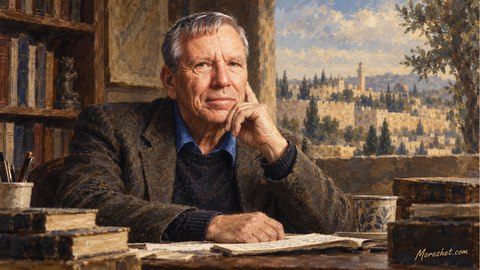
Oded Burla (1915–2009) was an Israeli writer, poet, illustrator and painter whose children’s books opened a playful space within Hebrew literature. His animals encounter unexpected situations, language takes surprising turns and the apparently impossible becomes an invitation to think. He respected the imaginative freedom of young readers, allowing a story to be strange and funny without immediately reducing it to a lesson.
A literary family and a visual imagination
Burla was born in Jerusalem, the son of the novelist Yehuda Burla and a member of a family with longstanding Sephardic roots in the city. He spent part of his childhood in Damascus, where his father worked in Hebrew education, and later studied in institutions including Mikveh Israel and Bezalel. Literature, art and teaching would remain closely connected in his own career.
During periods in the United States, he worked in Hebrew education and the arts. In the early 1950s he also contributed to the Hebrew service of Voice of America. After returning to Israel, he continued painting, designing and teaching. This visual background is important to his children’s writing: the shape of a creature and the character of a gesture can be as expressive as the sentence describing them.
From personal letters to an imaginative world
His first book, Letters to Liora, appeared in 1960, when he was forty-five. It grew from letters written to his niece while he was abroad. That beginning suggests the personal quality of his approach. Writing can be a conversation with a child, built around shared curiosity and the pleasure of offering something unexpected.
He went on to create a substantial body of children’s books, illustrating many of them himself. Animal characters, verbal invention and comic reversals are characteristic features. A story may follow its own peculiar logic with complete seriousness, arriving somewhere delightfully improbable. The reader is encouraged both to enjoy the joke and to imagine another way of arranging the world.
Bringing books into children’s lives
Burla also wrote for children’s television, including Rega im Dodley, and for children’s periodicals. His movement between writing, images and performance brought his work to audiences in several forms. Visits to schools, where he read and presented his stories, made the relationship between author and reader an immediate encounter.
His contribution to Hebrew nonsense writing gave imaginative play a substantial literary presence. In these stories, questioning an assumption or shifting perspective can produce discovery rather than confusion. An affection for animals and the natural world keeps the inventions connected with attentive observation. Freedom and care coexist within the same comic sensibility.
Why Oded Burla belongs in Moreshet
Burla belongs in Moreshet at Moreshet.com because he enlarged the expressive possibilities of childhood in Hebrew. He brought literary inheritance, visual art and an unmistakably personal imagination into a body of work that invites readers to participate. His books show that cultural heritage is also formed in moments of laughter and discovery, when a child learns that language can contain more possibilities than the familiar world first appears to offer.