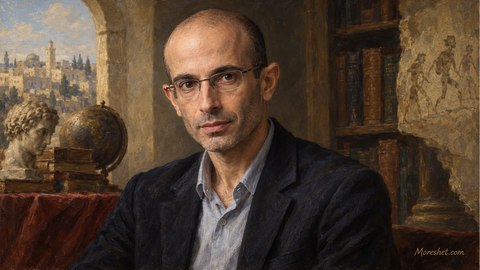
Zeev Sternhell
Israeli historian and political scientist whose studies of fascism, nationalism, Zionism, and democracy reshaped modern political thought
Zeev Sternhell (April 10, 1935–June 21, 2020) was an Israeli historian, political scientist, public intellectual, and one of the world's leading scholars of fascism and European intellectual history. As a professor at the Hebrew University of Jerusalem, he connected political history, political philosophy, and the study of ideology. His work asked how ideas about nation, community, authority, and violence become political movements and institutions. His books transformed academic discussions of fascism and reached readers far beyond Israel through translations, teaching, and public writing.
His own life bore the marks of twentieth-century Jewish history. Sternhell was born in Przemyśl, Poland, into an affluent Jewish family. His father died before the war, and his mother and sister were murdered by the Nazis. He survived after an uncle and aunt hid him in Lwów. After the war, he was taken to France on a Red Cross children's train, studied in Avignon, and immigrated alone to Israel in 1951 through Youth Aliyah. He studied at the Magdiel youth village, worked with a settlement group at Ushah, attended evening school in Haifa, and completed his secondary education at Bialik Gymnasium. He later recalled that Israel's War of Independence and his family's Zionist history inspired him to help build the Jewish state.
From military service to academic leadership
Sternhell served as an officer in the Golani Brigade and commanded a platoon during the Sinai Campaign. As a reservist, he took part in the Six-Day War, the Yom Kippur War, and the 1982 Lebanon War. At different points he served alongside General Israel Tal and held operations posts in armored formations. These experiences gave him a direct understanding of a state living under continuing pressure, but his principal contribution developed through the study of ideas.
He studied history and political science at the Hebrew University of Jerusalem and earned a doctorate from the Paris Institute of Political Studies in 1969 under the supervision of Jean Touchard. His dissertation examined the social and political ideas of Maurice Barrès. In 1969 he joined the Hebrew University faculty. He headed the Department of Political Science, directed the Levi Eshkol Institute for Social Research, became a full professor, held the Léon Blum Chair of Political Science, and retired in 2003. He also served as co-editor of the Jerusalem Quarterly and as a member of the editorial boards of History and Memory and the Journal of Political Ideologies.
Sternhell held research fellowships or visiting positions at leading institutions including the Paris Institute of Political Studies, St Antony's College, Oxford, UCLA, the Institute for Advanced Study in Princeton, the Woodrow Wilson Center, and research institutes in France, the Netherlands, and New York. These appointments connected Israeli scholarship with the international community studying political history and ideology.
Fascism and the idea of the revolutionary right
Sternhell devoted much of his career to a central question: how and why did Europe's liberal and democratic order collapse? Against interpretations that treated fascism as merely a consequence of the First World War, or as an accidental episode without substantial intellectual content, he argued that fascism had deep roots in the social and cultural transformations of the late nineteenth century. In his interpretation, fascism combined radical nationalism with an anti-rationalist assault on liberalism, democracy, and Marxism.
His most influential conceptual contribution was the idea of the “revolutionary right.” The term challenged the assumption that revolution belongs exclusively to the left while the right merely defends the existing order. Sternhell showed that right-wing movements could also seek political and cultural revolution. They could oppose liberalism, democracy, and Marxism at the same time, while accepting capitalism and private property. This framework offered a new way to understand how radical ideologies mobilize followers and present themselves as a comprehensive alternative to the established order.
He also distinguished fascism from Nazism. In his view, fascism represented the ideological core of the revolt against the Enlightenment and its universal values, while Nazism constituted an extreme war against humanity itself. This distinction formed part of his broader effort to analyze ideologies according to their intellectual content, rather than only by their institutions or historical consequences.
The books that reshaped fascism studies
Maurice Barrès and French nationalism
Sternhell's first major book, Maurice Barrès et le nationalisme français, published in 1972 from his doctoral research, examined the novelist, politician, and publicist Maurice Barrès. Sternhell argued that Barrès's nationalism was not simply an emotional response to France's defeat in the Franco-Prussian War. It was a coherent system of ideas: anti-rationalist, anti-universalist, nationalist, and antisemitic. By revealing the depth of radical currents within French political culture, Sternhell placed France within the wider European history of extreme nationalism.
The revolutionary right and Neither Right nor Left
In La Droite Révolutionnaire 1885–1914, first published in 1978, Sternhell developed the concept that became a signature of his work. In Ni droite, ni gauche, published in 1983 and translated into Hebrew as Neither Right nor Left: Fascist Ideology in France, he developed the argument that fascism was a “third way”: neither liberalism nor Marxist socialism, but a combination of radical nationalism, politics of force, and intellectual revolt against Enlightenment values.
The book attracted wide attention in France and abroad. In 2000, his first three studies—on Barrès, the revolutionary right, and fascist ideology in France—were issued as a French-language trilogy. They were translated into several languages, including Hebrew, English, and Italian, and generated a substantial secondary literature. Their significance lies not only in their account of the past. They gave readers a vocabulary for recognizing the links among nationalism, anti-liberalism, the worship of collective identity, and the rejection of universal rights.
The Birth of Fascist Ideology
In The Birth of Fascist Ideology, written with Mario Sznajder and Maia Asheri, Sternhell traced the formation of fascist ideology in France and Italy from the late nineteenth century to the First World War. The book emphasized the influence of Georges Sorel and the way revolutionary syndicalist currents moved away from Marxism, adopted nationalism, and concluded that capitalism could be accepted while political liberty, human rights, and liberalism were rejected.
Rather than presenting fascism as a shadow of Bolshevism or merely an instrument of capital, the book examined it as an intellectually autonomous phenomenon capable of turning abstract ideas into a political movement. Published in Hebrew as Yesodot ha-Fashizm, it helped readers understand how intellectuals, newspapers, journals, and political organizations participate in the creation of historical reality.
Zionism, the Labor movement, and Israeli society
Sternhell's only book written originally in Hebrew, Nation Building or Social Reform?: Nationalism and Socialism in the Israeli Labor Movement, 1904–1940, appeared in 1995 and was later translated into English, French, and Italian. It grew out of a personal and historical question: why was the society he encountered after immigrating to Israel not the egalitarian socialist society he had imagined from what he had read before arriving?
Through research into the Second Aliyah, the Labor movement, the kibbutz, and Mapai, Sternhell examined the tension between building a Jewish state and fulfilling universal ideals of equality and socialism. He argued that the central goals of the Yishuv's leaders were national power, immigration, and state-building; socialism functioned to a significant extent as a mobilizing language, while full economic cooperation remained concentrated mainly in the kibbutz and, to a lesser degree, the moshav.
The book made the history of Zionism and the Labor movement part of a broad historical and theoretical discussion. It connected the Israeli experience to larger questions about nationalism, class, property, migration, and state formation. Even where his interpretation prompted disagreement among historians of the Labor movement, the debate he helped create encouraged a more critical and detailed understanding of the origins of Israeli society.
The Anti-Enlightenment tradition
In Les Anti-Lumières: Une tradition du XVIIIe siècle à la guerre froide, published in French in 2006 and translated into Hebrew as The Anti-Enlightenment Tradition: From the Eighteenth Century to the Cold War, Sternhell extended his research across more than two centuries. He described the Anti-Enlightenment not as a rejection of modernity altogether, but as a proposal for another kind of modernity—one that placed society, history, tradition, and community before the individual and universal rights.
Sternhell contrasted the Enlightenment's commitment to human equality and natural rights with ideas emphasizing historical rights, national identity, and collective belonging. Moving through thinkers such as Edmund Burke and Nietzsche, he showed how ideas formed in philosophy and literature entered public journalism and political life. The book was translated and discussed internationally, giving readers a framework for understanding the continuing conflict between universalism and particularism.
Teacher, editor, and public intellectual
Sternhell did not limit himself to academic writing. For decades he published hundreds of articles, chiefly in Haaretz, and helped establish the Seventy-Seven Circle. He took part in Israeli debates over Zionism, democracy, human rights, and relations between Israel and the Palestinians. His public positions were rooted in a commitment to Israel as a free and open society. This public role made historical scholarship a resource for thinking about the present.
In 2008 he received the Israel Prize for Political Science. The prize committee cited the originality of his research, its influence on the understanding of ideological and radical movements, and his contribution to public discourse in Israel and abroad. He also received French honors, was elected to the Israel Academy of Sciences and Humanities in 2010, and to the American Academy of Arts and Sciences in 2016.
His personal life was closely connected to family and Israeli society. He was married to Ziva Sternhell, a lecturer and architecture critic, and they had two daughters. In 2008 he was lightly injured by a pipe bomb outside his Jerusalem home. He continued to teach, write, and participate in public life. He died on June 21, 2020, at the age of 85.
Why Zeev Sternhell's legacy belongs in Moreshet
Zeev Sternhell merits a prominent place in Moreshet because he made the study of fascism, nationalism, and democracy a means of understanding the dangers and possibilities of the modern world. His work on the revolutionary right, the intellectual origins of fascism in France and Italy, and the Anti-Enlightenment tradition changed the language used by scholars and readers to analyze radical ideologies. His study of Zionism and the Israeli Labor movement added a direct contribution to understanding Jewish and Israeli society, including the tension between nation-building and equality and the way ideas become institutions and everyday realities.
His legacy also belongs to the Jewish story of survival, migration, and the creation of a national home: a Jewish child who lost his family in the Holocaust, immigrated alone to Israel, served in the Israel Defense Forces, and became a scholar of worldwide influence. Through research, teaching, and journalism, he gave Israeli society a language of memory, critical inquiry, and civic responsibility. For these reasons, Moreshet.com presents Sternhell not simply as an award-winning scholar or author, but as a thinker who shaped how Jews and Israelis understand their past, their state, and their responsibility to defend human freedom and democratic society.