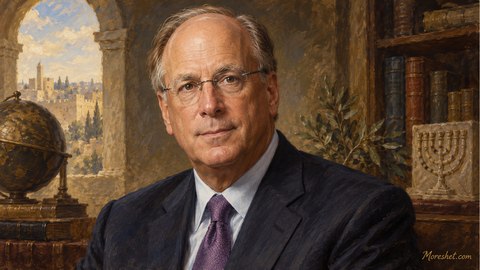
Joseph “Yossi” Vardi

Yossi Vardi — AI-generated artistic portrait · Moreshet.com
A pioneer of Israel’s software and internet industries who combined early-stage investment, public service, and the cultivation of global innovation communities
Dr. Joseph “Yossi” Vardi is an Israeli entrepreneur, investor, and former public official whose career traces much of Israel’s development from a young computing industry into a global center of technology entrepreneurship. His work has ranged across software, energy, the internet, telecommunications, electro-optics, and water technology. He has founded companies, backed entrepreneurs at their earliest stages, managed major areas of government economic policy, promoted regional cooperation, and created international gatherings that connected Israeli innovators with colleagues around the world.
Vardi’s importance cannot be reduced to a single company or acquisition. His early backing of Mirabilis, the developer of ICQ, helped demonstrate that a small Israeli team could build a consumer internet product used around the world. He subsequently supplied many other founders with capital, advice, contacts, and the confidence to pursue international markets. His earlier experience in government and infrastructure gave this work an unusual breadth: he understood innovation not only as a source of private success, but also as part of industrial development, national policy, and Israel’s relationship with the wider world.
From Tel Aviv to Israel’s emerging software industry
Vardi was born in Tel Aviv on September 2, 1942. He attended Ironi Alef High School and participated in the Dizengoff Scouts. During his Israel Defense Forces service, he taught at the Israeli Air Force Technical School, where he met Talma, his future wife. They became the parents of three sons: Arik, Oded, and Dani.
At the Technion–Israel Institute of Technology, Vardi pursued an education that joined engineering with management. He earned a B.Sc. in industrial management engineering, an M.Sc. in operations research, and a doctorate. His research addressed decision-making and planning in electric-power systems, including the location of generating stations, reliability, pricing, and variable demand. His doctoral work received the Kennedy-Leigh Award, and he co-authored professional studies on power-generation economics and energy-system planning.
In 1969, at the age of 26, Vardi co-founded TEKEM, short for Advanced Technology, and served as its first chief executive. TEKEM was among Israel’s early software houses, established when the domestic software industry was still small and closely tied to government, industrial, and large-system needs. The company embodied an idea that would recur throughout Vardi’s career: engineering knowledge could become an independent commercial industry and a significant source of national growth.
Public responsibility for energy and industrial development
In 1970, when he was 27, Vardi was appointed director-general of Israel’s Ministry of Development. He became involved in national policy for energy and natural resources and in the oversight of state-owned industries working in chemicals, phosphates, mining, copper, fertilizers, and electricity. The ministry’s sphere included major enterprises such as Israel Chemicals, the Timna copper mines, and phosphate operations in the Negev. The position placed him at the intersection of economic planning, regional development, infrastructure, and the management of strategically important industries.
In 1974, Vardi went to North America as director of Israel’s Investment Authority and consul for economic affairs at the Israeli consulate in New York. He promoted investment and industrial cooperation between Israel and the United States and contributed to the process that established the Israel-U.S. Binational Industrial Research and Development Foundation, commonly known as BIRD. The foundation later became an important mechanism through which Israeli and American companies could share the risks and opportunities of joint technological development.
On returning to Israel, Vardi became the first director-general of the Ministry of Energy and also chaired the Israel National Oil Company. He worked on energy policy, the organization of state oil-exploration activity, and the oil-related dimensions of the negotiations leading to peace with Egypt. He resigned in November 1978 after he was unable to implement his proposal to combine the government bodies engaged in oil exploration into a single national company operating on a commercial basis.
Building companies and contributing to the Israeli economy
After leaving full-time government service, Vardi helped establish companies including Granite Hacarmel, Alon, and International Laser Technologies. He served on the boards of prominent Israeli businesses such as Scitex, Maariv, Elite, Bezeq, Amdocs, Arkia, and Elisra. He also assisted Ormat Industries in identifying and developing its geothermal-energy activity. These roles connected established industry and infrastructure with the expanding fields of communications and advanced technology.
Vardi continued to contribute to public institutions and government-appointed bodies. He chaired the public commission on regulation of the electricity sector and participated in work concerning venture-capital fundraising through the stock exchange and the development of Israel’s innovation infrastructure. He served on the Advisory Council of the Bank of Israel and bodies associated with the Israel Securities Authority, and he chaired the Jerusalem Foundation. He also took part in governing or advisory bodies connected with the Technion, the Open University of Israel, the Hebrew University of Jerusalem, and the Weizmann Institute of Science.
Mirabilis and ICQ: a defining moment for Israeli technology
In the mid-1990s, Vardi became the founding investor in Mirabilis, created by his son Arik Vardi together with Yair Goldfinger, Sefi Vigiser, and Amnon Amir. The company developed ICQ, one of the first instant-messaging services distributed on a worldwide scale through the internet. It allowed users to see when friends were online, exchange messages in real time, and maintain an ongoing social presence on the network—functions that later became routine but were strikingly new during the early era of household internet access.
In 1998, roughly 19 months after ICQ’s launch, AOL acquired Mirabilis. The agreement included an initial payment of $287 million and contingent consideration that could raise its total value to approximately $407 million. The significance went beyond the purchase price. The acquisition showed that a young Israeli company could create a global consumer product and attract a major international buyer with remarkable speed. It inspired other founders and helped establish a model of Israeli entrepreneurship built around ambitious products, rapid distribution, and a global market from the outset.
Vardi did not write ICQ’s software, but his role as founding investor, adviser, and experienced business guide was central. He provided resources and judgment at a time when consumer internet companies were unfamiliar territory for much of the Israeli business establishment. Mirabilis established him as one of the angel investors most closely associated with the emergence of Israel’s internet sector.
Backing founders at the beginning
Following Mirabilis, Vardi became involved in the founding, financing, or development of dozens of technology companies. Different accounts credit him with participation in more than 80 ventures over his career, although the number varies according to whether founding, investment, and sustained mentorship are counted in the same way. His characteristic approach was to engage early, while a team and product were still taking shape, rather than waiting until the commercial model had already been proven.
Companies he invested in or helped develop include Answers.com and Tucows, which reached the public markets; Gteko, acquired by Microsoft; Tivella, acquired by Cisco; Airlink, acquired by Sierra Wireless; FoxyTunes, acquired by Yahoo; Wibiya, acquired by Conduit; and The Gift Project, acquired by eBay. His broader portfolio has included mobile communications, social gaming, content discovery, connectivity, and internet infrastructure.
The value of this work is not measured only by the number of exits. Vardi became known for identifying imaginative founders, encouraging rapid experimentation, and connecting Israeli entrepreneurs with investors, executives, and partners outside Israel. Those relationships strengthened a professional network that benefited companies beyond his own portfolio. He is also a co-holder of a patent related to instant messaging on telephones, further reflecting his involvement in the evolution of digital communication.
Creating communities of innovation
Vardi devoted substantial energy to creating settings where technologists, designers, artists, investors, and entrepreneurs could meet informally. He founded Kinnernet, an annual multiday gathering by the Sea of Galilee designed to encourage curiosity, experimentation, and the exchange of ideas among participants from Israel and abroad. Rather than functioning as a conventional business conference, it offered a setting in which demonstrations, conversations, and personal relationships could develop into new collaborations.
Internationally, Vardi helped lead conferences and gatherings including DLD in Munich, the 4YFN startup event organized by Mobile World Capital Barcelona, and Stream. He advised international institutions and corporate leaders, including the World Bank, the United Nations Development Programme, and senior executives at AOL and Amazon. Through this work, he helped present Israeli innovation not merely as a collection of successful companies, but as an outward-looking community capable of exchanging knowledge with technology centers worldwide.
Economic cooperation as a bridge
Vardi continued to accept public responsibilities after moving into business. He served as a special adviser on regional cooperation and participated in economic contacts involving Arab states, including Jordan and Egypt, as well as multilateral discussions and talks with Palestinians. During Yitzhak Rabin’s premiership, he worked on long-term infrastructure and economic-cooperation proposals. He later took part in the Israeli delegation to the Wye Plantation talks.
In 2013, Vardi joined Israeli and Palestinian business figures in launching Breaking the Impasse, a World Economic Forum-supported initiative intended to encourage diplomatic progress with the participation of the private sector. This aspect of his career applied business experience and professional relationships to opening channels of communication and practical cooperation, without assuming that economic activity by itself could resolve political disagreements.
Recognition for a cumulative contribution
Vardi has received recognition from academic, governmental, and professional institutions. His honors include Israel’s Industry Prize in the electronics category, lifetime-achievement recognition in high technology, Tel Aviv University’s Hugo Ramniceanu Prize in Economics, and honorary doctorates from the Technion and Ben-Gurion University of the Negev. In 2014, Wired included him among the prominent figures shaping Europe’s digital industry, and in 2019 he was named a Beloved Citizen of Tel Aviv–Yafo.
In 2020, the Hebrew University and the Chaim Herzog Foundation presented him with the Chaim Herzog Prize for a unique contribution to the State of Israel, recognizing his work for social unity and coexistence. In October 2025, he received the Israeli Presidential Medal of Honor, one of the state’s highest civilian distinctions. Together, these honors recognize a career that joined entrepreneurship with public service, international engagement, and sustained support for younger innovators.
Why this legacy belongs in Moreshet
Vardi belongs in Moreshet because his work produced lasting, practical effects on Israeli society and the economy. He helped establish one of the country’s early software companies, carried responsibility for major energy and natural-resource industries, advanced industrial cooperation with the United States, and gave crucial early support to Mirabilis—a company that changed how millions of people communicated online and became an emblem of Israeli technological capability.
His legacy is also visible in the people and institutions he helped strengthen: founders who received investment and guidance, companies connected to global markets, innovation communities built through gatherings he created, and public and academic institutions that benefited from his experience. For Moreshet.com, his story demonstrates how engineering knowledge, business courage, public responsibility, and human networks can strengthen Israel while contributing to wider technological progress. It is not simply the story of a successful investor; it is part of the history of how Israel became an influential center of software, internet innovation, and global entrepreneurship.